
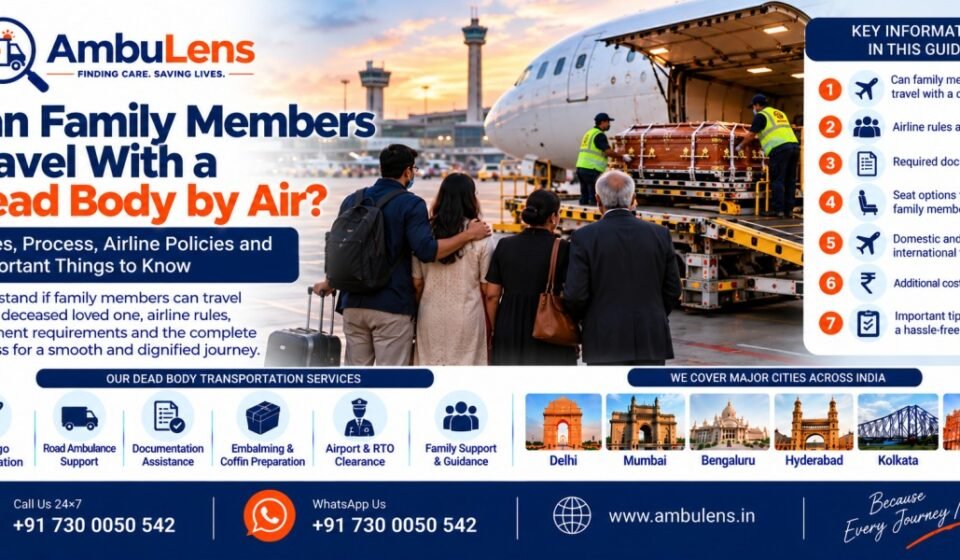

When a loved one dies away from home, families face many difficult decisions.
Air transportation can help move the remains over long distances.
However, families often ask if they can travel with the deceased.
The answer depends on the airline, route, documents, and type of remains.
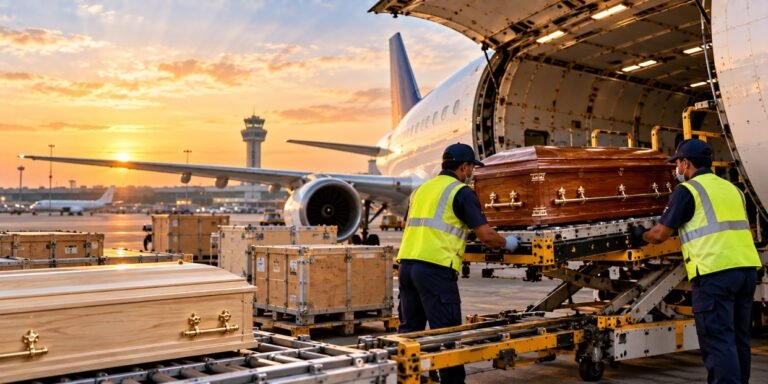
A non-cremated body travels through the airline’s cargo process.
It does not travel as a normal passenger item.
Therefore, family members usually travel separately as passengers.
They can coordinate the cargo process with the airline and airport team.
This guide explains the process in simple terms.
Can a Family Member Travel on the Same Flight?
Yes, a family member may be able to travel on the same flight.
However, the deceased person travels separately as human remains cargo.
The family member needs a normal passenger ticket.
The airline handles the body through its cargo department.
Therefore, the two bookings follow different procedures.
Air India confirms that human remains travel as special cargo.
The airline accepts remains in coffins or funeral urns.
Can a Family Member Sit With the Dead Body?
No, a family member cannot sit beside a coffin during the flight.
The coffin does not travel inside the passenger cabin.
Instead, airline cargo teams handle the remains separately.
Also, passengers cannot access the cargo hold during the flight.
Air India specifically states that cargo cannot be accessed during flight.
Therefore, families should plan separate passenger travel.
How Does Air Transportation of a Dead Body Work?
The process usually follows several important steps.
Step 1: Confirm the Airline Requirements
First, contact the airline cargo department.
Then, confirm the current human remains requirements.
Requirements can differ by airline and destination.
Therefore, do not rely on an old document checklist.
Step 2: Prepare the Required Documents
Next, collect the necessary documents.
These may include:
- Death certificate
- Embalming certificate
- Police clearance certificate
- Coffin or packaging certificate
- Consular documents for international routes
- Cancelled passport for international transportation
- Consignee declaration
- Additional health documents when required
Air India lists several of these documents for human remains transportation.
Step 3: Arrange Embalming and Coffin Preparation
A non-cremated body usually requires suitable preparation.
The embalming process should follow applicable rules.
The coffin must also meet airline handling requirements.
For example, Air India does not accept used coffins.
Therefore, families should arrange approved preparation before cargo booking.
Step 4: Book Human Remains Cargo
After document verification, the airline cargo booking can begin.
The cargo team checks available space and route details.
They may also require advance information.
Air India states that prior intimation is necessary for human remains.
Step 5: Book the Family Member’s Passenger Ticket
The family member can then book a normal passenger ticket.
The passenger and cargo bookings remain separate.
However, both journeys should match the same travel plan.
This makes airport coordination easier.
Step 6: Coordinate Airport Handling
The airport team receives the human remains through the cargo process.
Meanwhile, the family member follows the normal passenger process.
Therefore, the family should know:
- Cargo terminal location
- Passenger terminal location
- Reporting time
- Cargo contact details
- Destination receiver details
Good coordination can reduce confusion at the airport.
Can Family Members Travel With Cremated Ashes?
Cremated ashes follow different airline rules.
Some airlines allow ashes in cabin baggage or checked baggage.
However, security screening and destination rules still apply.
For example, Air India allows urns on domestic flights.
It also permits urns on international flights, subject to applicable rules.
The urn must remain properly sealed and protected.
It may also need to pass airport security screening.
Therefore, families should check the airline’s current baggage rules before travel.
What Documents Does the Family Member Need?
The passenger needs normal travel documents.
For domestic travel, this usually means valid government identification.
For international travel, the passenger needs a valid passport and visa.
However, the documents for the deceased remain separate.
These documents may include:
- Death certificate
- Embalming certificate
- Police certificate
- Cancelled passport
- Consular certificate
- Packaging certificate
- Health clearance documents
Air India requires additional documents for international human remains transportation.
Can a Family Member Handle the Cargo Paperwork?
Yes, a family member may help coordinate the paperwork.
However, the exact process depends on the airline and destination.
A professional repatriation provider can also coordinate with the cargo team.
This support can help when the family is unfamiliar with airport procedures.
For international arrivals into India, eCARe clearance may also apply.
The process includes human remains documentation and airline transport details.
Can Family Members Travel From Another City?
Yes, family members can travel from another city.
For example, the deceased may travel from Mumbai to Jaipur.
A family member may fly separately from Delhi to Jaipur.
Similarly, a family member may travel from Ahmedabad to Mumbai.
Meanwhile, the remains can move through the required cargo route.
Therefore, families should coordinate both journeys carefully.
Dead Body Transportation From Major Indian Cities
Families may need air transportation from many Indian cities.
AmbuLens can help coordinate human remains transportation from locations such as:
- Mumbai
- Delhi
- Jaipur
- Bengaluru
- Chennai
- Hyderabad
- Kolkata
- Ahmedabad
- Pune
- Lucknow
For example, dead body transportation from Mumbai may involve airport cargo coordination and destination delivery.
Similarly, dead body transportation from Jaipur may involve local ambulance pickup before air cargo movement.
Families can also review our guides on dead body transportation by flight and domestic human repatriation.
Road Ambulance and Air Cargo Coordination
Some routes require road transportation before or after the flight.
For example, an ambulance may collect the deceased from a hospital.
The team can then transport the remains to the departure airport.
After arrival, another vehicle can complete the final delivery.
Therefore, air cargo often works together with road ambulance services.
AmbuLens provides road ambulance, air ambulance, and human repatriation support.
International Human Repatriation and Family Travel
International repatriation involves additional requirements.
The family may need to manage:
- Passport documentation
- Consular approvals
- Embassy coordination
- Health clearance
- Airline cargo booking
- Destination arrangements
For remains arriving in India, public health clearance applies.
The Indian health authorities list specific documentation requirements.
Therefore, families should begin coordination as early as possible.
You can also learn more about international human repatriation services before arranging the journey.
What Happens at the Destination Airport?
The family member does not collect the coffin from the passenger baggage belt.
Instead, the remains arrive through the cargo process.
The authorised receiver collects the remains after required clearance.
Then, the destination team can arrange ground transportation.
Therefore, the family should keep receiver details ready.
The receiver may need:
- Full name
- Phone number
- Identification
- Address
- Cargo details
- Air Waybill information
For international arrivals, eCARe also requires transport and receiver information.
What If the Family Cannot Travel?
A family member does not always need to travel with the remains.
A professional repatriation team can coordinate the movement instead.
The team can help with:
- Body collection
- Embalming arrangements
- Coffin preparation
- Documentation
- Airline cargo booking
- Airport handling
- Destination pickup
- Final delivery
Therefore, families can focus on their immediate responsibilities.
Common Mistakes Families Should Avoid
Assuming the coffin travels in the cabin
It does not.
The airline handles the coffin through its cargo system.
Booking the family ticket first
First, confirm the cargo schedule.
Then, match the passenger journey with the confirmed plan.
Ignoring airline documentation
Missing paperwork can delay cargo acceptance.
Using outdated airline rules
Airline policies can change.
Always confirm the latest requirements before booking.
Forgetting destination arrangements
Someone should be ready to receive the remains.
Therefore, confirm the destination vehicle and receiver in advance.
How AmbuLens Can Help
Arranging air transportation after a death can feel overwhelming.
AmbuLens can coordinate the journey with care and professionalism.
Our support can include:
- Human remains transportation
- Dead body ambulance service
- Embalming coordination
- Coffin preparation
- Airline cargo coordination
- Airport handling
- Domestic human repatriation
- International human repatriation
- Destination ambulance service
You can also explore our dead body transportation service and related human repatriation resources.
Related Resources
Documents required for international human remains transportation
Documents required for dead body transportation in India
How Much Does Air Cargo Cost for Dead Body Transportation in India?
How to Arrange Dead Body Transportation Between Two Indian States
Frequently Asked Questions
Can a family member travel on the same flight as a dead body?
Yes, a family member may travel on the same flight.
However, the deceased travels separately through the airline cargo process.
Can a family member sit with the coffin during the flight?
No.
A coffin travels through the airline cargo system, not the passenger cabin.
Can family members travel with cremated ashes?
In some cases, yes.
Airline rules allow ashes in cabin or checked baggage under specific conditions.
Does the family member need special airline permission?
The passenger usually follows normal passenger rules.
However, the human remains shipment requires separate airline cargo arrangements.
What documents are required for human remains by air?
Requirements vary by airline and route.
They may include death, embalming, police, packaging, and other certificates.
Can someone else receive the remains at the destination?
Yes, an authorised receiver can collect the remains after the required clearance.
Can AmbuLens arrange the complete transportation?
Yes. AmbuLens can coordinate pickup, documentation, embalming, coffin preparation, airline cargo, airport handling, and final delivery.