
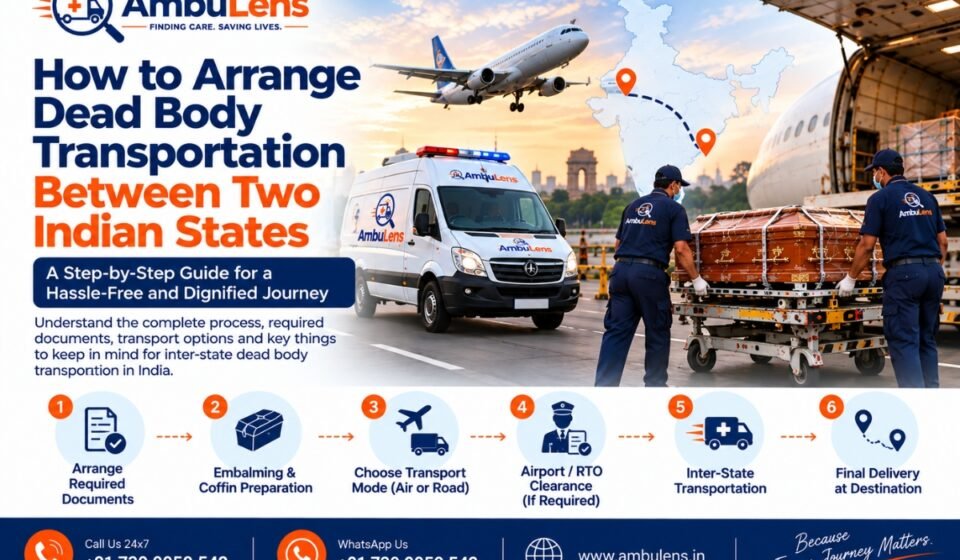

When a death occurs outside the home state, families often need to move the deceased back home. This process can feel difficult during an emotional time. However, proper planning can make the transportation smoother.
Dead body transportation between two Indian states needs careful coordination. The process may involve documentation, embalming, a coffin, an ambulance, and airline or road arrangements.
The right option also depends on the distance, condition of the body, documents, and family requirements.
This guide explains how to arrange interstate dead body transportation step by step.
Why Interstate Dead Body Transportation Needs Planning
Moving a deceased person from one state to another involves several steps. Therefore, families should start the process as soon as possible.
First, the family needs to confirm the place of death and destination. Next, they should collect the required documents.
After that, they can choose between road and air transportation.
For example, a family may need:
- Dead body ambulance service
- Embalming
- Coffin or approved body container
- Death certificate
- Medical documents
- Police documents, when applicable
- Airline cargo booking for air transport
- Airport clearance
- Final delivery at the destination
Proper coordination helps avoid delays during transportation.
Step 1: Confirm the Pickup and Destination
Start by confirming where the death occurred. Then, confirm the final destination.
The pickup point may be:
- Hospital
- Mortuary
- Residence
- Nursing home
- Another medical facility
The destination may be a home, hospital, mortuary, or cremation facility.
For example, a family may need dead body transportation from Mumbai to Jaipur. Another family may need dead body transportation from Delhi to Ahmedabad.
The exact route helps determine the best transportation method.
Step 2: Collect the Required Documents
Documents are an important part of interstate transportation.
The exact requirements can vary by case, transport mode, and local authorities. Therefore, families should confirm the requirements before booking.
Common documents can include:
- Death certificate
- Government identification
- Hospital records
- Medical certificate
- Police documents, when applicable
- Post-mortem documents, when applicable
- Embalming certificate
- Coffin or packaging documents for air cargo
- Airline documents for air transportation
For more information, see our guide on [documents required for dead body transportation in India].
Documentation should be checked carefully before transportation begins.
Step 3: Complete Embalming When Required
Embalming helps preserve the body during transportation. It can also support longer journeys.
The requirement depends on the transportation method and airline or authority involved.
For air transportation, airlines can have specific requirements for embalming and packaging.
Therefore, families should arrange embalming through an experienced service provider.
The provider can also help coordinate the required certificate.
Step 4: Arrange a Coffin or Approved Container
A suitable coffin or approved container may be needed for transportation.
Road and air transportation can have different requirements. In addition, airlines can have specific packaging rules.
The container should be prepared according to the applicable transportation requirements.
For air cargo, the family should confirm the airline’s current human remains guidelines before booking.
This step helps prevent problems during airport handling.
Step 5: Choose Road or Air Transportation
The next step is choosing the right transportation method.
Road Dead Body Transportation
Road transportation can work well for shorter or moderate distances.
It can also provide direct movement from the pickup location to the destination.
For example, families may consider a road ambulance for:
- Jaipur to Delhi
- Mumbai to Pune
- Delhi to Ahmedabad
- Chennai to Bengaluru
A dedicated dead body ambulance can collect the deceased from a hospital, mortuary, or residence.
For road transportation, travel time and road conditions should also be considered.
You can learn more about our [road ambulance service].
Air Transportation for Long-Distance Routes
Air transportation can be useful for longer interstate routes.
For example, families may need air cargo for:
- Mumbai to Kolkata
- Delhi to Chennai
- Bengaluru to Delhi
- Hyderabad to Mumbai
- Kolkata to Jaipur
Air transportation can reduce travel time. However, it needs additional coordination.
The process can include:
- Body preparation
- Embalming, when required
- Coffin preparation
- Document verification
- Airline cargo booking
- Airport handling
- Destination airport clearance
- Ground transportation
Families should arrange the airport and destination services before the flight.
Step 6: Arrange the Dead Body Ambulance
A dead body ambulance may be required at both ends of the journey.
At the pickup location, the ambulance can collect the deceased from the hospital, mortuary, or residence.
For air transportation, another ambulance can receive the body at the destination airport.
This helps maintain a coordinated transfer from the airport to the final destination.
For example, a family arranging dead body transportation from Mumbai to Jaipur may need:
- Pickup ambulance in Mumbai
- Airport coordination
- Air cargo booking
- Destination ambulance in Jaipur
This approach reduces the need for family members to coordinate several providers separately.
Step 7: Complete Airline Cargo Arrangements
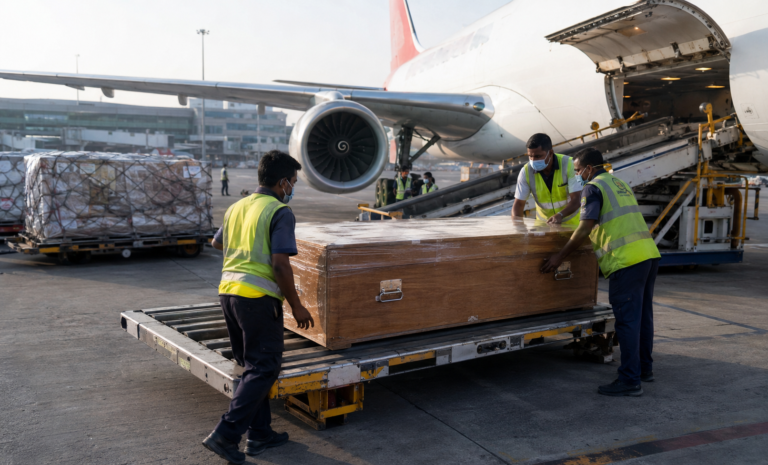
For air transportation, human remains travel through the airline’s cargo process.
The airline may require documents before accepting the shipment. Advance coordination is important.
The required paperwork can include:
- Death certificate
- Embalming certificate
- Police clearance, when required
- Coffin documents
- Identification documents
- Other airline-specific paperwork
Airlines can update their requirements. Therefore, families should confirm the current requirements before booking.
Our guide on [dead body transportation by flight in India] explains the air transportation process in more detail.
Step 8: Coordinate Destination Airport Clearance
The process does not end when the flight arrives.
The destination team needs to coordinate with the airport cargo department. They also need to complete the required clearance.
After clearance, an authorised person or service provider can collect the deceased.
Then, a destination ambulance can transport the body to the final location.
For example, if the route is Delhi to Ahmedabad, the destination team should be ready at the Ahmedabad airport.
This planning helps reduce waiting time at the airport.
Step 9: Arrange Final Delivery
After collection, the deceased can be transported to the final destination.
The destination may include:
- Family residence
- Hospital
- Mortuary
- Funeral facility
- Cremation facility
The family should confirm the final address before transportation begins.
They should also share the contact details of the person receiving the deceased.
This makes the final handover easier.
Road vs Air Transportation for Interstate Dead Body Movement
Both options can work, depending on the route.
| Factor | Road Transportation | Air Transportation |
|---|---|---|
| Best for | Short and moderate routes | Long-distance routes |
| Travel time | Depends on road distance | Usually faster |
| Main requirement | Ambulance and documents | Airline cargo and documents |
| Airport handling | Not required | Required |
| Destination transfer | Direct ambulance delivery | Airport pickup and final delivery |
| Planning | Comparatively simple | Needs more coordination |
Therefore, families should select the option based on distance, urgency, documentation, and available arrangements.
How Much Does Interstate Dead Body Transportation Cost?
There is no single fixed price for interstate dead body transportation.
The final cost depends on several factors.
These can include:
- Pickup city
- Destination city
- Travel distance
- Road or air transportation
- Ambulance charges
- Airline cargo charges
- Coffin cost
- Embalming charges
- Airport handling
- Documentation
- Destination delivery
For example, dead body transportation from Mumbai to Kolkata can have different costs from Jaipur to Delhi.
Air transportation can also include separate cargo and airport charges.
Therefore, families should request a route-specific quotation.
How AmbuLens Can Help
Arranging interstate dead body transportation can involve several providers and departments.
AmbuLens can help coordinate the process from pickup to final delivery.
Support can include:
- Dead body ambulance
- Body collection
- Embalming arrangements
- Coffin arrangements
- Documentation support
- Air cargo coordination
- Airport handling
- Destination ambulance
- Final delivery
AmbuLens provides support for domestic and interstate human remains transportation.
Families can also explore our [dead body transportation service] for more information.
Dead Body Transportation Between Major Indian Cities
Interstate transportation may be required from many Indian cities.
Common routes can include:
Mumbai to Jaipur
Families may choose road or air transportation based on urgency and requirements.
Delhi to Ahmedabad
Air cargo can be considered for faster long-distance transportation.
Bengaluru to Hyderabad
Road transportation may be suitable because of the shorter distance.
Chennai to Kolkata
Air transportation can help reduce long travel time.
Kolkata to Delhi
Families can consider air cargo when speed and route distance make it suitable.
Each route needs separate planning. Therefore, the final option should be selected after checking the documents and transportation requirements.
Common Mistakes to Avoid
Families can face delays when important steps are missed.
Therefore, avoid these common mistakes:
- Booking transportation before checking documents
- Delaying the death certificate
- Not confirming airline requirements
- Arranging only the pickup ambulance
- Forgetting destination airport coordination
- Not confirming the final delivery address
- Choosing transportation without checking the route
- Waiting until the last moment for air cargo arrangements
Early planning can make the process more organised.
What Families Should Do First
If a death occurs outside the home state, follow these steps:
- Confirm the pickup location.
- Confirm the destination.
- Collect the death certificate.
- Gather hospital and identification documents.
- Check police or post-mortem requirements.
- Confirm embalming requirements.
- Choose road or air transportation.
- Arrange the coffin or approved container.
- Book the ambulance and cargo services.
- Confirm destination delivery arrangements.
Most importantly, keep all documents together.
Also, keep copies of important papers for the family records.
Why Professional Coordination Helps
Interstate transportation involves several steps. Families may also need to coordinate with hospitals, police authorities, airlines, airports, and ambulance providers.
A professional service can manage these steps together.
This can reduce confusion during a difficult time.
Moreover, professional coordination helps ensure that the pickup, documentation, transportation, and final delivery follow a planned process.
Related Resources
Frequently Asked Questions
1. Can a dead body be transported from one Indian state to another?
Yes. Dead body transportation can be arranged between Indian states by road or air, depending on the route and requirements.
2. Which documents are required for interstate dead body transportation?
Common documents include the death certificate, identification, hospital records, and other documents based on the case. Police or post-mortem documents may also apply.
3. Is embalming required for interstate transportation?
Embalming requirements depend on the transportation method and applicable rules. Air transportation can have specific requirements.
4. Can a dead body be transported by ambulance between two states?
Yes. A suitable dead body ambulance can transport the deceased between states, especially for road journeys.
5. Can a dead body be transported by air in India?
Yes. Human remains can be transported through airline cargo, subject to the airline’s documentation, packaging, and handling requirements.
6. How much does interstate dead body transportation cost?
The cost depends on the route, transportation method, ambulance, coffin, embalming, documentation, airport handling, and final delivery.
7. Can AmbuLens arrange airport-to-destination transportation?
Yes. Destination coordination can include airport collection and ambulance transportation to the final location.