
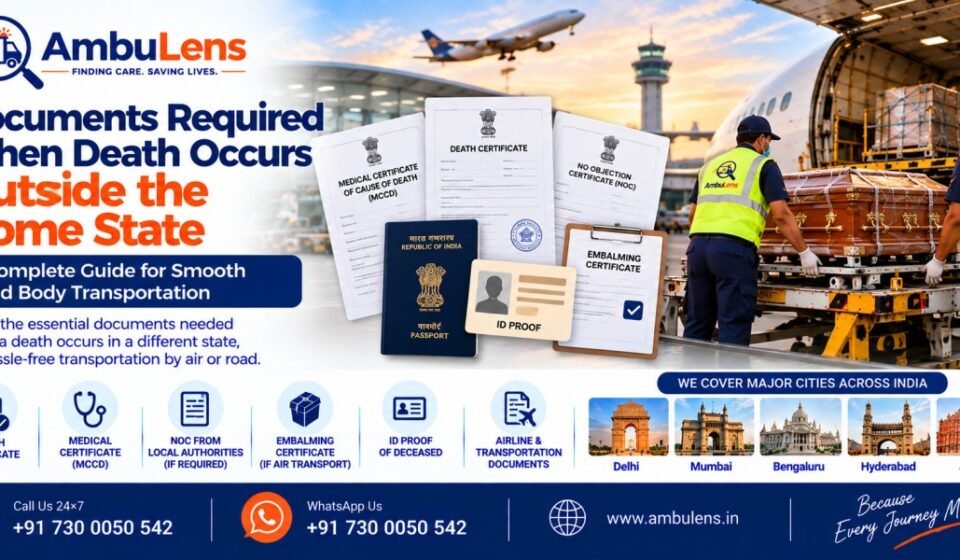

When a death occurs outside the home state, families often need to move the deceased to another city. This process can feel difficult during an emotional time.
The required documents depend on the transport method, destination, airline, and circumstances of death. Therefore, families should confirm the current requirements before booking transportation.
This guide explains the common documents needed for dead body transportation between states in India. It also covers road ambulance, air cargo, airport clearance, and destination delivery.
Why Documents Matter for Interstate Dead Body Transportation
Documents help authorities and transport providers verify the identity and circumstances of death.
They also support the safe movement of human remains between cities.
For example, a family may need documents when moving a deceased person from Mumbai to Jaipur. The same applies to transportation from Delhi to Lucknow or Bangalore to Hyderabad.
Therefore, preparing documents early can reduce delays.
Basic Documents Required After a Death
Several documents may be required in most transportation cases.
Common documents include:
- Death certificate
- Government ID of the deceased
- Hospital or medical records
- Medical certificate related to the death
- Police documents, when applicable
- Embalming certificate, when required
- Coffin certificate, when required
- Transportation documents
- Identification of the person receiving the deceased
However, requirements can vary by case. Families should not assume that one checklist applies to every route.
1. Death Certificate
The death certificate is one of the most important documents.
It officially records the death and provides essential details about the deceased.
The document may be required for road transportation, air cargo, and other formal procedures.
Families should keep the original document available. They should also keep several copies for different authorities and service providers.
For more information, see the documents required for dead body transportation in India.
2. Government Identification
Government identification may help confirm the identity of the deceased.
Depending on the case, documents can include:
- Aadhaar card
- Passport
- Voter ID
- Driving licence
- Other accepted government identification
For domestic transportation, the exact identification requirement can vary.
For international transportation, passport-related documents may become more important.
Therefore, families should keep the available identity documents ready.
3. Hospital Documents
If death occurs in a hospital, the hospital may provide several supporting documents.
These can include:
- Hospital discharge documents
- Medical records
- Death-related medical paperwork
- Identification details
- Documents showing the place of death
These records can help support the transportation process.
Families should ask the hospital administration for the complete document set before arranging pickup.
4. Medical Certificate Related to Death
A medical certificate can provide information about the medical circumstances of death.
It is different from the official death certificate.
The medical document may support the death registration process. However, the exact document required for transportation depends on the authority and transport method.
Therefore, families should keep both documents when available.
5. Police Documents
Police documentation may be required in certain cases.
This can apply when the death involves:
- Accident
- Unnatural death
- Medico-legal case
- Post-mortem
- Suspicious circumstances
Police clearance or an NOC may be required before transportation.
The exact requirement depends on the case and local authority.
Therefore, families should coordinate with the hospital and police department when the death falls under a medico-legal process.
6. Post-Mortem Documents
A post-mortem can create additional documentation requirements.
If the deceased underwent a post-mortem, families may need relevant police and medical documents.
These documents can help confirm that the deceased has been released for transportation.
The family should collect the required papers before arranging the vehicle.
For more information, read Dead Body Transportation After Post-Mortem: Complete Guide.
7. Embalming Certificate
An embalming certificate may be required for air transportation.
The requirement depends on the airline, route, and case.
For example, Air India lists an embalming certificate for a body transported in a coffin.
Therefore, families should check the selected airline before arranging embalming.
The certificate should match the transportation documents.
8. Coffin Certificate and Packaging Documents
Air transportation may require a suitable coffin and packaging.
Airlines can have specific requirements for human remains.
For example, Air India requires human remains to follow its packaging and documentation rules. It also does not accept used coffins.
Therefore, families should confirm the coffin requirements before booking air cargo.
Documents Required for Road Transportation
Road transportation usually involves fewer airline-related documents.
However, families still need important identification and death-related documents.
A typical interstate road transportation file may include:
| Document | Purpose |
|---|---|
| Death certificate | Confirms the death |
| Government ID | Helps verify identity |
| Hospital documents | Supports the case details |
| Police documents | Required in applicable cases |
| Post-mortem papers | Required after medico-legal cases |
| Transportation documents | Supports the journey |
The exact list can vary by state and case.
For road transportation support, families can explore AmbuLens Road Ambulance Service.
Documents Required for Air Transportation
Air cargo usually involves more documentation.
Families may need:
- Death certificate
- Government ID
- Embalming certificate
- Police clearance, when applicable
- Coffin-related documents
- Airline forms
- Cargo booking documents
- Additional documents required by the airline
Air India confirms that human remains require advance arrangements and specific documentation.
Therefore, families should check the airline’s current requirements before booking.
You can also read Dead Body Transportation by Flight in India.
Domestic Interstate Transportation
Domestic transportation means moving the deceased between cities or states within India.
For example:
Mumbai → Jaipur
Delhi → Ahmedabad
Bangalore → Hyderabad
Chennai → Kolkata
The documents usually focus on proof of death, identity, medical records, and transportation clearance.
However, additional documents may apply in medico-legal cases.
International Transportation Requires More Documents
International human remains transportation can require additional paperwork.
Documents may include:
- Death certificate
- Embalming certificate
- Passport
- Cancelled passport
- Consular documents
- Police clearance
- Airline cargo documents
- Coffin or packaging certificates
- Destination-country documents
The requirements vary by country and airline.
For transportation to India from another country, the Ministry of Health and Family Welfare uses the eCARe system for human remains clearance.
Therefore, international cases should be planned carefully.
Read the Complete Guide to International Dead Body Repatriation.
What If Death Occurs in Another City?
The process can feel confusing when the family lives in a different state.
For example, suppose the family lives in Jaipur but the death occurs in Mumbai.
The family may need to arrange:
- Hospital documentation
- Death certificate
- Government ID
- Police documents, if required
- Embalming, if required
- Coffin preparation
- Road or air transportation
- Airport or route clearance
- Destination ambulance
- Final delivery
A professional transportation service can coordinate these steps.
Example: Death in Mumbai, Family in Jaipur
Suppose a person from Jaipur passes away in Mumbai.
The family may choose road or air transportation.
For road transportation, the deceased can travel from Mumbai to Jaipur by specialised vehicle.
For air transportation, an ambulance can move the deceased from the hospital to Mumbai Airport. Air cargo can then transport the deceased to Jaipur.
After arrival, a local ambulance can complete the final journey.
For route-specific information, see Dead Body Transportation Service in Mumbai.
Example: Death in Delhi, Family in Ahmedabad
A similar process may apply when death occurs in Delhi.
The family can arrange road or air transportation based on the destination and urgency.
The documents should be collected before the vehicle or cargo booking.
For airport transportation, families can also review the Delhi Airport Human Remains Transportation guide.
What Happens If Documents Are Missing?
Missing documents can delay transportation.
Therefore, families should contact the hospital first.
Next, they should check with the local police department if the case requires clearance.
For air transportation, they should also contact the selected airline or cargo provider.
A transportation company can help identify missing documents. However, official authorities must issue documents that require government approval.
How to Prepare Documents Before Transportation
A simple checklist can help families stay organised.
Step 1: Collect Hospital Documents
Ask the hospital for all available death-related papers.
Step 2: Obtain the Death Certificate
Keep the original and multiple copies ready.
Step 3: Collect Identification
Keep the deceased’s available government ID or passport.
Step 4: Check Police Requirements
Confirm whether an NOC or clearance is needed.
Step 5: Confirm Embalming Requirements
Ask the selected airline or transport provider before arranging embalming.
Step 6: Confirm Coffin Requirements
Check the airline’s current coffin and packaging rules.
Step 7: Confirm Destination Documents
Ask what the receiving person or destination authority must provide.
This preparation can reduce unnecessary delays.
Common Mistakes Families Should Avoid
Families should avoid relying on an old checklist.
Airline rules can change.
State procedures can also differ.
Therefore:
- Confirm requirements before booking.
- Keep original documents safe.
- Prepare copies.
- Check names and spellings carefully.
- Confirm airline requirements.
- Ask about police clearance.
- Keep contact details of the receiving person.
- Confirm destination delivery arrangements.
These simple steps can make interstate transportation easier.
How AmbuLens Helps With Interstate Dead Body Transportation
AmbuLens supports families with transportation arrangements across India.
The team can help coordinate:
- Body pickup
- Road ambulance
- Air cargo
- Embalming
- Coffin arrangements
- Documentation support
- Airport coordination
- Destination ambulance
- Final delivery
The exact services depend on the route and case requirements.
Families can also explore the AmbuLens Dead Body Transportation Service.
Why Documentation Support Matters
Documentation is often one of the most time-sensitive parts of transportation.
A missing certificate can delay the next step.
Similarly, incorrect information can create problems during booking.
Therefore, checking the paperwork early can save time.
A coordinated service can help families understand which documents are needed for their route.
Conclusion
When death occurs outside the home state, transportation requires careful planning.
Families usually need proof of death, identification, hospital records, and other supporting documents.
Road transportation may need fewer documents than air cargo. However, medico-legal cases can require additional clearance.
International repatriation involves more documentation.
Therefore, families should confirm the current requirements before transportation. Early preparation can make the process smoother and reduce avoidable delays.
You can also read related AmbuLens resources:
- What Happens When a Dead Body Reaches the Destination Airport?
- Dead Body Transportation by Air from Mumbai
- Domestic Human Repatriation Services in India
- Documents Required for Dead Body Transportation in India
- Complete Dead Body Transportation Package
These resources can help families understand the complete transportation process.
Frequently Asked Questions
What documents are needed for dead body transportation between states?
Common documents include the death certificate, government ID, hospital records, and transportation documents. Police or post-mortem documents may also apply.
Is a death certificate required for interstate transportation?
A death certificate is an important document for transportation. Families should keep the original and copies ready.
Is police NOC required for every dead body transportation case?
No. Police clearance depends on the circumstances of death. It is more likely in accident, unnatural, or medico-legal cases.
Is an embalming certificate required for air transportation?
It depends on the airline and route. Some airlines require an embalming certificate for bodies transported in coffins.
What documents are needed after a post-mortem?
Post-mortem cases may require additional medical and police documents. The exact list depends on the case and local authority.
Can a dead body be transported from Mumbai to Jaipur?
Yes. Road and air transportation options can be considered. The required documents depend on the transport method and case.
Can a dead body be transported from Delhi to Ahmedabad?
Yes. Families can choose road or air transportation based on the route, urgency, and availability.