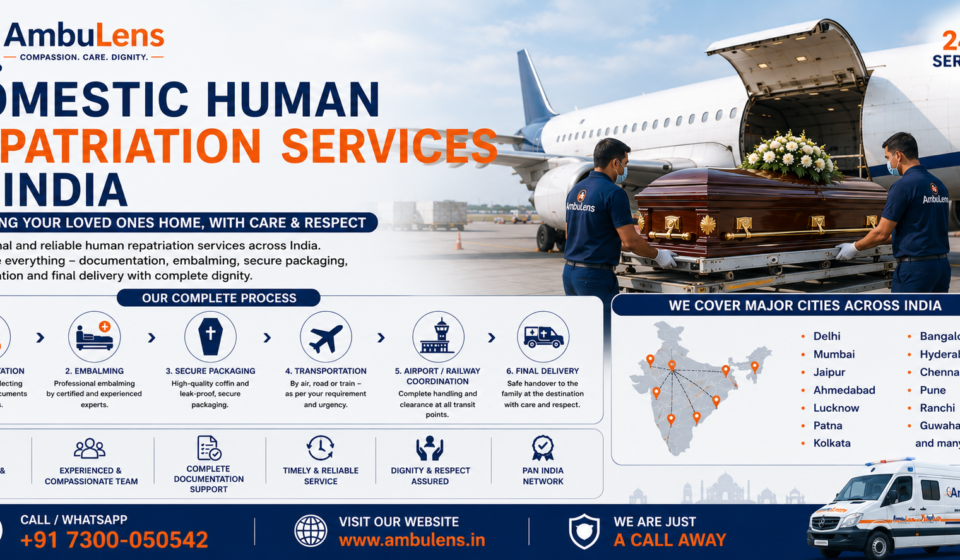

When a loved one passes away away from their hometown, the family may need to transport the deceased to another city or state. This process is known as domestic human repatriation.
Unlike ordinary transportation, moving human remains requires careful documentation, suitable preparation, secure packaging, and coordination with hospitals, authorities, transport providers, airports, and airlines.
Therefore, families often choose professional domestic human repatriation services in India to manage the process with dignity and fewer logistical difficulties.
AmbuLens provides domestic and international human repatriation support, including documentation, embalming, coffin arrangements, and airport coordination.
What Is Domestic Human Repatriation?
Domestic human repatriation means transporting a deceased person from one location in India to another.
For example, a person may pass away in Mumbai while their family lives in Jaipur. In this situation, the family may need to arrange human repatriation from Mumbai to Jaipur.
Similarly, transportation may be required between:
- Delhi and Jaipur
- Mumbai and Delhi
- Mumbai and Lucknow
- Mumbai and Kolkata
- Mumbai and Chennai
- Mumbai and Hyderabad
- Mumbai and Bangalore
- Jaipur and Delhi
- Ahmedabad and Mumbai
- Chennai and Delhi
- Hyderabad and Mumbai
- Kolkata and Patna
- Pune and Jaipur
The transportation method depends on the distance, urgency, road connectivity, airline availability, and family’s requirements.
Why Do Families Need Domestic Human Repatriation?
People frequently travel between Indian cities for work, education, business, and personal reasons.
Unfortunately, a death can occur away from the family’s hometown.
In such cases, relatives may want to bring the deceased back to their native city for the final rites.
For instance, a person from Jaipur may pass away in Mumbai. The family may prefer to conduct the funeral in Jaipur.
Likewise, someone from Delhi may pass away in Bangalore and need transportation back to Delhi.
Professional repatriation services can coordinate the required arrangements from the place of death to the final destination.
How Does Domestic Human Repatriation Work in India?
The process can vary according to the circumstances.
However, most cases involve several important stages.
1. Confirm the Place of Death
First, the family needs to establish where the death occurred.
It could be:
- Hospital
- Home
- Nursing facility
- Accident location
- Hospice
- Other authorised location
The location determines which authorities and service providers need to be contacted.
2. Collect the Required Documents
Documentation plays an important role in domestic transportation.
Depending on the circumstances, families may need:
- Death certificate
- Hospital documents
- Embalming certificate
- Police documents or NOC, where applicable
- Identity documents
- Medical records
- Transportation-related forms
- Airline cargo documents, when applicable
Requirements can vary according to the airline, route, and circumstances of death.
For example, Air India’s current domestic human-remains requirements include a death certificate, embalming certificate for a body transported in a coffin, cremation certificate for ashes, and police certificate.
Therefore, families should confirm the current checklist before transportation.
3. Arrange Embalming
When a non-cremated body needs to travel over a long distance, embalming may be required.
An authorised professional performs the procedure and provides an embalming certificate.
The certificate may contain details about the procedure and materials used.
For airline transportation, embalming requirements depend on the carrier and type of shipment.
Therefore, families should coordinate with the selected airline before finalising preparations.
4. Prepare the Coffin or Suitable Container
The deceased must be placed in appropriate packaging for transportation.
The packaging protects the remains during handling and transportation.
For air transportation, airlines have specific requirements regarding coffins, packaging, labelling, and acceptance.
Therefore, families should use a provider familiar with airline cargo procedures.
5. Select the Transportation Method
Domestic human repatriation can involve different transportation methods.
Road Transportation
Road transportation works well for short and medium-distance transfers.
It can provide direct movement from:
Hospital → Destination City → Home/Funeral Location
Air Transportation
Air transportation can be useful for long-distance transfers.
For example:
Mumbai → Delhi
or
Jaipur → Chennai
Air cargo can reduce travel time compared with a long road journey.
Train Transportation
Train transportation can also be considered in suitable cases, depending on railway rules, route availability, documentation, and the circumstances.
The best option depends on the family’s needs.
Domestic Human Repatriation by Road
Road transportation remains one of the most practical options for many interstate transfers.
A dedicated dead body ambulance or hearse can collect the deceased from the hospital or mortuary.
The vehicle then travels directly to the destination.
Road transportation may be suitable when:
- The destination is nearby.
- The family wants door-to-door transportation.
- Flight availability is limited.
- Airport cargo procedures would create complications.
- The family prefers road travel.
For example, dead body transportation from Jaipur to Delhi may be arranged by road when direct transportation is preferred.
Domestic Human Repatriation by Air
Air transportation becomes particularly useful when the destination is far away.
Airlines generally handle human remains through their cargo divisions.
Air India confirms that human remains can be carried on domestic sectors with the required documentation.
The process generally includes:
Documentation → Embalming → Coffin Preparation → Cargo Booking → Airport Handling → Flight → Destination Collection → Final Ambulance
Because airlines treat human remains as special cargo, advance coordination is important.
Domestic Human Repatriation by Train
Train transportation can provide another option for certain routes.
However, availability and acceptance depend on railway policies and the circumstances.
Families should confirm the current railway requirements before selecting this method.
A professional transportation provider can help determine whether train transportation is practical for the particular route.
Documents Required for Domestic Human Repatriation
The required documents can differ from case to case.
However, families should generally keep the following ready.
Death Certificate
The death certificate confirms the death and provides essential information about the deceased.
Embalming Certificate
This may be required when a non-cremated body is transported.
Police Documents
Police documentation may apply depending on the circumstances.
Medico-legal cases may require additional clearance.
Hospital Documents
Hospital records can help establish the circumstances surrounding the death.
Identification Documents
The deceased’s identification may be required for verification.
Airline Documents
Air transportation requires additional cargo documentation.
For example, Air India currently requires a death certificate, embalming certificate for a body in a coffin, and police certificate for domestic human-remains transportation.
Always confirm the latest requirements with the relevant transport provider and authorities.
What Happens in a Medico-Legal Death?
A medico-legal death may involve police investigation.
Examples can include:
- Accidents
- Suspected unnatural death
- Certain sudden deaths
- Cases requiring post-mortem examination
In these situations, families should follow the instructions of the hospital and investigating authorities.
Transportation should begin only after the required legal formalities and permissions are completed.
This step helps prevent delays later.
Domestic Human Repatriation After a Hospital Death
When the death occurs in a hospital, the family usually receives the necessary medical and death-related documents from the hospital.
The family can then contact a repatriation service.
The service provider may coordinate:
- Hospital documentation
- Embalming
- Coffin preparation
- Police formalities, where applicable
- Ambulance collection
- Airline or road transportation
- Destination ambulance
- Final handover
This approach simplifies the process during a difficult time.
Domestic Human Repatriation After a Death at Home
When death occurs at home, the process can differ.
The family should first contact the appropriate medical and local authorities to obtain the necessary certification.
After the death is legally documented, the family can arrange transportation.
A professional service can then help with:
- Body collection
- Documentation
- Embalming
- Coffin arrangements
- Transportation
- Final delivery
Families should not move the deceased before completing the applicable formalities.
Domestic Human Repatriation from Mumbai
Mumbai is a major transportation hub.
Families may need to move human remains from Mumbai to cities across India.
Common routes include:
- Mumbai to Delhi
- Mumbai to Jaipur
- Mumbai to Ahmedabad
- Mumbai to Lucknow
- Mumbai to Patna
- Mumbai to Ranchi
- Mumbai to Kolkata
- Mumbai to Chennai
- Mumbai to Hyderabad
- Mumbai to Bangalore
- Mumbai to Varanasi
- Mumbai to Guwahati
Road and air transportation can both be considered depending on the destination.
Domestic Human Repatriation from Jaipur
Jaipur is another major city where interstate transportation requirements can arise.
Families may need to arrange transportation from Jaipur to:
- Delhi
- Mumbai
- Ahmedabad
- Lucknow
- Kolkata
- Patna
- Chennai
- Hyderabad
- Bangalore
- Varanasi
The Airport Health Organisation at Jaipur International Airport lists public health clearance of dead bodies and human remains among its functions.
Therefore, airport-related transportation should be coordinated carefully when air cargo is selected.
Domestic Human Repatriation from Delhi
Delhi serves as an important transportation hub for northern India.
Families may arrange transportation from Delhi to cities such as:
- Jaipur
- Lucknow
- Chandigarh
- Mumbai
- Kolkata
- Patna
- Ahmedabad
- Chennai
- Hyderabad
The choice between road and air depends on the final destination.
Domestic Human Repatriation from Bangalore
When a person passes away in Bangalore but their family lives elsewhere, interstate transportation may be required.
Air transportation can help with longer routes.
Road transportation may work better for nearby destinations.
The service provider can help coordinate the appropriate option.
Domestic Human Repatriation from Hyderabad
Families in Hyderabad may require transportation to cities such as Mumbai, Delhi, Jaipur, Bangalore, Chennai, Kolkata, or other destinations.
The final method depends on the route, urgency, and available transportation options.
Domestic Human Repatriation from Chennai
Chennai connects southern India with major cities across the country.
For long-distance transportation, air cargo may reduce travel time.
However, families should confirm airline acceptance and documentation before booking.
Domestic Human Repatriation from Kolkata
Kolkata serves as an important eastern transportation hub.
Families can arrange road or air transportation depending on the destination.
For long-distance interstate transfers, air cargo may provide a faster option.
How Much Does Domestic Human Repatriation Cost?
There is no single fixed price.
The final cost depends on several factors.
Distance
Longer road journeys usually involve higher transportation costs.
Transportation Method
Air, road, and train transportation have different pricing structures.
Embalming
Professional embalming may add to the total cost.
Coffin
The coffin and packaging requirements influence the price.
Documentation
Additional documentation or administrative services may create extra charges.
Airport Handling
Air transportation can involve cargo handling and airport-related charges.
Destination Ambulance
If the remains arrive at an airport, another hearse or ambulance may be required.
Therefore, the total cost can include:
Embalming + Coffin + Documentation + Transportation + Airport Handling + Destination Ambulance
A personalised quotation is the best way to understand the actual cost.
How Long Does Domestic Human Repatriation Take?
The timeline depends on the route and transportation method.
Road transportation may take several hours or longer.
Air transportation itself may be faster, but the complete process includes:
- Document collection
- Embalming
- Coffin preparation
- Cargo booking
- Airport reporting
- Cargo acceptance
- Flight schedule
- Destination collection
- Final transportation
Therefore, families should consider the complete timeline rather than only the flight duration.
Why Choose Professional Domestic Human Repatriation Services?
Arranging human transportation independently can become complicated.
Families may need to communicate with several organisations.
These may include:
- Hospital
- Mortuary
- Police
- Embalming facility
- Airline
- Airport cargo team
- Destination ambulance provider
- Funeral facility
A professional service can coordinate these stages.
This can reduce administrative pressure and help families focus on their loved ones and funeral arrangements.
How AmbuLens Helps With Domestic Human Repatriation
AmbuLens provides domestic and international human repatriation services across India. Its website lists support for documentation, embalming, coffin arrangements, airport coordination, and transportation.
The service can help coordinate transportation from cities such as Mumbai, Jaipur, Delhi, Ahmedabad, Chennai, Hyderabad, Bangalore, Kolkata, and other locations.
Depending on the case, support may include:
- Dead body transportation
- Human repatriation
- Road ambulance
- Air cargo coordination
- Embalming assistance
- Coffin arrangements
- Airport coordination
- Destination ambulance
- Interstate transportation
AmbuLens lists its service as available 24/7 and provides +91 7300-050542 for assistance.
Why Families Prefer End-to-End Repatriation Support
An end-to-end service can make coordination easier.
Instead of arranging each step separately, families can work with one service provider for multiple requirements.
The process may look like:
Call the Service → Share Details → Document Verification → Embalming → Coffin Preparation → Transportation Booking → Airport/Road Transfer → Destination Handover
This approach can reduce confusion, especially when transportation needs to happen quickly.
Things to Check Before Booking Human Repatriation
Before finalising a service, families should confirm:
- Transportation method
- Total estimated cost
- Required documents
- Embalming arrangements
- Coffin specifications
- Airline acceptance, if applicable
- Airport reporting requirements
- Destination ambulance
- Expected timeline
- Final delivery location
- Contact person throughout the journey
Clear communication can help prevent unnecessary delays.
Air vs Road Domestic Human Repatriation
| Factor | Air Transportation | Road Transportation |
|---|---|---|
| Speed | Usually faster for long distances | Depends on road distance |
| Door-to-door delivery | Requires destination ambulance | Usually possible |
| Airport procedures | Required | Not required |
| Cargo booking | Required | Not required |
| Best suited for | Long-distance routes | Short and medium routes |
| Documentation | Additional airline documents | Transportation documents |
| Cost | Depends on airline and route | Depends on distance and vehicle |
There is no universal best option.
The right choice depends on the family’s situation.
Conclusion
Domestic human repatriation services in India help families transport their loved ones from one city or state to another after death.
The process involves more than simply arranging an ambulance. Families may need to manage documentation, embalming, coffin preparation, police formalities, airline cargo, airport procedures, and destination transportation.
For shorter routes, road transportation can offer direct movement. Meanwhile, air transportation can be useful for long-distance routes.
Most importantly, families should confirm current airline and authority requirements before transportation.
Professional support can make the process more organised and help ensure that the deceased reaches the final destination with dignity and care.
Frequently Asked Questions
1. What are domestic human repatriation services?
Domestic human repatriation services arrange transportation of a deceased person from one Indian city or state to another, including documentation, embalming, coffin preparation, transportation, and destination coordination.
2. Can human remains be transported by air within India?
Yes. Airlines can transport human remains on domestic sectors, subject to their current policies and required documents. Air India currently confirms domestic carriage of human remains.
3. What documents are required for domestic human repatriation?
Documents may include a death certificate, embalming certificate, police certificate or clearance, identification documents, hospital documents, and airline cargo forms where applicable.
4. Is embalming necessary for domestic transportation?
Requirements depend on the transportation method and circumstances. For air transportation in a coffin, airlines may require an embalming certificate.
5. Can human remains be transported by road?
Yes. Dedicated dead body ambulances and hearses can transport human remains between cities and states.