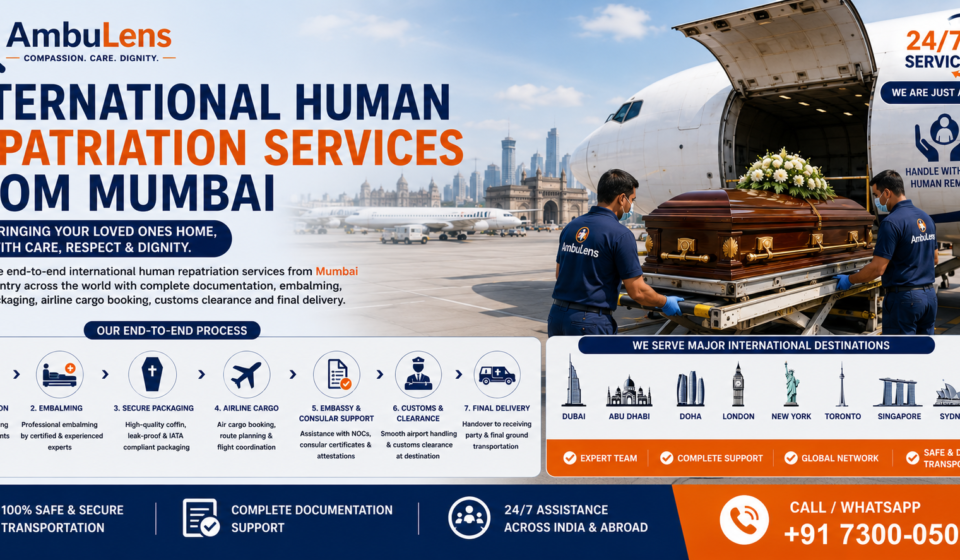

Losing a loved one in Mumbai while the family lives abroad can create an extremely difficult situation. Besides emotional grief, families must arrange documentation, embalming, coffin preparation, embassy formalities, airline cargo, customs clearance, and destination transportation.
Therefore, international human repatriation services from Mumbai can help families coordinate the complete process professionally.
Whether the destination is Dubai, Abu Dhabi, Doha, London, New York, Toronto, Singapore, Sydney, or another international location, the requirements can vary. Moreover, the destination country and airline may require specific documents before accepting human remains.
This guide explains the process, documents, costs, preparation, airline coordination, and destination arrangements involved in international human repatriation from Mumbai.
What Is International Human Repatriation?
International human repatriation means transporting human remains from one country to another.
In this case, international human repatriation from Mumbai refers to arranging transportation from Mumbai to a foreign destination.
For example, a person may pass away in Mumbai while their family lives in:
- Dubai
- Abu Dhabi
- Doha
- Riyadh
- London
- Manchester
- New York
- Toronto
- Singapore
- Sydney
- Melbourne
- Kuala Lumpur
- Frankfurt
The process usually involves several organisations.
These can include:
- Hospital or mortuary
- Embalming facility
- Police authorities
- Embassy or consulate
- Airline cargo department
- Airport authorities
- Customs authorities
- Destination funeral service provider
- Family representatives
Consequently, professional coordination can make the process easier for families.
Why Choose International Human Repatriation from Mumbai?
Mumbai is a major international aviation and commercial hub. Therefore, it offers connectivity to many international destinations.
However, international transportation of human remains involves much more than booking a flight.
Families may need to arrange:
- Death documentation
- Medical certificates
- Embalming
- Coffin preparation
- Police clearance, where applicable
- Passport-related documentation
- Consular documentation
- Airline cargo booking
- Customs procedures
- Destination coordination
As a result, professional Mumbai international dead body transportation services can reduce the administrative burden.
How International Human Repatriation from Mumbai Works
The process can vary depending on the destination country and circumstances of death.
However, the general process follows these steps.
Step 1: Contact a Repatriation Service
First, contact a professional human repatriation provider.
Share essential details such as:
- Location of the deceased
- Date of death
- Destination country
- Destination city
- Nationality
- Passport details
- Cause of death
- Hospital or mortuary details
- Preferred transportation date
The team can then identify the likely documentation and coordination requirements.
Step 2: Collect the Death Certificate
The death certificate remains one of the most important documents.
It should accurately state the deceased person’s details.
Authorities may also require the cause of death.
For international transportation, document requirements can vary by destination. Therefore, families should obtain the appropriate certificate and any required translation.
Air India’s current international human-remains guidance lists a death certificate among the required documents for international cargo transportation.
Step 3: Complete Embalming
Embalming may be required before international transportation.
An authorised professional performs the procedure and issues an embalming certificate.
The certificate may need to mention:
- Name of the deceased
- Date of embalming
- Chemical used
- Procedure followed
- Packaging details
- Details of the authorised professional
The Government of India’s eCARe guidance also specifies requirements for embalming certificates in cases where human remains arrive in India, including details of the chemical used and procedure followed.
However, because your journey is from Mumbai to another country, the destination country’s rules remain especially important.
Step 4: Prepare the Coffin
International airlines have strict packaging requirements.
The deceased may need to travel inside a suitably sealed coffin or casket.
For example, Air India’s current cargo guidance states that non-cremated remains must be adequately packaged to prevent leakage and damage. It also requires suitable marking and labelling.
The exact coffin specification can vary according to:
- Airline
- Destination country
- Transit country
- Local health regulations
- Customs requirements
Therefore, families should confirm the requirements before purchasing or preparing the coffin.
Step 5: Obtain Police Clearance or NOC
Police documentation may become necessary, particularly in unnatural or medico-legal deaths.
For example, Air India’s current international cargo guidance lists a police certificate for international transportation and states that it is mandatory when the death was unnatural.
A medico-legal case can take longer because authorities may need to complete an investigation or post-mortem process first.
Therefore, families should not arrange final transportation until the relevant authorities provide clearance.
Step 6: Complete Consular Formalities
The destination country’s embassy or consulate may require specific documentation.
Requirements can include:
- Death certificate
- Embalming certificate
- Passport
- Police clearance
- Medical documents
- Consular forms
- Authorisation letter
- Coffin or packaging certificate
- NOC or consular approval
The exact requirements depend on the destination country.
For example, Air India’s current international cargo documentation lists a consular certificate from the office of the consular authority of the deceased’s nationality among its requirements.
Therefore, embassy coordination should begin early.
Step 7: Cancel or Submit the Passport
The deceased person’s passport may need to be cancelled or submitted as part of the repatriation process.
Requirements depend on nationality and destination.
Air India’s current international human-remains guidance lists a cancelled passport among the additional documents required for international carriage.
Therefore, the family or authorised representative should confirm the procedure with the relevant authority.
Step 8: Book Airline Cargo
Human remains generally travel as specialised cargo rather than ordinary passenger baggage.
Airlines require advance arrangements.
Air India currently states that human remains can travel on international sectors when the required documents and clearances are available.
The booking process may involve:
- Document verification
- Airline approval
- Cargo space confirmation
- Air Waybill preparation
- Airport cargo acceptance
- Security checks
- Loading
- International transportation
Flight schedules and cargo acceptance can change. Therefore, confirm the booking before finalising funeral arrangements at the destination.
Step 9: Mumbai Airport Cargo Handling
Once the documents and cargo booking are ready, the deceased is transported to the designated airport cargo facility.
The team coordinates:
- Cargo acceptance
- Document verification
- Security procedures
- Airline handling
- Customs requirements
- Air Waybill documentation
- Final loading
Professional airport coordination can help prevent avoidable delays.
Step 10: International Flight Transportation
After cargo acceptance, the remains travel to the destination country.
Depending on the route, the shipment may involve:
- Direct flight
- Connecting flight
- Transit airport
- Multiple airline coordination
Transit requirements can also apply.
Therefore, the selected route should be checked carefully before booking.
Step 11: Destination Airport Clearance
After arrival, the receiving representative usually completes the required procedures.
These may involve:
- Customs
- Airport authorities
- Health authorities
- Consular documentation
- Airline cargo release
- Document verification
The receiving family or local funeral provider should be ready before the flight arrives.
Step 12: Final Transportation to the Destination
After airport clearance, a local hearse or funeral transportation vehicle can take the deceased to the final location.
This may be:
- Family residence
- Funeral home
- Cemetery
- Crematorium
- Religious facility
- Mortuary
Therefore, destination arrangements should be confirmed before departure from Mumbai.
Documents Required for International Human Repatriation from Mumbai
There is no single worldwide checklist.
Requirements depend on the destination country, nationality, airline, transit location, and cause of death.
However, commonly requested documents may include:
1. Death Certificate
This establishes the legal fact of death.
2. Embalming Certificate
This confirms completion of the required preservation procedure.
3. Passport
The deceased person’s passport may need to be submitted or cancelled.
4. Police Clearance
This may apply to unnatural or medico-legal deaths.
5. Medical Certificate
Medical authorities may request supporting information about the cause of death.
6. Coffin or Packaging Certificate
This confirms that the remains have been prepared according to applicable transportation requirements.
7. Consular Certificate
The relevant consular authority may issue or require a certificate.
8. Authorisation Letter
A family member may authorise a professional provider to handle transportation formalities.
9. Airline Cargo Documents
The airline issues cargo-related documentation, including the Air Waybill.
10. Destination-Country Documents
The receiving country may require additional permits, translations, or clearances.
Always confirm the final checklist with the destination embassy, airline, and relevant authorities.
International Human Repatriation from Mumbai to Dubai
Dubai is one of the frequently used international destinations for families with connections to the UAE.
When transporting human remains from Mumbai to Dubai, the family may need to coordinate:
- Indian documentation
- Embalming
- Coffin preparation
- Airline cargo
- Consular formalities
- UAE entry requirements
- Dubai airport clearance
- Destination funeral transportation
The exact requirements can change according to nationality and circumstances.
Therefore, families should confirm the current UAE requirements before booking.
International Human Repatriation from Mumbai to Abu Dhabi
Mumbai to Abu Dhabi transportation requires coordination between Indian authorities, the airline, and relevant UAE authorities.
A professional provider can help coordinate the documentation and cargo process.
After arrival, local transportation can move the deceased from the airport to the designated funeral or family location.
International Human Repatriation from Mumbai to Doha
For transportation from Mumbai to Doha, the family should confirm the current requirements with the airline and relevant Qatari authorities.
The process may include:
Documentation → Embalming → Coffin Preparation → Consular Formalities → Airline Cargo → Doha Clearance → Final Transportation
International Human Repatriation from Mumbai to London
Transportation from Mumbai to London can involve additional documentation because international funeral transportation must comply with both Indian and UK requirements.
Families should confirm:
- Death documentation
- Embalming requirements
- Coffin specifications
- Airline requirements
- UK entry requirements
- Destination funeral arrangements
Professional coordination can help manage communication between the different parties.
International Human Repatriation from Mumbai to the USA
Mumbai to USA human repatriation can involve airline, consular, customs, and destination funeral-home requirements.
The receiving funeral home in the United States should be contacted before departure.
It can help confirm the destination requirements and arrange collection from the airport.
International Human Repatriation from Mumbai to Canada
For Mumbai to Canada transportation, families should coordinate with the receiving funeral home and relevant Canadian authorities.
The service provider can then coordinate the Indian-side documentation and airline cargo arrangements.
International Human Repatriation from Mumbai to Australia
Mumbai to Australia transportation may involve a longer flight route and potentially transit arrangements.
Therefore, early planning becomes important.
Families should confirm:
- Airline acceptance
- Transit requirements
- Destination documentation
- Coffin specifications
- Australian entry requirements
- Receiving funeral provider
International Human Repatriation from Mumbai to Singapore
Singapore-bound transportation also requires coordination with the airline and Singapore authorities.
A receiving funeral provider can help manage airport collection and final transportation.
What Happens in a Medico-Legal Death?
A medico-legal death can require additional procedures.
Examples include:
- Accident
- Suspected unnatural death
- Homicide
- Suicide
- Unknown cause of death
In such cases, police and medical authorities may need to complete their investigation.
Consequently, international transportation may take longer.
Families should wait for the required legal clearance before proceeding with airline cargo arrangements.
Can Cremated Ashes Be Transported Internationally from Mumbai?
Yes, cremated remains can often travel internationally.
However, the airline and destination country may have specific requirements.
Air India states that cremated remains can be transported in funeral urns and requires a cremation certificate for international cargo transportation.
The urn may also need secure packaging.
Therefore, families should confirm:
- Cremation certificate
- Urn requirements
- Packaging requirements
- Airline approval
- Destination-country requirements
- Transit-country rules
before travelling.
How Much Does International Human Repatriation from Mumbai Cost?
There is no fixed international repatriation price.
The final cost depends on several factors.
Airline Cargo Charges
Airline cargo rates vary by destination, weight, route, and airline.
Embalming
Professional embalming can add to the total cost.
Coffin or Casket
International transportation may require specialised packaging.
Documentation
Translation, notarisation, certificates, and administrative procedures can add expenses.
Embassy or Consular Charges
Some countries may charge fees for certificates or related services.
Airport Handling
Cargo handling and airport procedures can affect the total amount.
Customs Clearance
Customs-related charges can apply depending on the destination.
Destination Transportation
The receiving country may require a hearse or funeral vehicle.
Therefore, the overall cost may include:
Embalming + Coffin + Documentation + Consular Formalities + Airline Cargo + Airport Handling + Customs + Destination Transportation
A personalised quotation provides a more accurate estimate.
How Long Does International Human Repatriation Take?
The timeline varies significantly.
It depends on:
- Destination country
- Airline availability
- Documentation
- Embassy processing
- Cause of death
- Police investigation
- Customs procedures
- Transit requirements
- Destination clearance
A straightforward case may move faster.
However, medico-legal cases or incomplete documentation can cause delays.
Therefore, families should avoid relying on a fixed number of days until the airline and authorities confirm the arrangements.
Common Reasons for Repatriation Delays
Families can face delays because of:
- Missing death certificate
- Incorrect name or passport details
- Delayed embalming
- Missing police clearance
- Incomplete consular documents
- Incorrect coffin specifications
- Airline cargo unavailability
- Transit-country restrictions
- Customs delays
- Destination documentation issues
Therefore, document verification should happen before cargo booking.
Why Use a Professional International Repatriation Service?
International transportation involves multiple authorities.
A family may otherwise need to coordinate with:
- Hospital
- Mortuary
- Embalming facility
- Police
- Embassy
- Airline
- Airport
- Customs
- Destination funeral home
A professional service can coordinate these steps.
Consequently, families can focus on their loved ones and funeral arrangements.
How AmbuLens Helps With International Human Repatriation from Mumbai
AmbuLens states that it provides domestic and international body repatriation services, including documentation, embalming, coffin arrangements, and airport coordination.
The company lists a Mumbai location and provides a 24/7 hotline at +91 7300-050542.
Its human repatriation support can help coordinate:
- Documentation
- Embalming
- Coffin arrangements
- Airline cargo coordination
- Airport procedures
- International transportation
- Destination coordination
For families arranging international dead body transportation from Mumbai, this end-to-end coordination can reduce the need to manage multiple service providers separately.
Why Choose AmbuLens?
AmbuLens provides ambulance and human repatriation support across India.
Its website specifically states that it can assist with international body repatriation and coordinate documentation, embalming, coffin arrangements, and airport procedures.
The service can be useful when families need support with:
- Mumbai airport coordination
- International airline cargo
- Embalming arrangements
- Coffin preparation
- Documentation
- Destination coordination
- Door-to-door transportation
The team lists 24/7 service availability, which can be particularly useful because international flights and documentation requirements may involve tight timelines.
Important Difference: Repatriation to India vs Repatriation from India
This distinction is important.
Bringing Human Remains Into India
The Government of India’s eCARe system handles public-health clearance for human remains arriving at Indian airports. The official guidance lists documents such as an embalming certificate, death certificate, NOC from an Indian Embassy, cancelled passport, and packaging certificate.
Sending Human Remains From Mumbai to Another Country
For an outbound shipment from Mumbai, the requirements depend primarily on:
- Destination country’s regulations
- Destination embassy or consulate
- Airline
- Transit country
- Indian authorities
- Customs requirements
Therefore, do not automatically apply India’s inbound eCARe checklist to an outbound Mumbai shipment.
Instead, confirm the current destination-specific requirements before booking.
Things to Check Before Booking
Before arranging international human repatriation from Mumbai, confirm:
- Destination country
- Destination city
- Airline
- Flight route
- Transit airport
- Required documents
- Embalming requirements
- Coffin specifications
- Embassy requirements
- Police clearance
- Customs procedures
- Destination funeral-home arrangements
- Final transportation
- Total estimated cost
This checklist can help prevent avoidable delays.
International human repatriation services from Mumbai help families manage the complex process of transporting a loved one to another country.
The process can involve documentation, embalming, coffin preparation, police clearance, consular formalities, airline cargo booking, customs procedures, and destination transportation.
Moreover, every international route has its own requirements. Therefore, families should confirm the latest rules with the destination embassy, airline, and relevant authorities.
With professional coordination, the process can become more organised and manageable during an extremely difficult time.
Frequently Asked Questions
1. What are international human repatriation services from Mumbai?
These services help transport human remains from Mumbai to another country by coordinating documentation, embalming, coffin preparation, consular formalities, airline cargo, airport procedures, and destination transportation.
2. Can a dead body be transported internationally from Mumbai?
Yes. Human remains can be transported internationally through approved airline cargo services, subject to the airline, Indian authorities, and destination-country requirements.
3. What documents are required for international human repatriation?
Requirements vary. Common documents include the death certificate, embalming certificate, passport, police clearance where applicable, consular documents, coffin or packaging certification, and airline cargo paperwork.
4. Is embalming required for international transportation?
Many airlines and destination countries require embalming for non-cremated human remains. However, requirements vary, so families should confirm them before preparation.
5. Can ashes be transported from Mumbai to another country?
Yes. Cremated remains can often be transported internationally in an appropriate urn, subject to airline and destination-country requirements.