
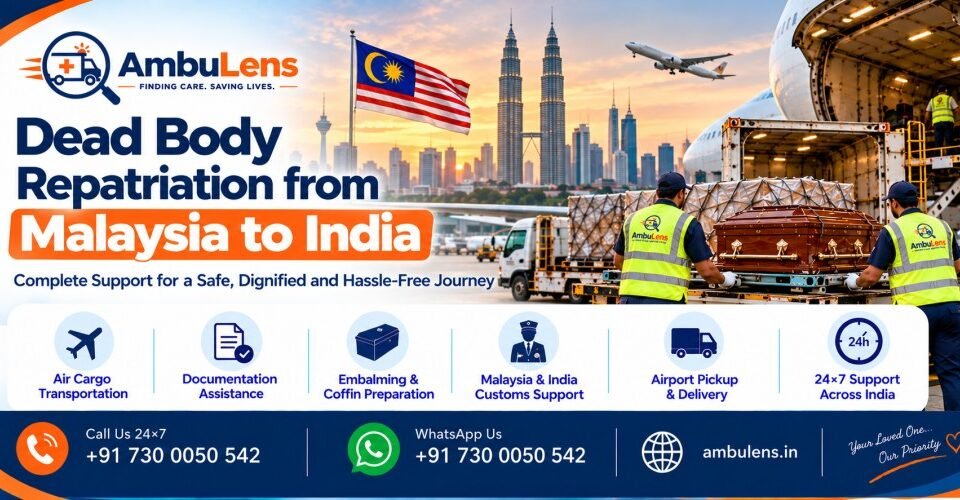

When a loved one passes away in Malaysia, family members may wish to bring them home to India for the final rites. However, international transportation of mortal remains involves several formalities. These include death registration, document preparation, embalming, airline cargo arrangements and public health clearance.
The process can feel overwhelming during a difficult time. Therefore, understanding each step can help families make informed decisions and avoid preventable delays.
AmbuLens provides support for international dead body transportation and repatriation arrangements. This guide explains the process of dead body repatriation from Malaysia to India, the documents families may need, the main cost factors and delivery arrangements for Indian cities.
What Is Dead Body Repatriation from Malaysia to India?
Dead body repatriation means transporting the deceased from one country to another for final rites. In this case, it involves moving mortal remains from Malaysia to India.
The process usually involves local authorities, a funeral or casket service provider, the High Commission of India in Kuala Lumpur, the airline and the receiving authorities in India.
Additionally, the family must arrange a person to receive the remains at the destination airport. The receiving arrangements should be confirmed before the flight departs.
For an overview of available support, visit the AmbuLens dead body transportation service page.
Documents Required for Malaysia to India Dead Body Transportation
The required documents depend on the circumstances of death and the authorities involved. However, families should prepare the following documents for the process.
1. Death Certificate
Obtain the official death certificate issued by the Malaysian authorities. Hospital or medical records may also be required.
The certificate should clearly identify the deceased and state the cause of death where applicable. If authorities request a translation, arrange an acceptable English version.
2. Passport and Identification Documents
Keep the deceased person’s original passport and copies available. The Indian mission may need the passport for cancellation or other formalities.
If the passport is lost or unavailable, inform the relevant authorities immediately. A police report or other supporting documents may be necessary.
3. Police Report, If Applicable
A police report may be required if the death resulted from an accident, suicide, homicide or another unnatural cause.
In such cases, authorities may need additional investigation or clearance before releasing the remains. Therefore, the family should not assume that the standard process will apply.
4. Next-of-Kin Consent and Relationship Proof
The next of kin may need to provide a notarised affidavit or consent letter authorising transportation of the remains.
Authorities may also request proof of the relationship between the deceased and the family member making the application. Examples include a birth certificate or another accepted government-issued record.
5. Embalming and Casket Documents
The local funeral service provider generally coordinates embalming and the preparation of the casket for international transportation.
The relevant certificates may confirm embalming, sealing and compliance with packaging requirements. The airline and receiving authorities must accept the preparation before transport.
6. Consular Clearance and Indian Arrival Clearance
The High Commission of India in Kuala Lumpur handles applicable consular formalities, including death registration and the relevant no-objection documentation.
In addition, Indian authorities require public health clearance for human remains arriving from abroad. The eCARe portal provides the official process and document guidance.
Step-by-Step Process for Dead Body Repatriation from Malaysia to India
The exact process depends on the circumstances of death and the location in Malaysia. Nevertheless, these steps provide a useful overview.
Step 1: Report the Death and Obtain Official Records
First, contact the hospital or relevant local authority. Obtain the necessary medical records and Malaysian death certificate.
If the death was accidental or unnatural, follow the police and investigation procedures. These cases may require additional approvals before the authorities release the remains.
Step 2: Contact the Indian High Commission
Next, contact the High Commission of India in Kuala Lumpur for current requirements.
The family or its authorised representative should prepare the requested documents. Moreover, names, passport details and other personal information must match across the records.
Incomplete or inconsistent documents can cause delays. Therefore, check every document before submission.
Step 3: Arrange Embalming and Casket Preparation
After the relevant release and approvals, coordinate with an authorised local funeral or casket service provider.
The provider can explain the embalming procedure, casket specifications and required certificates. The airline’s cargo requirements must also be considered before finalising the preparation.
Step 4: Complete Consular and Cargo Formalities
Once the necessary records are available, complete the applicable consular formalities. Then, coordinate the airline cargo booking and confirm the accepted route.
Flight availability, cargo capacity and handling requirements can affect the schedule. Consequently, families should confirm the arrangements instead of relying on an estimated departure date.
Step 5: Apply for Indian Public Health Clearance
Before arrival, arrange the required public health clearance through the applicable eCARe process.
The consignee and transport operator must follow the current instructions for submitting documents and transport details. Indian authorities may request additional information if the application is incomplete.
Step 6: Receive the Remains in India
Finally, the designated receiver coordinates with the airline, cargo terminal and relevant airport authorities.
After the required clearance and release, the remains can move to the final destination. Depending on the family’s requirements, this may involve road transportation to a home, hospital mortuary or funeral location.
For more details, read our guide to what happens when a dead body reaches the destination airport.
How Much Does Dead Body Repatriation from Malaysia to India Cost?
There is no single fixed price for every Malaysia-to-India repatriation case. The total cost depends on the circumstances, service requirements, airline arrangements and destination within India.
Therefore, request an itemised quotation before confirming the service.
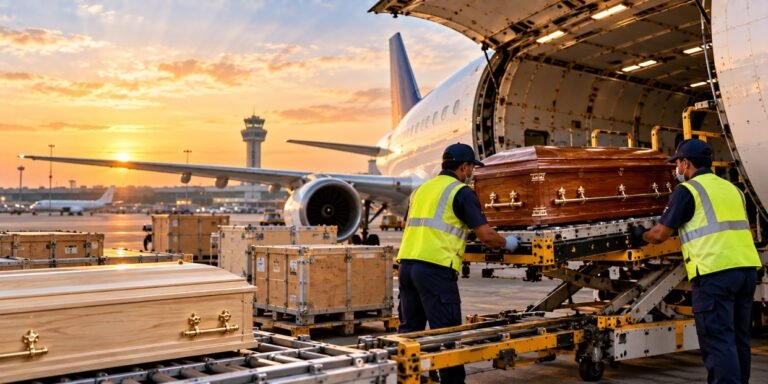
Main Factors That Affect the Cost
1. Local transportation in Malaysia
The cost may include moving the deceased from a hospital or other location to a funeral facility or airport cargo terminal.
2. Embalming and casket preparation
The preparation method, casket specifications, sealing and required certificates can affect the overall amount.
3. Documentation and consular formalities
Some cases involve additional documents, translations, notarisation or other administrative steps. Unnatural deaths may require extra procedures.
4. Airline cargo charges
Air cargo charges can vary according to the airline, route, chargeable weight, cargo handling and availability. Therefore, the cost may differ between destinations.
5. Airport handling and clearance
The process may include cargo terminal handling and coordination with the authorities responsible for clearance in India.
6. Transportation within India
Road transportation from the arrival airport to the final destination adds to the total cost. For example, delivery to Jaipur may involve different arrangements from delivery to Delhi, Mumbai or Chennai.
7. Special circumstances
Investigations, missing documents, additional approvals or changes to the planned route can affect the final amount.
How to Request an Accurate Quotation
When contacting a service provider, share the available details:
The city in Malaysia where the death occurred.
The intended destination city and state in India.
Whether the death certificate and passport are available.
Whether the case involves a police investigation.
Any known requirements or arrangements already completed.
Ask for a written breakdown of the services, third-party charges, exclusions and any potential additional expenses. This approach helps families compare quotations more clearly.
Dead Body Transportation from Malaysia to Major Indian Cities
The arrival airport and final destination affect the transportation arrangements. Here are some common destination examples.
Dead Body Transportation from Malaysia to Delhi
Delhi may serve as the arrival point for families in the capital region and nearby states. After arrival, the receiving party must coordinate airport clearance and any onward road transportation.
Confirm the flight route, receiving arrangements and local transport requirements before booking.
Dead Body Transportation from Malaysia to Mumbai
For families in Maharashtra and nearby areas, Mumbai may be a suitable destination depending on available cargo routes.
However, the airline must confirm acceptance and the required documentation. Additional road transportation may be needed if the final destination lies outside Mumbai.
Dead Body Transportation from Malaysia to Jaipur
Families arranging dead body transportation to Jaipur should confirm whether the most practical option is a suitable direct or connecting cargo route, followed by any required local arrangements.
If the remains arrive at another Indian airport, road transportation to Jaipur may form part of the plan. See our guide to dead body transportation services in Jaipur.
Dead Body Transportation from Malaysia to Chennai
Chennai may be considered for families in Tamil Nadu and nearby regions. The receiving arrangements depend on the confirmed flight route and cargo acceptance.
After clearance, the family or its service provider can arrange onward transportation to the final location.
Dead Body Transportation from Malaysia to Bengaluru
For families in Karnataka, Bengaluru may be an appropriate destination when airline cargo arrangements support the route.
Before departure, confirm the arrival details, clearance requirements and receiver information. This helps reduce confusion during airport collection.
Please note: These city examples do not guarantee direct flights or cargo availability. The airline and service provider must confirm the route for each case.
How Long Does Repatriation from Malaysia to India Take?
The overall duration varies from case to case. It depends on the release of the remains, document readiness, consular procedures, embalming, cargo availability and Indian arrival clearance.
Straightforward cases may progress more quickly than cases involving police investigations or missing records. Furthermore, weekends, public holidays and flight schedules can affect coordination.
For this reason, avoid relying on a fixed delivery promise before the authorities and airline confirm the arrangements. A service provider can help identify pending steps and provide updates as the case progresses.
You can also read our guide on documents required for dead body transportation in India.
How AmbuLens Can Help
Arranging international transportation during bereavement can be difficult, particularly when family members live in different countries.
AmbuLens supports families with international dead body transportation arrangements and coordination for the journey to India. Depending on the case, assistance may include guidance on documentation, embalming and casket preparation, cargo booking, clearance coordination and onward transportation.
The exact scope depends on the route and case requirements. Therefore, discuss the available documents, origin city, destination and pending formalities when requesting assistance.
Visit the AmbuLens dead body transportation service page to learn more about the service.
Related Resources
Frequently Asked Questions
1. What documents are required to bring a dead body from Malaysia to India?
Common requirements include a Malaysian death certificate, passport records, consular documentation, embalming and packaging certificates, and Indian public health clearance documents. Additional records may apply depending on the circumstances.
2. Is permission from the Indian High Commission required?
Applicable consular formalities are generally part of the process for repatriating an Indian national. Contact the High Commission of India in Kuala Lumpur to confirm the current requirements for your specific case.
3. How much does it cost to transport a dead body from Malaysia to India?
The cost depends on local arrangements, embalming, casket preparation, documents, airline cargo, airport handling and onward transportation. Request an itemised quotation for the specific route.
4. Can a dead body be transported by air from Malaysia to India?
Yes, air cargo may be used when the airline accepts the shipment and the applicable documentation, packaging and clearance requirements are met. The route and availability must be confirmed before booking.
5. How long does Malaysia-to-India dead body repatriation take?
There is no guaranteed timeframe for every case. The duration depends on documentation, official approvals, investigations if applicable, cargo availability and clearance at the Indian airport.
6. Can the remains be transported to Jaipur, Delhi or Mumbai?
The destination depends on the confirmed airline route and receiving arrangements. If the remains arrive at another airport, onward transportation by road may be required.
7. What happens if the deceased person’s passport is missing?
Inform the Indian High Commission and the relevant local authorities as soon as possible. They may require a police report or other supporting records before proceeding.