

When a loved one passes away abroad, families face an emotional and difficult time. Arranging transportation to India can also involve several documents and official approvals. Therefore, knowing what to prepare can make the process easier to manage.
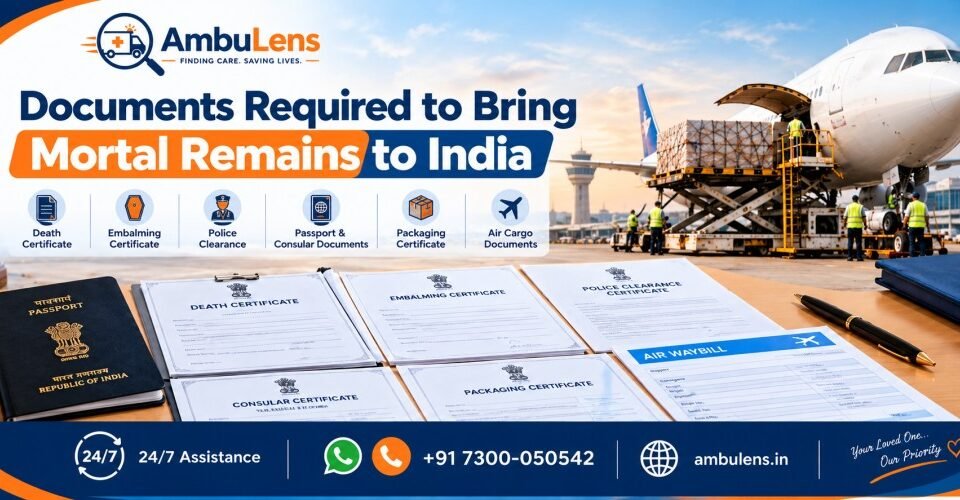
The documents required to bring mortal remains to India depend on the country where the death occurred and the circumstances of the case. However, families generally need a death certificate, an embassy no-objection certificate (NOC), an embalming certificate and passport documentation.
In addition, India’s eCARe portal manages public health clearance for human remains arriving from abroad. Families should confirm the current requirements before booking airline cargo.
This guide explains the key documents, the steps involved and how families can arrange onward transportation to cities such as Delhi, Mumbai, Jaipur, Chennai and Bengaluru.
What Documents Are Required to Bring Mortal Remains to India?
India’s Ministry of Health and Family Welfare lists four mandatory documents for eCARe human-remains clearance: an embalming certificate, a death certificate, an NOC from the Indian Embassy in the country of departure and a cancelled copy of the deceased person’s passport. Authorities may request supporting documents depending on the case.
Here is what each document means.
1. Death Certificate
The death certificate provides official confirmation of the person’s death. The competent authority in the country where the death occurred issues this document.
Families may also need a hospital death notification or medical report. In some cases, authorities require both documents to complete local formalities and register the death with the Indian Embassy.
2. No-Objection Certificate from the Indian Embassy
The Indian Embassy or Consulate reviews the relevant documents and issues the required NOC according to its procedures.
This approval supports the transportation of mortal remains to India. The family or authorised representative should follow the instructions of the Indian Mission responsible for the country where the death occurred.
For example, families arranging repatriation from Qatar should follow the Embassy of India in Doha’s death registration guidance.
3. Embalming Certificate
An authorised provider issues the embalming certificate after completing the required preparation. Airlines and public health authorities use this document as part of the international transportation process.
However, families should confirm the applicable embalming and packaging standards before booking cargo. Requirements can vary according to the departure country and the circumstances of the death.
4. Cancelled Passport of the Deceased
The deceased person’s passport generally requires cancellation through the relevant authorities or Indian Mission, as applicable.
The eCARe process lists a cancelled passport copy among the mandatory documents. If the original passport is unavailable for a valid reason, families should ask the relevant Indian Mission and airline about the current procedure rather than assuming that a photocopy will suffice.
5. Certificate of Packaging of Human Remains
The person arranging transportation may need a certificate confirming that the provider has packaged the remains according to applicable standards.
India’s eCARe guidance lists this certificate as supporting documentation rather than a universal mandatory upload. Nevertheless, the authorities or airline may request it for a particular case. Therefore, confirm the requirements before shipment.
6. Non-Infectious Disease or Non-Communicable Disease Certificate
Authorities may request this certificate when the cause of death remains unknown or an investigation is pending. The relevant health authority determines the applicable documentation.
It is not a universal requirement for every case. Check the latest eCARe guidance and the instructions from the airport health officer.
7. Police Report or Clearance
A police report may be necessary when the death resulted from an accident, occurred outside a hospital or requires investigation.
For example, the Embassy of India in Doha asks for police clearance when an Indian national dies outside a hospital. Other countries may follow different procedures.
8. Consent Letter or Power of Attorney
The next of kin may need to provide written consent for transporting the deceased to India. The family may also authorise a sponsor, relative or service provider to manage the local formalities.
The required format and attestation can vary by country. Therefore, ask the relevant Embassy or Consulate whether notarisation, a Power of Attorney or any additional supporting document applies.
9. Airline Air Waybill and Cargo Documents
The airline or cargo agent issues the air waybill after the relevant booking arrangements. This document identifies the shipment and supports the cargo handling process.
The receiving family should keep the flight details, cargo reference and collection instructions ready. In addition, the airline may require the details of the person who will collect the remains at the destination airport.
10. Additional Local Documents
The departure country may require other documents before authorities release the remains. These may include:
Transfer or release permission from local authorities.
Immigration or exit clearance.
Mortuary release documentation.
Sponsor or employer letters, where applicable.
Translations or attestations of official documents.
Transit documents, if the shipment passes through another country.
Not every case requires every item on this list. Confirm the exact requirements with the relevant authorities and airline.
eCARe Clearance for Bringing Mortal Remains to India
The Ministry of Health and Family Welfare operates the eCARe portal, which supports electronic clearance for human remains arriving from abroad. The system helps the relevant airport health authorities review documents before and after transportation.
The process generally involves the following steps:
Prepare the documents. Gather the death certificate, embalming certificate, embassy NOC and cancelled passport copy.
Submit the application. The applicant enters the required details and uploads the documents through the eCARe portal.
Wait for document review. The relevant authority reviews the submission and may request additional information.
Coordinate the airline booking. Follow the portal’s approval instructions and the airline’s cargo requirements.
Arrange collection in India. The nominated recipient should prepare for destination clearance and present the original documents when required.
A provisional clearance certificate does not replace final airport clearance. The airport health authority verifies the relevant documents when the remains arrive.
Step-by-Step Process for Preparing Repatriation Documents
Correct paperwork can help prevent avoidable delays. Follow these steps while coordinating with the relevant authorities.
Step 1: Notify the Authorities
Inform the local authorities, hospital or mortuary, next of kin and the relevant Indian Embassy or Consulate. If the death requires an investigation, follow the authorities’ instructions before arranging transportation.
Step 2: Collect the Death Documents
Obtain the official death certificate and any required medical report. Also, ask whether the authorities require police clearance or additional local permissions.
Step 3: Complete Embassy Formalities
Submit the required forms, family consent and supporting documents to the relevant Indian Mission. Follow its instructions for death registration and the NOC.
Step 4: Arrange Embalming and Packaging
Once the relevant authorities permit the release, arrange embalming and suitable packaging through an authorised provider. Collect the required certificates before proceeding.
Step 5: Apply for eCARe Clearance
Submit the application and required documents through the official portal. Respond to any request for additional information before finalising the shipment.
Step 6: Confirm Cargo and Receiving Details
Coordinate the air waybill, flight details and destination airport with the airline. Make sure the nominated recipient in India knows when and where to collect the remains.
Step 7: Arrange Onward Transportation
After the airport authorities complete the required clearance, arrange delivery to the family’s hometown. The final journey may involve road transportation to Jaipur, Delhi, Mumbai or another city.
Documents Required for Dead Body Transportation from Different Countries
The core Indian arrival documents remain important, but the departure-country requirements can differ.
Documents for Repatriation from Qatar to India
For an Indian national who dies in Qatar, the Embassy of India in Doha lists documents such as the hospital death notification, death certificate, Transfer Dead Body Certificate, next-of-kin consent, passport and airway bill. It may also require police clearance if the person died outside a hospital.
Families should follow the Embassy’s current instructions because the exact documents depend on the case.
Documents for Repatriation from Saudi Arabia to India
Families arranging transportation from Riyadh, Jeddah or Dammam should contact the relevant Indian Embassy or Consulate for the current local process. The authorities may require death records, family consent, local clearances, passport formalities and embalming documents.
For more guidance, read Human Repatriation from Saudi Arabia to India.
Documents for Repatriation from Other Countries
Other countries may use different death registration systems and release permits. Some may require translated reports, additional health certificates or transit approvals.
Therefore, families should not rely on a document checklist prepared for another country. Confirm the requirements with the relevant Indian Mission and local authorities before booking transportation.
Dead Body Transportation to Delhi, Mumbai, Jaipur and Other Indian Cities
The destination city affects airline routing, airport clearance and onward delivery arrangements. Families should confirm the destination airport and receiving person’s details before cargo booking.
Dead body transportation in Delhi: Confirm the airport receiving arrangements and onward transport to the final address.
Dead body transportation in Mumbai: Prepare the consignee details and confirm airport collection requirements.
Dead body transportation in Jaipur: Check whether the shipment can arrive through a suitable airport and whether road delivery is required.
Dead body transportation in Chennai, Bengaluru or Hyderabad: Confirm the available route, destination clearance and local delivery arrangements.
For domestic arrangements, explore Dead Body Transportation Services in Jaipur. For broader international arrangements, see International Human Repatriation Services from Jaipur.
Common Mistakes to Avoid When Preparing Documents
Small paperwork errors can lead to additional checks or delays. To reduce this risk, take the following precautions.
Do not assume every country follows the same process. Confirm local rules with the relevant Embassy or Consulate.
Check names and passport details carefully. Make sure the documents identify the deceased consistently.
Confirm translations and attestations. Ask whether the authorities need certified translations or notarised consent.
Do not book cargo too early. Confirm the required clearances and eCARe process before finalising transportation.
Keep the receiving person informed. Share the flight details and collection instructions with the nominated recipient.
Check original-document requirements. Digital uploads may not replace originals at the destination airport.
These checks help families coordinate the process with fewer avoidable complications.
How AmbuLens Can Help with Mortal Remains Transportation
Managing documents across countries can be difficult during bereavement. Families may need to coordinate with local authorities, the Indian Embassy, an embalming provider, the airline and the receiving party.
AmbuLens offers human repatriation and transportation coordination, subject to the requirements of each case. The team can discuss documentation, embalming and packaging arrangements, airline cargo, airport handling and onward delivery.
Share the country where the death occurred, the destination city in India and the documents already available. This information can help the team review the requirements and explain the available arrangements.
Related Resources
Frequently Asked Questions
1. What are the mandatory documents to bring mortal remains to India?
India’s eCARe guidance lists the embalming certificate, death certificate, NOC from the Indian Embassy and cancelled passport copy as mandatory documents. Authorities may request additional documents depending on the case.
2. Is an embassy NOC required for bringing mortal remains to India?
Yes. The Indian Embassy or Consulate issues the relevant NOC according to its procedures. Families should follow the instructions of the Indian Mission responsible for the country where the death occurred.
3. Is a police report always required?
No. The requirement depends on the circumstances and local rules. Authorities may request a police report or clearance for deaths involving accidents, investigations or deaths outside a hospital.
4. Is a packaging certificate mandatory for every shipment?
India’s eCARe guidance lists the packaging certificate as supporting documentation, not a universal mandatory upload. However, the authorities or airline may request it for a specific case.
5. What is eCARe clearance?
eCARe is India’s electronic system for public health clearance of human remains arriving from abroad. Applicants submit the required information and documents for review through the official portal.
6. Can I arrange dead body transportation from Qatar to Jaipur?
Families can explore transportation from Qatar to Jaipur, subject to the required clearances, airline route and onward delivery arrangements. The relevant authorities and service provider can confirm the practical options.
7. What if the deceased person’s passport is unavailable?
Do not assume that a photocopy or another document will automatically suffice. Contact the relevant Indian Mission and airline to confirm the current procedure for cases where the original passport is unavailable for a valid reason.