
Transporting human remains by air requires careful documentation, preservation, packaging, airline coordination, and airport clearance. During such a difficult time, families may not know which documents they need or where to obtain them.
Understanding the documents required for dead body transportation by air can help families prepare faster and avoid unnecessary delays.
The exact requirements depend on whether the transportation is domestic within India or international, the airline, the departure and destination airports, the cause of death, and the rules of the destination country.
Professional dead body transportation providers can help families coordinate documentation, embalming, coffin preparation, cargo booking, airport procedures, and final delivery.
Why Are Documents Required for Air Transportation of Human Remains?
Airlines treat human remains as specialized cargo. Therefore, the shipment must meet applicable health, safety, security, packaging, and airline requirements.
Documentation helps authorities and airlines verify:
- Identity of the deceased
- Date and place of death
- Cause of death
- Preservation status
- Packaging and coffin requirements
- Legal authorization for transportation
- Consignee and receiving details
- Airline cargo information
IATA’s Compassionate Transportation Manual provides guidance on airline acceptance, documentation, packaging, handling, and country-specific requirements for transporting human remains.
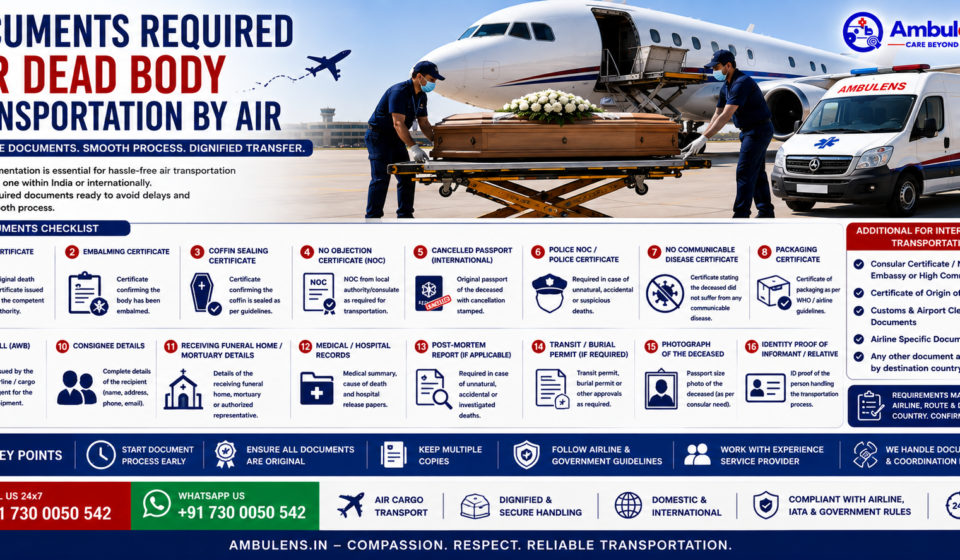
Documents Required for Dead Body Transportation by Air
The following documents are commonly required or may be requested depending on the circumstances.
1. Death Certificate
The Death Certificate is one of the most important documents.
It confirms:
- Name of the deceased
- Date of death
- Place of death
- Relevant registration details
- Cause of death, where recorded
Families should obtain the official certificate from the appropriate authority.
For international transportation, an English version or certified translation may be required when the original document is in another language. Destination-country rules should always be checked.
2. Embalming Certificate
An Embalming Certificate confirms that the deceased has undergone the required preservation procedure.
Airlines and authorities may require embalming for transportation in a coffin, particularly for international transfers.
The certificate generally confirms details about the embalming and preservation process.
Air India currently lists an embalming certificate among the documents required for international carriage of a human body in a coffin.
3. Coffin Sealing Certificate
A Coffin Sealing Certificate may be required to confirm that the coffin has been properly sealed.
For international transportation, the coffin may need to meet specific airline and public-health requirements.
Some authorities require a hermetically sealed coffin or casket.
Therefore, families should allow the funeral or transportation service provider to arrange the appropriate coffin and sealing certification according to the airline and destination requirements.
4. No Objection Certificate (NOC)
A No Objection Certificate may be required depending on the circumstances and route.
For international repatriation, a consular NOC can be an important part of the documentation process.
For example, India’s Ministry of Health and Family Welfare lists an NOC from the Indian Embassy, High Commission, or Consulate among the documents required for human remains arriving in India.
Requirements can differ for domestic transportation.
Therefore, families should confirm whether an NOC is required for their particular route.
5. Cancelled Passport of the Deceased
For international transportation, the deceased person’s passport may need to be cancelled.
Air India lists a cancelled passport among the documents required for international transportation of human remains.
The requirement is particularly relevant when a deceased person is being repatriated between countries.
Families should keep the original passport and copies available until the relevant authorities complete their procedures.
6. Police NOC or Police Certificate
A police document may be required when the death is:
- Accidental
- Unnatural
- Sudden
- Unexplained
- Under investigation
Air India’s current international human-remains guidance specifically lists a police certificate as mandatory when the death is unnatural.
The exact document and issuing authority can vary by jurisdiction.
Therefore, families should consult the hospital, police authorities, funeral service provider, or airline when the death falls into these categories.
7. No Communicable Disease Certificate
A No Communicable Disease Certificate may be required for certain air transportation cases.
It helps establish that the deceased does not present a relevant communicable-disease risk under applicable requirements.
Air India’s current guidance for transporting dead bodies by air in India mentions a “No Communicable Disease” certificate, while some international government checklists also request a certificate relating to infectious or non-infectious disease status.
The exact requirement depends on the route and applicable health regulations.
8. Packaging Certificate
Human remains transported by air must be packaged according to applicable requirements.
A packaging certificate may confirm that the remains have been prepared and packed according to the required standards.
India’s Ministry of Health and Family Welfare lists a Certificate of Packaging of Human Remains as per WHO guidelines among the documents for public-health clearance of remains arriving in India.
The transportation provider should verify the packaging requirements with the airline and relevant authorities.
9. Air Waybill
The Air Waybill (AWB) is an important cargo document for air transportation.
It contains shipment information such as:
- Shipper
- Consignee
- Origin
- Destination
- Cargo details
- Airline information
- Shipment reference
IATA notes that documentation for human-remains transportation includes accurately completing the Air Waybill and providing the necessary supporting documents.
The airline or authorized cargo agent generally coordinates this document.
10. Consignee Details
The airline and authorities may require complete information about the person or organization receiving the human remains.
This may include:
- Full name
- Address
- Phone number
- Email address
- Relationship to the deceased
- Funeral home details
- Receiving hospital or mortuary, where applicable
Accurate consignee information helps prevent delays during final handover.
11. Receiving Funeral Home or Mortuary Details
For long-distance or international transfers, families may need to provide details of the receiving funeral home, mortuary, or authorized representative.
Keep the following information ready:
- Organization name
- Address
- Contact person
- Phone number
- Email address
- Authorization details
This information helps coordinate the final stage of transportation.
12. Medical and Hospital Records
Hospitals may provide supporting documents such as:
- Medical summary
- Cause-of-death documentation
- Hospital release documents
- Medical history
- Treatment summary
- Post-mortem report, where applicable
Not every document is required for every shipment.
However, keeping relevant medical records available can help when authorities or airlines request additional information.
13. Post-Mortem Report
A Post-Mortem Report may be required when the death was:
- Accidental
- Unnatural
- Suspicious
- Sudden
- Unexplained
The report can help establish the circumstances and cause of death.
The requirement varies according to the circumstances and local legal procedures.
Therefore, families should consult the relevant authorities when a post-mortem examination has taken place.
14. Transit Permit or Burial Permit
A Transit Permit, burial permit, or similar authorization may be required in certain cases.
Requirements can depend on:
- Destination
- State regulations
- International route
- Local authorities
- Cause of death
- Funeral arrangements
Some international repatriation checklists specifically include transit or burial permits.
Therefore, the transportation provider should confirm whether this document applies to the particular shipment.
15. Photograph of the Deceased
Some consular or repatriation procedures may request a photograph of the deceased.
For example, certain Indian consular procedures for transportation of mortal remains request a photograph along with other documentation.
This is not necessarily a universal requirement for every domestic air cargo shipment.
16. Identity Proof of the Family Member or Informant
The family member handling the transportation process may need to provide identification.
Possible documents include:
- Aadhaar Card
- Passport
- Voter ID
- Other government-issued identification
International consular procedures may also require the passport and address proof of the informant or relative.
Domestic vs International Dead Body Transportation Documents
The documentation requirements can differ significantly.
| Domestic Air Transportation | International Transportation |
|---|---|
| Death Certificate | Death Certificate |
| Embalming Certificate, where required | Embalming Certificate |
| Airline cargo documents | Cancelled passport |
| Packaging/coffin documents | Consular NOC, where applicable |
| Police documents, if applicable | Coffin sealing documentation |
| Consignee details | Airline medical/cargo documentation |
| Hospital release documents | Destination-country permits |
| Other route-specific documents | Transit, customs and health documents |
International transportation generally involves more documentation because multiple countries, airlines, customs authorities, and consular offices may be involved.
IATA notes that there is no single universal international process because country and operator requirements can differ.
Documents for International Repatriation to India
When human remains are being transported to India from another country, additional public-health clearance may apply.
The Ministry of Health and Family Welfare’s eCARe system lists documents such as:
- Embalming Certificate
- Death Certificate
- NOC from the Indian Embassy
- Cancelled passport
- Packaging certificate
- Supporting health documentation where required
The eCARe system is designed to facilitate electronic clearance of human remains arriving at Indian airports.
Some cases may require additional documentation, including disease-related certificates or transit/burial permits.
Documents for International Transportation from India
When human remains are being transported from India to another country, the requirements depend on the destination country and airline.
Families may need:
- Death Certificate
- Embalming Certificate
- Coffin Sealing Certificate
- Passport of the deceased
- Passport cancellation
- Police certificate, where applicable
- No Communicable Disease Certificate, where required
- Consular documentation
- Air Waybill
- Destination funeral home details
- Transit permits, where applicable
- Customs documentation
- Destination-country permits
Air India currently lists death, embalming, police, cancelled-passport, and consular documentation among its international human-remains cargo requirements.
What Documents Are Needed for an Unnatural Death?
Unnatural deaths often require additional legal documentation.
These cases may include:
- Road accidents
- Workplace accidents
- Suicide
- Homicide
- Sudden unexplained death
- Death under investigation
Depending on the circumstances, authorities may require:
- Police NOC
- Post-mortem report
- Police certificate
- Release authorization
- Other investigation-related documents
Airline requirements should be confirmed before booking the shipment.
What Documents Are Needed for Cremated Ashes?
Transporting ashes is different from transporting a body in a coffin.
Depending on the route and airline, families may need:
- Death Certificate
- Cremation Certificate
- Identification documents
- Consignee details
- Airline cargo or baggage documentation
- Destination-country documentation
Air India distinguishes between human bodies transported in coffins and cremated remains transported in urns.
Therefore, families should clearly inform the airline whether they are transporting a body or cremated ashes.
Step-by-Step Process for Preparing Documents
Families can follow this process to make documentation easier.
Step 1: Obtain the Death Certificate
Get the official Death Certificate from the appropriate authority.
Step 2: Contact the Airline or Cargo Provider
Confirm the current human-remains documentation requirements.
Step 3: Arrange Embalming
Use an authorized professional where embalming is required.
Step 4: Obtain the Embalming Certificate
Keep the original and copies available.
Step 5: Prepare the Coffin
Arrange an airline-compliant coffin and obtain the applicable sealing or packaging documentation.
Step 6: Complete Police Formalities
Complete police and post-mortem procedures if the death was accidental, unnatural, or under investigation.
Step 7: Confirm the Consignee
Provide accurate receiving-person or funeral-home information.
Step 8: Complete Cargo Documentation
The airline or cargo agent prepares the Air Waybill and other shipment paperwork.
Step 9: Complete Airport Formalities
The transportation team coordinates airport cargo, health, security, and other applicable clearances.
Step 10: Arrange Final Handover
The receiving funeral home or authorized representative takes custody at the destination.
Common Documentation Mistakes to Avoid
Families can reduce delays by avoiding these mistakes.
1. Using Incorrect Names
The deceased’s name should match the relevant official documents.
2. Submitting Incomplete Certificates
Check every document before submitting it to the airline or authority.
3. Ignoring Translation Requirements
Some countries or authorities require English translations or certified translations. Air India also advises checking destination-country rules for translated documents.
4. Waiting for the Last Minute
International documentation may take additional time.
5. Not Checking Airline Requirements
Airlines can have their own acceptance procedures.
6. Forgetting Destination Requirements
The destination country’s rules can be different from India’s requirements.
7. Not Keeping Copies
Maintain both physical and digital copies of important documents.
How Professional Dead Body Transportation Services Help
Arranging air transportation independently can be difficult during a bereavement.
Professional providers can coordinate:
- Document collection
- Embalming
- Coffin preparation
- Certificate coordination
- Airline cargo booking
- Air Waybill
- Airport coordination
- Ground transportation
- Customs procedures
- Consular coordination
- Destination handover
IATA specifically recognizes funeral operators, airlines, and freight forwarders as stakeholders in the human-remains transportation process.
Therefore, professional coordination can help families manage multiple requirements through one point of contact.
Cost of Dead Body Transportation by Air
Documentation is only one component of the overall transportation cost.
The final cost may depend on:
- Departure city
- Destination
- Airline
- Cargo charges
- Distance
- Coffin requirements
- Embalming
- Ground transportation
- Airport handling
- Documentation
- Customs requirements
- International consular procedures
Therefore, families should request a customized quotation rather than relying on a fixed online price.
For related information, explore Dead Body Transportation Services in India.
How Long Does Documentation Take?
The time required varies from case to case.
Domestic transfers may involve fewer formalities than international repatriation.
International transportation can take longer because it may involve:
- Consular approvals
- Airline confirmation
- Customs procedures
- Health clearance
- Destination-country documentation
- Transit permissions
Therefore, families should begin the process as soon as possible.
Checklist for Dead Body Transportation by Air
Before the shipment, confirm the following:
- Death Certificate
- Embalming Certificate, where required
- Coffin Sealing Certificate, where required
- Police NOC or certificate, if applicable
- Post-mortem report, if applicable
- No Communicable Disease Certificate, if required
- Packaging Certificate, if required
- Passport and cancellation, for applicable international transfers
- Consular NOC, where applicable
- Transit or burial permit, where applicable
- Air Waybill
- Consignee details
- Receiving funeral home details
- Required translations
- Other airline or destination-country documents
Because requirements vary, this checklist should be treated as a planning guide rather than a universal legal checklist.
Why Choosing the Right Service Provider Matters
Human remains transportation requires more than arranging an airline booking.
A professional provider should understand:
- Airline cargo procedures
- Coffin requirements
- Embalming documentation
- Airport coordination
- Ground transportation
- International repatriation
- Consular requirements
- Customs procedures
- Destination handover
Consequently, experienced coordination can help reduce administrative difficulties during a stressful time.
Related Dead Body Transportation Services
Families may also require:
- Dead Body Transportation Services in India
- Air Cargo Dead Body Transportation Services
- Road Dead Body Transportation Services
- Mortuary Freezer Box Services
- Embalming Services
- Human Repatriation Services
- International Human Remains Transportation
- Dead Body Transportation from Another State
These related services can be internally linked to relevant service pages to help families find the appropriate transportation option.
Conclusion
Understanding the documents required for dead body transportation by air can help families prepare for the process with fewer complications.
A Death Certificate, embalming documentation, coffin or packaging certificates, airline cargo documents, and other supporting paperwork may be required. International transportation can require additional documents such as a cancelled passport, consular NOC, police certificate, transit permits, and destination-country approvals.
However, requirements are not identical for every shipment. They can change according to the airline, route, airport, cause of death, and destination-country regulations.
Therefore, families should confirm the latest requirements with the airline, airport authorities, consulate, and transportation provider before finalizing the shipment.
Professional dead body transportation providers can assist with documentation, embalming, coffin preparation, cargo booking, airport coordination, ground transportation, and final handover.
Frequently Asked Questions
What documents are required for dead body transportation by air?
Common documents may include the Death Certificate, Embalming Certificate, coffin or packaging documentation, airline cargo documents, consignee details, and police documents where applicable. International transfers may require additional consular and passport documentation.
Is an Embalming Certificate required for air transportation?
For transportation of a body in a coffin, airlines may require an Embalming Certificate, particularly for international shipments. Requirements depend on the airline and route. Air India currently lists an Embalming Certificate for international carriage of a human body in a coffin.
Is a police NOC required for dead body transportation by air?
It depends on the circumstances and route. Police documentation is particularly relevant for accidental, unnatural, sudden, or investigated deaths. Air India states that a police certificate is mandatory for international human-remains shipments when the death is unnatural.
Is a passport required for transporting human remains internationally?
For international transportation, the deceased’s passport and its cancellation may be required. Air India lists a cancelled passport among its international human-remains documentation requirements.
What documents are required for transporting a dead body to India?
For human remains arriving in India, India’s Ministry of Health and Family Welfare lists documents including an Embalming Certificate, Death Certificate, NOC from the Indian Embassy, cancelled passport, and packaging certificate, with additional documents required in certain cases.
Can ashes be transported by air?
Yes. Cremated remains can be transported by air, but the documentation and packaging requirements differ from those for a body in a coffin. Airlines should be contacted in advance to confirm their current requirements.
Can a transportation service provider arrange the documents?
Professional providers can assist with collecting and coordinating documents, embalming certificates, coffin preparation, airline cargo paperwork, airport procedures, and related formalities. However, documents issued by government, police, hospitals, airlines, or consulates must come from the relevant authorities.