
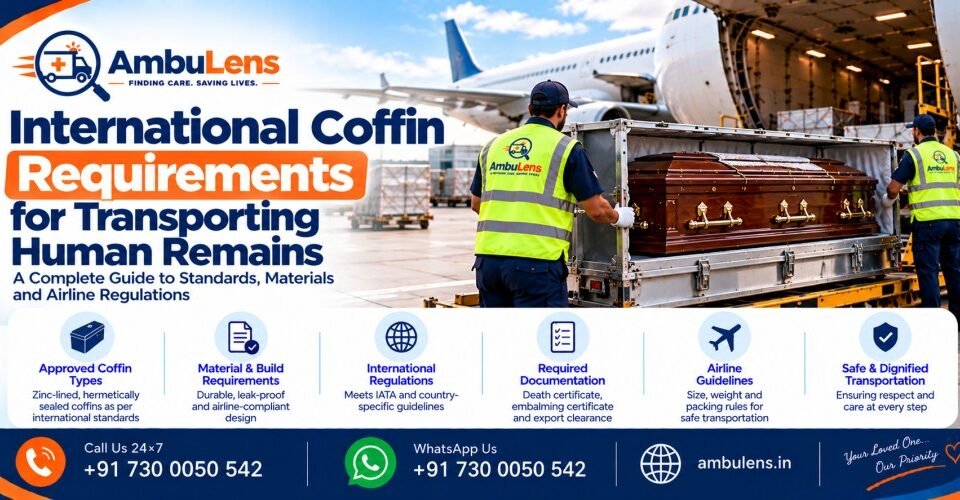

When a family needs to transport a deceased loved one across international borders, coffin preparation becomes an essential part of the process. However, requirements can vary by country, airline, route and public health authority.
The international coffin requirements for transporting human remains generally cover suitable containment, embalming where required, secure sealing and supporting documentation. Therefore, families should confirm the applicable rules before arranging the shipment.
This guide explains the main requirements and the steps families can take to avoid unnecessary delays. It also covers transportation to major Indian cities, including Delhi, Mumbai, Jaipur, Chennai and Bengaluru.
Why Do International Coffin Requirements Matter?
International transportation involves several checks before an airline accepts human remains. Authorities and carriers need to ensure that the shipment meets applicable health, safety and handling requirements.
An unsuitable coffin or missing certificate may delay acceptance. Consequently, families should coordinate with a qualified funeral service provider before making the final arrangements.
Moreover, requirements can differ between the departure and destination countries. A coffin accepted by a local funeral home may still need additional preparation for international air cargo.
Main Coffin Requirements for International Transportation
1. Suitable Coffin or Casket Construction
The coffin must meet the requirements of the relevant authorities and airline. Depending on the route, the service provider may recommend a coffin with an appropriate inner lining or an additional sealed containment layer.
However, there is no single coffin specification that applies to every international shipment. Confirm the required construction with the funeral director, airline cargo team and receiving authorities.
2. Leak-Resistant and Secure Containment
International transportation often requires secure containment to prevent leakage and protect the shipment during handling. Some routes or authorities may require a hermetically sealed inner container or another approved arrangement.
Therefore, do not assume that an ordinary funeral coffin will meet international shipping rules. Ask the provider to confirm the exact containment requirements for the intended route.
3. Embalming Requirements
Many international repatriation routes require embalming before the airline accepts human remains. The process helps prepare the deceased for transportation and may form part of the required health documentation.
Nevertheless, the exact rules depend on the departure country, destination country and airline. Confirm the requirements before scheduling embalming or booking cargo.
4. Coffin Sealing and Certification
Some authorities or airlines require a certificate confirming that the coffin has been prepared and sealed according to applicable rules. The funeral service provider can explain who must issue the certificate and which details it must contain.
In addition, check whether the documents require an official translation or consular verification.
5. External Packaging and Cargo Handling
The shipment must also meet the carrier’s handling and acceptance requirements. The airline or cargo agent can confirm the required external packaging, labelling and booking documents.
As a result, families should coordinate the coffin preparation and cargo booking together rather than treating them as separate tasks.
Documents Required for International Coffin Transportation
The required documents depend on the country of departure, destination and circumstances of death. However, families may need several of the following documents:
Death certificate issued by the relevant authority.
Embalming certificate, where required.
Coffin sealing or preparation certificate, where applicable.
Passport and identification documents of the deceased.
Release or transportation permits from local authorities.
Consular NOC or other embassy documents, where required.
Airline cargo booking details and air waybill.
Health clearance or import documentation required by the destination country.
Certified translations of documents, where requested.
For transportation to India, families should check the current requirements with the relevant Indian Embassy or Consulate and the receiving authorities.

Step-by-Step Process for Preparing a Coffin for International Transport
Step 1: Confirm the Destination Requirements
First, identify the destination country and the airport that will receive the shipment. Then, ask the relevant authorities or cargo agent for the latest requirements.
This step helps the family avoid preparing a coffin that does not meet the receiving country’s rules.
Step 2: Contact a Qualified Funeral Service Provider
Next, work with a funeral director or authorised provider who handles international repatriation. The provider can coordinate preparation, embalming, coffin selection and required certificates.
Additionally, confirm whether the provider has experience with the intended airline and route.
Step 3: Complete Embalming and Preparation
If the route requires embalming, arrange the procedure through an appropriate provider. The provider should also prepare the coffin and supporting documents according to the applicable requirements.
Step 4: Obtain the Required Certificates
Before cargo booking, check that all necessary certificates and permits are ready. These may include the embalming certificate, coffin sealing certificate and documents from local authorities.
Where necessary, arrange translations or consular authentication in advance.
Step 5: Confirm Airline Acceptance
After preparation, confirm the shipment details with the airline or cargo agent. Ask about the coffin specifications, packaging, cargo booking, handling charges and document submission deadlines.
Step 6: Arrange Arrival Clearance
Finally, coordinate with the receiving party at the destination airport. They should understand the local clearance requirements and arrange onward transportation if needed.
For shipments arriving in India, review our guide to what happens when a dead body reaches the destination airport.
International Coffin Requirements for Transportation to India
When families transport human remains to India, they must consider both the departure country’s rules and India’s arrival requirements. The coffin, preparation certificates and consular documents should match the requirements for the specific case.
In addition, human remains arriving in India require applicable public health clearance. The eCARe portal provides information about the clearance process and required documents.
Families should verify the checklist before booking cargo. This is particularly important when the shipment involves a connecting flight, different cargo handlers or additional road transportation after arrival.
Dead Body Transportation Services to Major Indian Cities
After international arrival and clearance, families may need onward transportation to their home city. The route and final delivery requirements can affect the arrangements and total cost.
Dead Body Transportation in Delhi
For Delhi, confirm the arrival airport, cargo release process and local collection arrangements. If the final destination lies outside Delhi, arrange suitable onward transportation.
Dead Body Transportation in Mumbai
For Mumbai, verify the cargo route, required documents and airport handling arrangements. Also, confirm whether the service quotation includes delivery to the final address.
Dead Body Transportation in Jaipur
For Jaipur, families should check whether the shipment can arrive through a suitable airport or requires onward road transportation. Confirm the expected route and charges in advance.
Read our guide to Dead Body Transportation Service in Jaipur.
Dead Body Transportation in Chennai
For Chennai, coordinate the arrival arrangements and required clearance documents. The receiving provider can also explain any local transportation requirements.
Dead Body Transportation in Bengaluru
For Bengaluru, confirm the arrival airport, shipment details and collection arrangements. If the cargo arrives in another city, additional road transportation may be necessary.
For further information, visit the AmbuLens dead body transportation service page or read our guide to dead body transportation by flight in India.
Common Mistakes to Avoid
Families can reduce avoidable delays by checking the requirements before booking transportation.
Using an unsuitable coffin: Confirm the required construction and sealing arrangements with the airline or cargo agent.
Booking cargo too early: Verify the documents and preparation requirements before confirming the shipment.
Missing certificates: Check the full document list with the relevant authorities.
Ignoring translation requirements: Arrange certified translations when the receiving authority requests them.
Assuming every country follows the same rules: Verify the rules for both the departure and destination countries.
Leaving arrival arrangements until the last minute: Coordinate airport clearance and onward delivery in advance.
Above all, ask for written confirmation of the applicable requirements. This helps the family and service provider work from the same checklist.
How to Get Help With International Coffin Requirements
If you need to transport human remains internationally, begin by sharing the departure country, destination country and current documentation status with a qualified service provider.
Then, request confirmation of the coffin specifications, embalming requirements, sealing certificate, cargo booking process and arrival clearance.
For transportation to India, you can also consult our guide to documents required for dead body transportation in India.
These checks help families understand the process and prepare the required documents before the shipment begins.
Related Resources
Frequently Asked Questions
1. What are the international coffin requirements for transporting human remains?
Requirements may include suitable coffin construction, secure or leak-resistant containment, embalming where required, sealing certification and supporting documents. The exact specifications depend on the route, airline and authorities.
2. Does an international coffin need to be hermetically sealed?
Some countries, airlines or routes may require a hermetically sealed inner container or another approved containment system. Confirm the specific requirement with the funeral provider and cargo agent.
3. Is embalming mandatory for international transportation?
Many international routes require embalming, but the rules vary. Check the requirements of the departure country, destination country and airline before arranging the procedure.
4. What certificate confirms that a coffin has been sealed?
Some routes require a coffin sealing or preparation certificate. The responsible funeral service provider or authorised professional can confirm the applicable certificate and who must issue it.
5. Can a regular coffin be used for international air cargo?
Not always. A regular coffin may not meet the airline’s packaging or containment requirements. Always confirm the specifications before booking the shipment.
6. What documents are required to transport human remains to India?
Depending on the case, documents may include a death certificate, embalming certificate, coffin sealing certificate, passport-related documents, consular NOC, cargo details and applicable public health clearance documents. Check the current eCARe requirements.
7. Can human remains be transported to Jaipur, Delhi or Mumbai after international arrival?
Yes, onward transportation may be arranged, subject to the required clearance and transport arrangements. The route depends on the arrival airport, final destination and available services.