


A stroke is a medical emergency that requires quick assessment and appropriate treatment. Therefore, timely transportation can become important when a patient needs to move to a specialized hospital.
An air ambulance for stroke patients can support medical transfers between cities. Depending on the patient’s condition, the aircraft may provide continuous monitoring, oxygen, ventilator support, and other critical-care equipment.
Moreover, air transportation can reduce travel time on long-distance routes. However, the treating medical team should first determine whether the patient can safely travel.
When Does a Stroke Patient Need an Air Ambulance?
Not every stroke patient needs air transportation. However, an air ambulance may be considered when a patient requires transfer to a specialized hospital over a long distance.
Common situations include:
- Acute stroke requiring specialist care
- Suspected severe stroke
- Need for advanced neurological treatment
- Transfer to a stroke or neuro-care centre
- Post-stroke patients requiring close monitoring
- Patients requiring ventilator support
- Hospital-to-hospital transfer
- Long-distance medical transportation
Furthermore, the medical team should review the patient’s neurological status before arranging the transfer.
Why Air Ambulance Can Help Stroke Patients
Stroke treatment can depend heavily on timely medical evaluation. Therefore, reducing unnecessary travel delays can be important during an intercity transfer.
Faster Long-Distance Transportation
For example, a patient may need to travel from Jaipur to Delhi for specialized neurological care.
Similarly, transfers may involve:
- Mumbai to Delhi
- Jaipur to Mumbai
- Delhi to Bangalore
- Ahmedabad to Mumbai
- Jaipur to Bangalore
- Chennai to Hyderabad
Air ambulance transportation can help cover these longer distances when the patient’s condition allows air travel.
Continuous Medical Monitoring During the Flight
Stroke patients can require close observation during transportation.
The medical team may monitor:
- Blood pressure
- Heart rate
- Oxygen saturation
- Breathing
- Level of consciousness
- Neurological condition
- Other vital signs
Moreover, the team can respond if the patient’s condition changes during the journey.
Medical Equipment for Stroke Patient Transfers
The equipment depends on the patient’s medical condition.
An appropriately equipped air ambulance may include:
- Patient stretcher
- Cardiac monitor
- Oxygen system
- Ventilator
- Defibrillator
- Infusion pumps
- Suction equipment
- Emergency medicines
- Vital-sign monitoring equipment
Therefore, the provider should review the patient’s medical reports before selecting the aircraft and equipment.
Medical Team for Stroke Patient Transportation
Stroke transfers require trained medical professionals.
Depending on the patient’s condition, the team may include:
- Critical-care doctor
- Emergency physician
- Registered nurse
- Paramedic
- Other trained healthcare professionals
The team monitors the patient throughout the transfer. Additionally, they manage prescribed medicines and provide required medical support.
Air Ambulance for Ischemic Stroke Patients
An ischemic stroke occurs when a blood vessel supplying the brain becomes blocked.
Patients may require urgent neurological evaluation and specialized treatment.
An air ambulance may be considered when the patient needs transfer to a hospital with appropriate neurological facilities.
However, the patient’s current condition, treatment status, and stability should guide the transportation decision.
Air Ambulance for Hemorrhagic Stroke Patients
A hemorrhagic stroke occurs when bleeding happens in or around the brain.
Such patients may require intensive monitoring and specialist neurological or neurosurgical care.
Therefore, long-distance transportation requires careful planning.
The medical team may consider:
- Current neurological status
- Blood pressure
- Breathing support
- Level of consciousness
- Recent imaging reports
- Medication requirements
- Need for ventilator support
- Receiving hospital capabilities
Stroke Patient Transfer: How the Process Works
A well-planned transfer can help reduce avoidable delays.
1. Medical Assessment
First, the medical team reviews the patient’s diagnosis, reports, medication, and current condition.
2. Receiving Hospital Confirmation
Next, the destination hospital confirms that it can accept the patient.
3. Aircraft and Equipment Planning
The provider selects an appropriate aircraft and medical setup.
4. Medical Team Arrangement
A suitable doctor, nurse, or paramedic team is assigned according to the patient’s needs.
5. Ground Ambulance Transfer
A suitable ambulance transports the patient from the hospital to the departure airport.
6. Air Medical Transfer
The medical team continues monitoring the patient during the flight.
7. Destination Hospital Transfer
After landing, a ground ambulance transports the patient to the receiving hospital.
This process can provide hospital-to-hospital and bed-to-bed medical transportation.
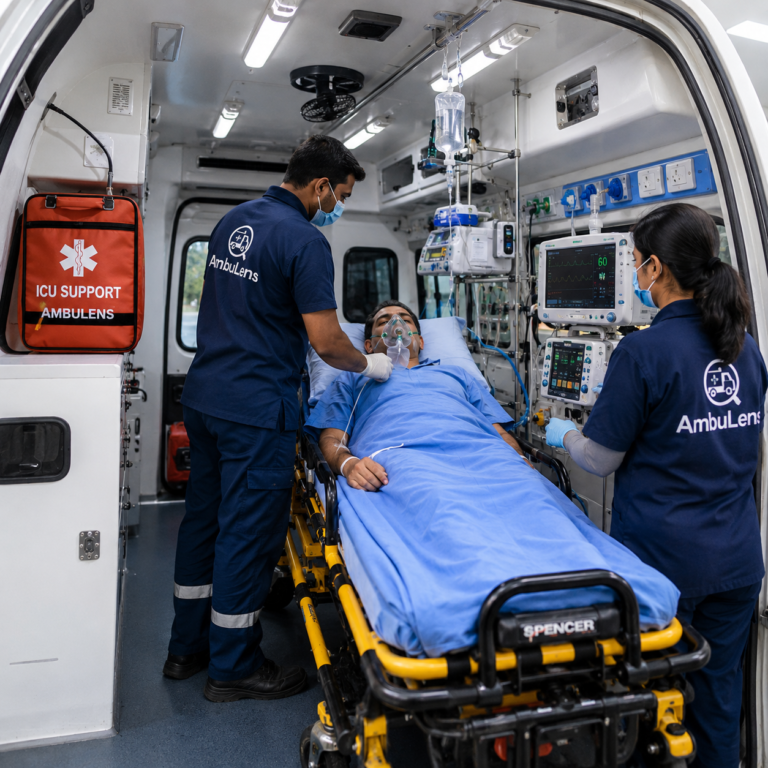
ICU Support During Stroke Patient Transfer
Some stroke patients may require intensive medical support.
For example, patients with severe neurological conditions may need:
- Ventilator support
- Oxygen therapy
- Continuous monitoring
- Medication management
- Airway support
- Critical-care supervision
In such cases, an appropriately equipped air ambulance can provide a mobile critical-care environment.
You can also read our How ICU Patient Transfer Works in India guide.
Air Ambulance vs Road Ambulance for Stroke Patients
Both transportation options can support stroke patients. However, the right choice depends on distance, urgency, road conditions, and medical requirements.
| Factor | Air Ambulance | Road Ambulance |
|---|---|---|
| Long-distance transfer | Faster option in many cases | May require more travel time |
| Short-distance transfer | May not be necessary | Often practical |
| Medical monitoring | Available | Available |
| Ventilator support | Available when required | Available in ICU ambulances |
| Doctor/medical team | Can be arranged | Can be arranged |
| Airport coordination | Required | Not required |
| Bed-to-bed transfer | Can be coordinated | Directly available |
For shorter transfers, a road ambulance may be more practical.
For longer routes, air transportation may reduce travel time.
Learn more about Road Ambulance Services.
Air Ambulance Services for Stroke Patients in Jaipur
Jaipur is an important medical centre in Rajasthan. Therefore, patients from nearby cities may require transportation to or from Jaipur for specialized treatment.
Air ambulance transfers can be coordinated from Jaipur to cities such as:
- Delhi
- Mumbai
- Bangalore
- Chennai
- Hyderabad
- Ahmedabad
For more information, visit our Air Ambulance Service in Jaipur.
Air Ambulance Services for Stroke Patients in Mumbai
Mumbai has several specialized hospitals and neurological care facilities. Therefore, patients may require transfers to Mumbai from other cities.
Common routes may include:
- Mumbai to Delhi
- Mumbai to Jaipur
- Mumbai to Ahmedabad
- Mumbai to Bangalore
- Mumbai to Chennai
Patients travelling through Mumbai can also receive coordinated ground ambulance support for airport and hospital transfers.
Preparing for a Stroke Patient Air Transfer
Families can help reduce delays by keeping important medical information ready.
Prepare:
- Medical reports
- CT or MRI reports
- Doctor’s transfer recommendation
- Current medication list
- Patient identification
- Hospital details
- Contact information
- Insurance documents, if applicable
Additionally, share recent medical reports with the air ambulance provider before the transfer.
This helps the medical team understand the patient’s requirements.
International Air Ambulance for Stroke Patients
Some patients require international medical transportation after receiving treatment in another country or when they need specialized care abroad.
For example, transfers may involve:
- India to UAE
- India to Singapore
- India to UK
- India to USA
- India to Canada
- India to Australia
International transfers require additional planning. Therefore, families should consider medical assessment, aircraft selection, airport permissions, immigration requirements, hospital coordination, and ground transportation.
Read our Complete Guide to Air Ambulance Services in India for more information.
How Much Does a Stroke Patient Air Ambulance Cost?
There is no fixed price for every stroke patient transfer.
The cost can depend on:
- Departure city
- Destination city
- Flight distance
- Aircraft type
- Patient’s medical condition
- Medical team required
- Equipment required
- Domestic or international transfer
- Airport charges
- Ground ambulance requirements
- Bed-to-bed service
Therefore, families should request a customized quotation after medical assessment.
How to Choose the Right Air Ambulance Provider
Before arranging transportation, consider these factors:
Medical Support
Check whether the provider can arrange the medical equipment required for the patient’s condition.
Trained Medical Team
Ask whether qualified doctors, nurses, or paramedics can accompany the patient.
Ground Ambulance Coordination
Furthermore, confirm that ambulances can be arranged at both departure and destination locations.
Hospital Coordination
The provider should coordinate with the sending and receiving hospitals.
24/7 Support
Stroke emergencies can occur at any time. Therefore, round-the-clock coordination can help families arrange transportation without unnecessary delays.
Conclusion
Stroke patients may need specialized medical transportation when they require treatment at another hospital or in another city.
An air ambulance can provide medical supervision, appropriate equipment, and faster long-distance transportation when the patient is suitable for air travel.
However, medical assessment should always come first. The patient’s condition, treatment needs, and destination hospital should guide the transfer plan.
Frequently Asked Questions
1. Can a stroke patient travel by air ambulance?
Yes. Some stroke patients can travel by air ambulance after medical assessment confirms that air transportation is suitable.
2. Is an air ambulance suitable for a severe stroke?
It may be suitable when the patient needs transfer to a specialized hospital. However, the medical team should assess the patient’s stability and support requirements first.
3. Can a stroke patient travel on a ventilator?
In some cases, yes. An appropriately equipped air ambulance can provide ventilator support when medically required.
4. Does an air ambulance provide neurological monitoring?
The medical team can monitor vital signs and the patient’s overall condition during transportation. The exact monitoring depends on the patient’s medical requirements.
5. Can stroke patients travel from Jaipur to Delhi by air ambulance?
Yes. Air ambulance transfers from Jaipur to Delhi can be coordinated based on the patient’s condition, aircraft availability, and receiving hospital requirements.
6. Can AmbuLens arrange a hospital-to-hospital stroke patient transfer?
Yes. AmbuLens can coordinate air ambulance and ground ambulance transportation for hospital-to-hospital transfers.