
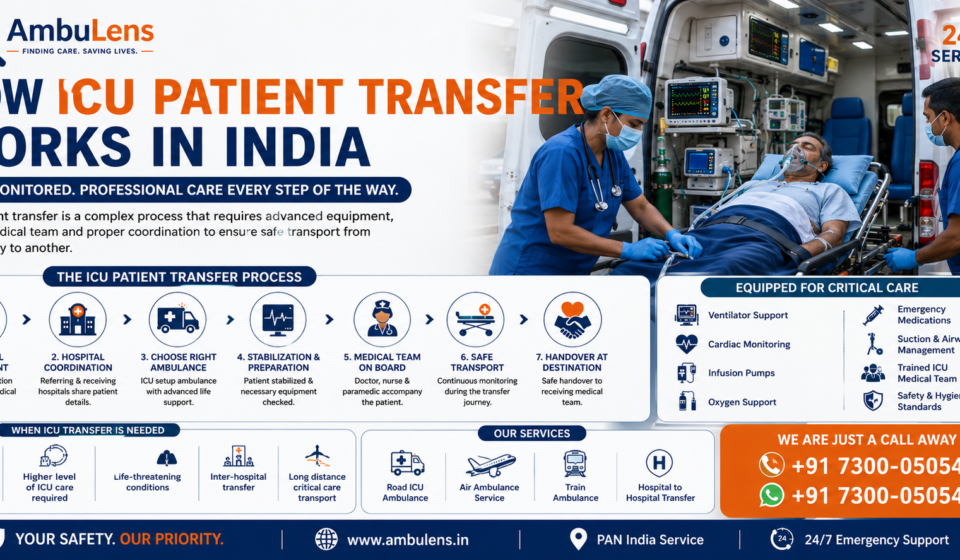

An ICU patient transfer requires careful planning, medical supervision, and the right transportation equipment. Unlike a routine patient transfer, an ICU transfer involves a patient who may depend on continuous monitoring, oxygen, a ventilator, medications, or other life-support measures.
In India, patients may need an ICU transfer when their current hospital does not provide the required treatment, a specialist facility is needed, or a higher level of care is recommended. Government guidance on inter-facility transfers emphasizes coordination between the referring and receiving facilities and appropriate medical support during transportation.
Therefore, understanding how ICU patient transfer works in India can help families prepare for the journey and make informed decisions.
AmbuLens provides medical transportation services across major Indian cities, including Mumbai, Delhi, Jaipur, Chennai, Hyderabad, Bangalore, Kolkata, Ahmedabad, Pune, Lucknow, and others. Its services include road ambulance, air ambulance, medical travel, and patient transfer support.
Important: ICU transfers should be planned with the treating medical team. The patient’s condition determines the appropriate ambulance, equipment, medical staff, and transportation method.
What Is an ICU Patient Transfer?
An ICU patient transfer means moving a critically ill patient from one medical facility or care location to another while maintaining the required level of medical support.
The transfer may happen:
- From one hospital to another
- From ICU to ICU
- From a smaller hospital to a tertiary-care centre
- From a hospital to a specialised treatment centre
- Between cities or states
- From a hospital to an airport for air ambulance transportation
The goal is not simply to move the patient.
The goal is to maintain continuity of care throughout the journey.
The Ministry of Health and Family Welfare’s patient-transfer guidance recommends assessing hospital capabilities, stabilising the patient as much as possible, and maintaining appropriate monitoring during transfer.
Why Do ICU Patients Need to Be Transferred?
Several situations can lead to an ICU patient transfer.
1. Specialised Treatment Is Required
A patient may need treatment that is unavailable at the current hospital.
For example, the patient may require:
- Neurosurgery
- Cardiac intervention
- Organ transplantation
- Advanced trauma care
- Cancer treatment
- Specialist surgery
- Advanced critical care
In such cases, transferring the patient to a better-equipped centre may become necessary.
2. The Current Hospital Has Limited ICU Facilities
Not every hospital has the same level of intensive-care infrastructure.
A patient may need transfer when the current facility lacks:
- Specialist doctors
- Ventilator capacity
- Advanced monitoring
- Surgical facilities
- Diagnostic services
- Organ-support capabilities
Government referral guidance recommends confirming that the receiving facility can manage the patient’s condition before transfer.
3. A Higher Level of Care Is Needed
Some patients become more medically complex during treatment.
For example, a patient may initially receive care at a secondary hospital but later require a tertiary-care ICU.
In such situations, timely referral can help the patient reach the appropriate level of care.
4. A Specialist Hospital Is Required
Sometimes the patient’s treatment depends on a specific specialist or department.
For example:
Local Hospital → Cardiac Centre
or
District Hospital → Neuroscience Centre
or
Private Hospital → Advanced Trauma Centre
The treating doctor generally initiates this type of transfer.
How ICU Patient Transfer Works in India
An ICU transfer usually follows several coordinated steps.
Step 1: Medical Assessment
The treating doctor first assesses whether the patient can safely undergo transportation.
The medical team may review:
- Diagnosis
- Blood pressure
- Heart rate
- Oxygen saturation
- Respiratory status
- Neurological status
- Ventilator settings
- Medication requirements
- Current treatment
- Recent procedures
- Risk during transportation
Before an emergency transfer, appropriate stabilisation should be attempted. Ministry of Health guidance includes airway, breathing, circulation, and vital-parameter management among important considerations before transfer.
Step 2: Identify the Receiving Hospital
The next hospital must have the required facilities.
The referring team should communicate with the receiving hospital before transportation.
Important information can include:
- Patient diagnosis
- Current condition
- Treatment provided
- Required ICU facilities
- Expected arrival time
- Specialist requirement
- Ventilator requirement
- Blood requirements
- Other critical-care needs
Recent DGHS patient-safety guidance also emphasizes prior communication between referring and receiving facilities.
Step 3: Choose the Right Ambulance
The patient’s condition determines the ambulance type.
Basic Ambulance
A basic ambulance may suit stable patients who do not require intensive medical support.
Advanced Life Support Ambulance
An ALS ambulance can support patients who require advanced monitoring and emergency-care capabilities.
ICU Ambulance
An ICU ambulance is designed for patients who require intensive medical support during ground transportation.
Ventilator Ambulance
A ventilator ambulance can be arranged for patients who require mechanical ventilation during transfer.
Air Ambulance
An air ambulance may be considered when the patient needs rapid long-distance transportation with medical support.
The National Health Mission identifies ambulance categories such as ALS and BLS within India’s emergency response and patient-transport system.
Step 4: Prepare the Patient for Transfer
The medical team prepares the patient before leaving the hospital.
Depending on the condition, preparation may include:
- Securing the airway
- Checking oxygenation
- Stabilising blood pressure
- Securing IV access
- Preparing medications
- Checking ventilator settings
- Monitoring vital signs
- Securing tubes and lines
- Preparing emergency medicines
The Ministry of Health guidance recommends stabilising patients as much as possible before transfer and continuing appropriate support during transportation.
Step 5: Arrange Medical Staff
An ICU patient should not travel without appropriate medical supervision.
The required team depends on the patient’s condition.
It may include:
- Critical-care doctor
- Emergency physician
- ICU nurse
- Paramedic
- Respiratory-care professional, where required
For particularly unstable patients, the receiving and referring teams should agree on the level of clinical support needed.
DGHS guidance states that medically unstable patients, including life-threatening cases such as patients on ventilators, should have appropriate medical staff accompanying them during transfer.
Step 6: Transfer the Patient to the Ambulance
Once the patient is ready, the medical team moves the patient from the ICU to the ambulance.
This stage requires care because the patient may have:
- IV lines
- Central lines
- Urinary catheter
- Feeding tube
- Drainage tubes
- Endotracheal tube
- Ventilator connection
- Monitoring cables
The team checks these connections before departure.
Step 7: Monitor the Patient During Transportation
Monitoring continues throughout the journey.
Depending on the patient’s condition, the team may monitor:
- Heart rate
- Blood pressure
- Oxygen saturation
- Respiratory rate
- ECG
- Temperature
- Neurological status
- Urine output
- Ventilator parameters
The Ministry of Health’s adult ICU policy recommends continuous or intermittent monitoring during patient movement and specifically highlights continuous heart-rate and SpO₂ monitoring during critical transfers.
Step 8: Hospital-to-Hospital Handover
Once the ambulance reaches the destination hospital, the patient is transferred to the receiving ICU.
The medical team provides a clinical handover.
The handover may include:
- Diagnosis
- Current condition
- Treatment given
- Medication details
- Ventilator settings
- Recent investigations
- Procedures performed
- Allergies
- Important changes during transport
A detailed handover helps the receiving ICU continue treatment without unnecessary interruption.
What Equipment Is Used During ICU Patient Transfer?
Equipment depends on the patient’s medical needs and the ambulance configuration.
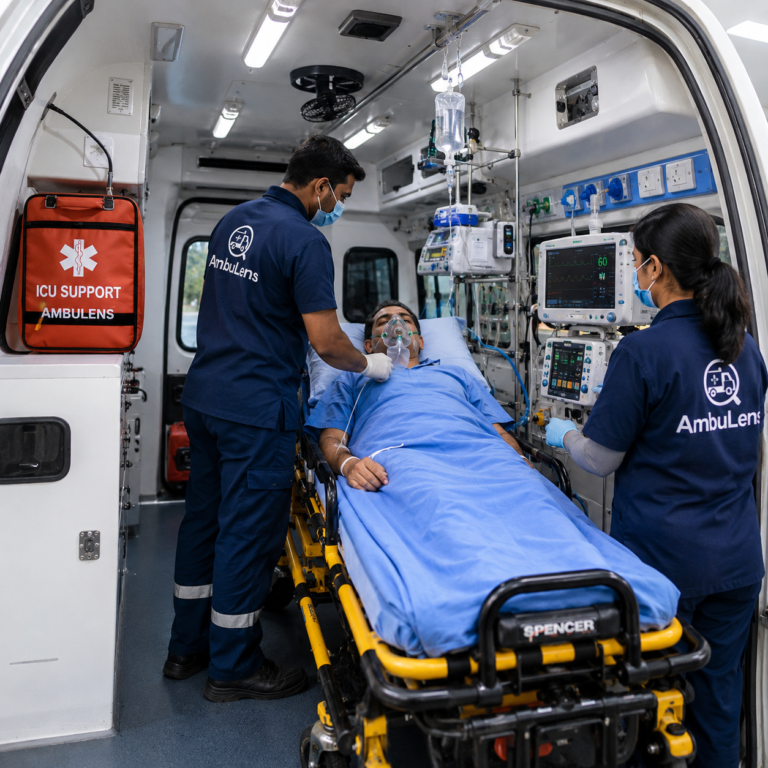
An ICU ambulance may carry:
- Ventilator
- Oxygen supply
- Cardiac monitor
- Defibrillator
- Infusion pumps
- Suction equipment
- Emergency medicines
- ICU stretcher
- Blood-pressure monitoring equipment
- Pulse oximeter
- Airway-management equipment
Not every patient requires every piece of equipment.
The treating medical team should determine the required setup before transportation.
ICU Patient Transfer for Ventilator Patients
Ventilator-dependent patients require special attention.
The ventilator must support the patient’s prescribed respiratory requirements throughout transportation.
The team should confirm:
- Ventilator settings
- Oxygen supply
- Battery or backup power
- Airway security
- Emergency ventilation equipment
- Monitoring equipment
- Medication availability
The receiving ICU should also know the patient’s current ventilator requirements before arrival.
Government patient-safety guidance specifically recognises ventilated patients as medically unstable cases requiring appropriate medical accompaniment during transfer.
ICU Patient Transfer by Road Ambulance
Road transportation is often suitable when the destination is within a manageable driving distance.
A properly equipped ICU ambulance can provide:
- Bed-to-bed transfer
- Ventilator support
- Oxygen
- Cardiac monitoring
- Medical supervision
- Emergency equipment
Road transfer also provides door-to-door access.
For example:
ICU in Mumbai → ICU Ambulance → Hospital in Pune
This can be simpler than arranging airport transportation for shorter distances.
ICU Patient Transfer by Air Ambulance
For long-distance transfers, an air ambulance can reduce travel time.
For example:
Mumbai → Delhi
or
Jaipur → Chennai
or
Hyderabad → Kolkata
An air ambulance can provide a dedicated medical environment for patients who require intensive support during the flight.
AmbuLens states that its air ambulance service provides rapid medical transportation for critically ill or injured patients across long distances.
However, the medical team should first determine whether the patient is fit for air transportation.
ICU Patient Transfer by Train Ambulance
A train ambulance can also be considered for selected long-distance transfers.
This option may suit some patients when:
- The patient is stable enough for rail travel.
- Long-distance transportation is required.
- Continuous medical supervision is needed.
- Air ambulance transportation is not suitable.
- Families require a potentially more economical option.
The exact suitability depends on the patient’s clinical condition.
How Much Does ICU Patient Transfer Cost in India?
There is no single fixed price for ICU patient transfer.
The cost depends on several factors.
1. Distance
Longer journeys generally require more fuel, time, staffing, and operational resources.
2. Ambulance Type
An ICU ambulance usually costs more than a basic patient-transport ambulance.
3. Medical Equipment
Ventilator support and advanced monitoring can affect the final quotation.
4. Medical Team
A doctor, nurse, or critical-care team may be required depending on the patient’s condition.
5. Air or Rail Transportation
Air ambulance transfers usually involve aircraft and airport-related expenses.
Train ambulance transfers have a different cost structure.
6. Ground Ambulance Transfers
For air transfers, the patient may need ambulances at both ends.
Therefore, the final price should be based on the complete journey rather than only the flight or road segment.
AmbuLens notes that medical transportation charges depend on factors such as distance, ambulance type, medical equipment, and location.
What Documents Are Required for ICU Patient Transfer?
Documentation can vary depending on the hospital and patient’s condition.
Families should generally keep:
- Patient identification
- Medical records
- Diagnosis report
- Treatment summary
- Recent investigation reports
- Prescription
- Discharge or transfer summary
- Medication details
- Doctor’s referral
- Insurance documents, if applicable
- Receiving hospital information
The referring hospital should provide a proper clinical summary.
DGHS patient-safety guidance recommends a referral slip containing demographic information, medical history, examination findings, treatment provided, and the reason for referral.
What Should Families Ask Before Booking an ICU Ambulance?
Before arranging transportation, ask the provider:
1. What type of ambulance is required?
Confirm whether the patient needs BLS, ALS, ICU, or ventilator support.
2. Who will accompany the patient?
Ask whether the team includes a doctor, nurse, or paramedic.
3. What equipment is available?
Confirm that the ambulance has the equipment required for the patient’s condition.
4. Is oxygen available?
If the patient needs oxygen, confirm the expected supply and backup arrangements.
5. Can ventilator patients be transported?
If applicable, confirm the ventilator and monitoring setup.
6. Is bed-to-bed transfer available?
This can simplify the journey for critically ill patients.
7. How will the receiving hospital be coordinated?
The receiving ICU should ideally be informed before departure.
Why Bed-to-Bed ICU Transfer Is Important
A bed-to-bed transfer covers the patient’s journey from the current bed to the destination bed.
For example:
Current ICU Bed → ICU Ambulance → Destination Hospital → Receiving ICU Bed
For air transportation:
Current ICU → Ground ICU Ambulance → Airport → Air Ambulance → Destination Airport → Ground ICU Ambulance → Receiving ICU
This approach reduces unnecessary transfers between family members and multiple transportation providers.
It also allows medical teams to coordinate the patient’s care across the journey.
ICU Patient Transfer Between Major Indian Cities
Long-distance ICU transfers happen between many Indian cities.
Common routes may include:
- Mumbai to Delhi
- Mumbai to Jaipur
- Mumbai to Ahmedabad
- Mumbai to Pune
- Mumbai to Bangalore
- Mumbai to Chennai
- Mumbai to Hyderabad
- Mumbai to Kolkata
- Delhi to Mumbai
- Delhi to Jaipur
- Delhi to Chennai
- Jaipur to Delhi
- Hyderabad to Chennai
- Bangalore to Chennai
- Kolkata to Delhi
The appropriate transportation method depends on the patient’s condition, distance, urgency, and available medical facilities.
ICU Patient Transfer in Mumbai
Mumbai has several advanced hospitals and major transport connections.
Patients may require transfers from Mumbai to:
- Delhi
- Jaipur
- Ahmedabad
- Pune
- Bangalore
- Chennai
- Hyderabad
- Kolkata
An ICU ambulance service in Mumbai can provide critical-care ground transportation for suitable routes.
For longer distances, an air ambulance may be considered.
ICU Patient Transfer in Delhi
Delhi is a major healthcare hub for patients requiring specialised treatment.
An ICU patient transfer in Delhi may involve transportation between hospitals or transfer to another state.
Depending on the patient’s condition, road or air ambulance services may be arranged.
ICU Patient Transfer in Jaipur
Patients in Jaipur may require transfer to Delhi, Mumbai, Ahmedabad, or another specialist centre.
An ICU ambulance service in Jaipur can support patients who need monitored transportation.
For long-distance critical transfers, an air ambulance may provide a faster alternative.
ICU Patient Transfer in Chennai
Chennai is an important healthcare destination in South India.
Patients may travel to or from Chennai for specialised treatment.
An ICU patient transfer service in Chennai can coordinate road ambulance, air ambulance, and other medical transportation requirements.
ICU Patient Transfer in Hyderabad
Hyderabad also receives patients from several surrounding cities and states.
An ICU ambulance service in Hyderabad can assist with hospital-to-hospital transfers.
Long-distance cases may require air ambulance coordination.
When Should an ICU Patient Not Be Moved Immediately?
A critically ill patient may sometimes require further stabilisation before transportation.
The treating doctor may first address:
- Airway problems
- Severe oxygenation issues
- Uncontrolled bleeding
- Unstable blood pressure
- Serious cardiac instability
- Other immediately life-threatening conditions
The Ministry of Health recommends stabilising critically ill patients as much as possible before transfer.
However, delaying a necessary transfer can also create risks.
Therefore, the treating medical team must balance stabilisation and timely access to definitive care.
What Happens If the Patient Becomes Unstable During Transfer?
An ICU ambulance should have equipment and trained staff appropriate to the patient’s condition.
If the patient’s condition changes, the accompanying medical team manages the situation within the scope of their clinical training and available equipment.
The receiving hospital should remain informed about significant changes.
This is another reason why choosing an appropriately equipped ambulance matters.
ICU Patient Transfer vs Normal Ambulance Transfer
| Feature | Normal Ambulance | ICU Ambulance |
|---|---|---|
| Patient type | Stable patients | Critical or unstable patients |
| ICU equipment | Limited | Advanced |
| Ventilator | Usually not available | Can be available |
| Cardiac monitoring | Limited | Available |
| Medical team | EMT/paramedic based on service | Higher-level medical support based on condition |
| Long-distance critical transfer | Not always suitable | Designed for appropriate cases |
| Continuous monitoring | Limited | Available |
The ambulance should always match the patient’s medical requirements.
How to Choose an ICU Patient Transfer Service in India
Look for a provider that can offer:
24/7 Availability
Medical emergencies can happen at any time.
Appropriate Medical Equipment
The ambulance should match the patient’s clinical requirements.
Trained Medical Staff
Critical patients require appropriate professional supervision.
Hospital Coordination
The provider should be able to coordinate with the referring and receiving facilities.
Bed-to-Bed Support
This can make the transfer more organised.
Multiple Transportation Options
A provider offering road, air, and other medical transportation options can help families select the most suitable route.
AmbuLens states that it provides 24/7 medical transportation assistance and services across India.
How AmbuLens Helps With ICU Patient Transfers
AmbuLens provides medical transportation support across India.
Its listed services include:
- Air ambulance
- Road ambulance
- Medical support
- Medical travel
- Patient transportation
- Human repatriation
The company serves major cities including Mumbai, Delhi, Bangalore, Kolkata, Hyderabad, Pune, Ahmedabad, Chennai, Jaipur, Lucknow, Bhopal, Indore, Kochi, Nagpur, Bhubaneswar, and Patna.
For ICU transfers, families can provide the patient’s medical details, current location, destination, and transportation requirements. The team can then coordinate the appropriate medical transportation.
Conclusion
Understanding how ICU patient transfer works in India can help families make better decisions during difficult medical situations.
An ICU transfer involves much more than arranging an ambulance. The process includes medical assessment, patient stabilisation, receiving-hospital coordination, appropriate equipment, trained medical staff, transportation planning, continuous monitoring, and clinical handover.
For shorter distances, an ICU road ambulance may be suitable. For long-distance transfers, an air ambulance may provide a faster option. In selected cases, train-based medical transportation may also be considered.
Most importantly, the patient’s medical condition should determine the transportation method.
If you need an ICU Patient Transfer Service in Mumbai, Delhi, Jaipur, Chennai, Hyderabad, Bangalore, Kolkata, or another city in India, professional coordination can help make the journey safer and more organised.
Frequently Asked Questions
1. What is an ICU patient transfer?
An ICU patient transfer is the movement of a critically ill patient from one hospital or care facility to another while maintaining the required level of medical support.
2. Why does an ICU patient need to be transferred?
A patient may need transfer because the current hospital lacks specialised treatment, advanced ICU facilities, specialist doctors, or other resources required for continued care.
3. Can a ventilator patient be transferred by ambulance?
Yes. Ventilator-dependent patients can be transported using an appropriately equipped ICU or ventilator ambulance with suitable medical staff.
4. Can an ICU patient travel by air ambulance?
Yes, selected ICU patients can travel by air ambulance when the treating medical team determines that air transportation is appropriate and safe.
5. What equipment does an ICU ambulance have?
Depending on the service and patient requirements, an ICU ambulance may include a ventilator, oxygen, cardiac monitor, defibrillator, infusion pumps, suction equipment, emergency medicines, and other critical-care equipment.
6. Does a doctor accompany an ICU patient?
The medical team depends on the patient’s condition. A doctor, critical-care professional, nurse, or paramedic may accompany the patient when clinically required.