
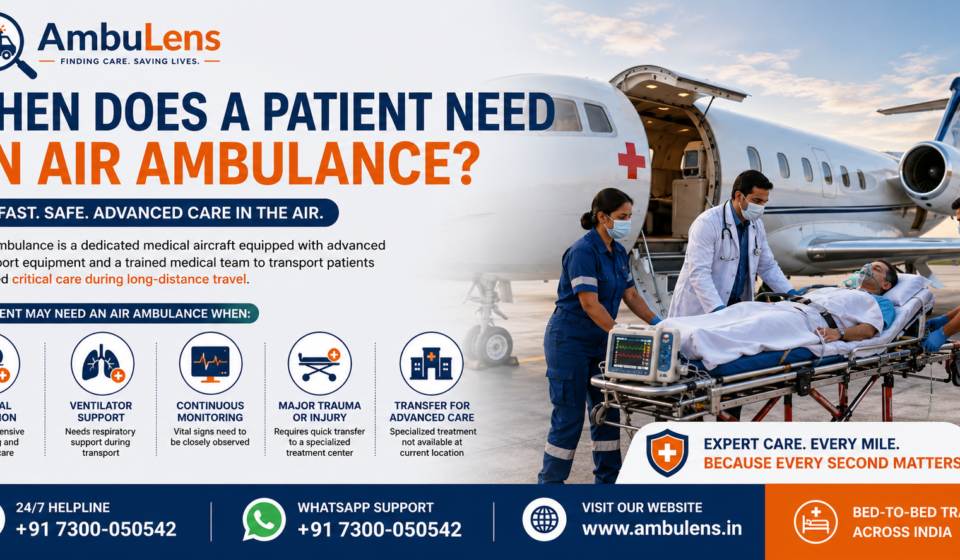

When a patient needs urgent medical transportation over a long distance, choosing the right mode of travel becomes extremely important. In some situations, a regular ambulance or commercial flight may not provide enough medical support.
An air ambulance offers a dedicated medical transportation option for patients who need rapid transfer and continuous medical care during the journey. However, not every patient requires an air ambulance.
So, when does a patient need an air ambulance? The answer depends on the patient’s medical condition, urgency, distance, mobility, required equipment, and level of medical supervision.
AmbuLens provides air ambulance and medical transportation support across major Indian cities, including Mumbai, Delhi, Jaipur, Chennai, Hyderabad, Bangalore, Kolkata, Ahmedabad, Pune, Lucknow, and others.
Important: The decision to transport a patient by air should come after assessment by qualified medical professionals. This article provides general information and does not replace medical advice.
What Is an Air Ambulance?
An air ambulance is a dedicated aircraft used to transport patients who require medical assistance during long-distance travel.
Unlike a regular commercial flight, an air ambulance can be arranged around the patient’s medical requirements. Depending on the case, the aircraft may carry medical equipment and a trained medical team.
Air ambulance arrangements may include:
- Patient stretcher
- Oxygen support
- Cardiac monitoring
- Ventilator support when required
- Infusion equipment
- Emergency medicines
- Doctor or critical-care physician
- Nurse or paramedic
- Ground ambulance transfers
- Hospital-to-hospital coordination
AmbuLens describes its air ambulance service as rapid medical transportation for critically ill or injured patients travelling long distances.
When Does a Patient Need an Air Ambulance?
An air ambulance may become appropriate when a patient’s medical condition makes conventional long-distance transportation unsafe or impractical.
1. The Patient Is Critically Ill
Patients with serious or unstable medical conditions may require continuous medical supervision.
For example, an air ambulance may be considered for patients who need:
- Intensive monitoring
- Advanced medical support
- Continuous oxygen
- Ventilator assistance
- Emergency medication
- Critical-care supervision
In such cases, travelling without adequate medical support can create unnecessary risks.
2. The Patient Requires Ventilator Support
Patients dependent on mechanical ventilation may require specialised transportation.
A dedicated medical aircraft can be equipped according to the patient’s requirements. The medical team can then monitor respiratory status throughout the journey.
However, the exact equipment and staffing should match the patient’s clinical condition.
3. The Patient Needs Continuous Monitoring
Some patients need regular monitoring of vital signs during transportation.
This can include patients with serious cardiac, neurological, respiratory, or other medical conditions.
An air ambulance can provide a controlled medical environment that is better suited to these requirements than ordinary travel.
4. The Patient Has Suffered Major Trauma
Patients with serious injuries may need rapid transportation to a specialised trauma or tertiary-care centre.
For example, an air ambulance may be considered when a patient requires:
- Trauma care
- Emergency surgery
- Neurosurgical treatment
- Orthopaedic intervention
- Intensive care
The treating medical team should determine whether the patient is stable enough for transfer.
5. The Patient Needs Specialised Treatment in Another City
Sometimes the required treatment is unavailable at the patient’s current location.
For example, a patient in Jaipur may need urgent treatment at a specialised centre in Delhi. Similarly, a patient in Mumbai may need to travel to Chennai, Hyderabad, Bangalore, or another city.
When road travel would take too long, an air ambulance may provide a faster transfer option.
When Is Air Ambulance Better Than Road Ambulance?
The choice between air and road transportation depends on several factors.
| Air Ambulance | Road Ambulance |
|---|---|
| Suitable for long-distance transfers | Suitable for short and moderate distances |
| Faster over major distances | More flexible for local transfers |
| Dedicated aircraft | Ground vehicle |
| Can provide specialised in-flight medical support | Can provide ICU support depending on ambulance type |
| Requires airport coordination | Door-to-door access |
| Generally higher cost | Generally lower cost |
For example, transporting a critically ill patient from Mumbai to Delhi by road may take considerably longer than flying.
Therefore, an air ambulance can become a practical option when time is medically important.
When Does a Patient Need an Air Ambulance Instead of a Commercial Flight?
A commercial flight may work for some medically stable patients. However, it may not provide the level of medical support required by critically ill patients.
A medical escort on a commercial flight can be considered for selected stable patients who can safely travel on a scheduled aircraft.
An air ambulance may be more appropriate when the patient:
- Needs intensive medical care
- Requires a stretcher with specialised support
- Needs continuous monitoring
- Requires mechanical ventilation
- Has an unstable medical condition
- Needs advanced medical equipment
- Cannot safely travel as a regular passenger
The DGCA’s accessibility standards specifically address medical passengers and note MEDIF requirements for certain cases, particularly stretcher and critical-illness passengers.
Therefore, families should obtain medical and airline clearance before making commercial flight arrangements for patients with significant medical needs.
Patients Who May Require Air Ambulance Services
Several types of patients may require specialised medical transportation.
Cardiac Patients
Patients with serious cardiac conditions may require close monitoring during transportation.
Depending on the condition, an air ambulance can provide appropriate cardiac monitoring and medical supervision.
Stroke Patients
Stroke patients may need rapid transfer to a hospital equipped for neurological treatment.
Time can be especially important when specialised treatment is required.
However, the patient must first be medically assessed for safe transfer.
Trauma Patients
Patients with severe injuries may need transportation to a trauma centre.
An air ambulance can reduce travel time over long distances while providing medical support during the journey.
Respiratory Patients
Patients with significant breathing difficulties may require oxygen or ventilator support.
For these patients, ordinary commercial travel may not be appropriate.
ICU Patients
Patients who currently require intensive care may need an ICU-level transportation setup.
An air ambulance can be arranged with medical equipment and personnel according to the patient’s needs.
Post-Surgery Patients
Some patients require transfer between hospitals after surgery.
If the patient remains medically complex or requires continuous monitoring, an air ambulance may be considered.
However, stable post-operative patients may have other transportation options.
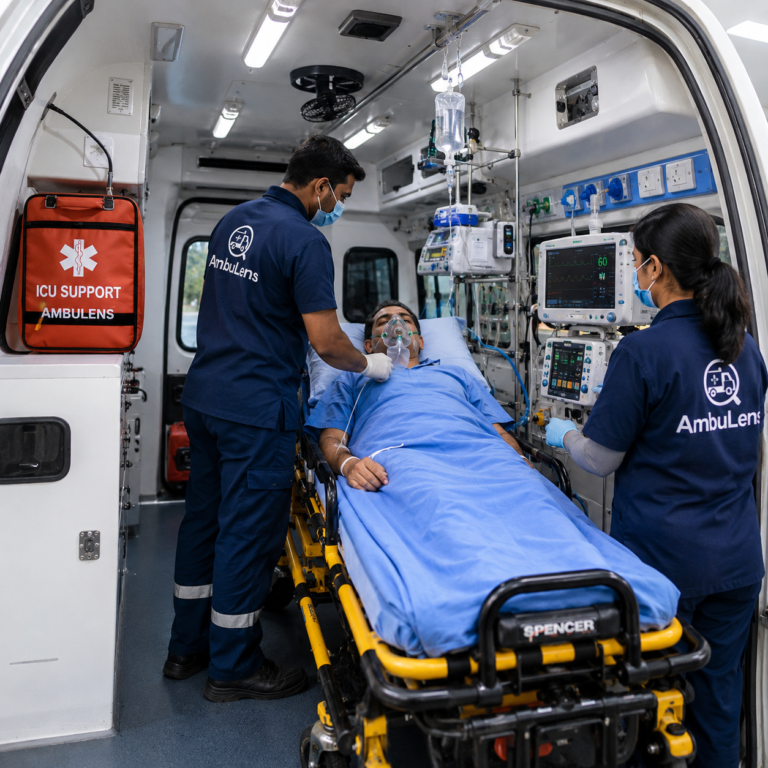
Air Ambulance for Hospital-to-Hospital Transfers
One of the most common reasons for medical air transportation is a hospital-to-hospital transfer.
For example:
Hospital in Mumbai → Ground Ambulance → Airport → Air Ambulance → Destination Airport → Ground Ambulance → Hospital in Delhi
This type of transfer can help patients reach specialised healthcare facilities without relying on lengthy road transportation.
AmbuLens provides medical transportation support and coordinates patient transfers across major Indian cities.
Air Ambulance for Long-Distance Patient Transfers
Distance is an important consideration.
Road transportation can become challenging when the destination is several hundred or thousand kilometres away.
For example, families may consider air ambulance transportation for routes such as:
- Mumbai to Delhi
- Mumbai to Kolkata
- Mumbai to Chennai
- Mumbai to Hyderabad
- Mumbai to Bangalore
- Delhi to Chennai
- Delhi to Mumbai
- Jaipur to Delhi
- Ahmedabad to Mumbai
- Hyderabad to Delhi
The best transportation method still depends on the patient’s condition rather than distance alone.
How Does an Air Ambulance Transfer Work?
A professional air ambulance transfer usually involves several stages.
Step 1: Medical Assessment
First, the patient’s medical condition is reviewed.
The team may evaluate:
- Diagnosis
- Vital signs
- Mobility
- Oxygen requirements
- Ventilator requirements
- Current treatment
- Medications
- Recent procedures
- Risk during transportation
Step 2: Select the Aircraft
The aircraft should match the patient’s medical and logistical requirements.
The choice may depend on:
- Distance
- Aircraft availability
- Patient condition
- Medical equipment
- Airport accessibility
- Flight permissions
Step 3: Arrange the Medical Team
The required medical professionals are selected according to the patient’s condition.
The team may include:
- Doctor
- Critical-care specialist
- Nurse
- Paramedic
Step 4: Prepare Medical Equipment
Required equipment is arranged before departure.
Depending on the patient’s condition, this may include oxygen, monitoring equipment, ventilator support, infusion equipment, and emergency supplies.
Step 5: Ground Ambulance Pickup
A road ambulance transports the patient from the hospital or residence to the departure airport.
Step 6: Air Transfer
The patient is transferred to the air ambulance.
The medical team monitors and supports the patient during the flight.
Step 7: Destination Transfer
After landing, another ambulance can transport the patient to the receiving hospital.
This creates a bed-to-bed medical transfer.
What Medical Equipment Can an Air Ambulance Carry?
Equipment depends on the patient’s medical requirements and the aircraft configuration.
Possible equipment may include:
- ICU stretcher
- Ventilator
- Oxygen system
- Cardiac monitor
- Defibrillator
- Infusion pumps
- Suction equipment
- Emergency medication
- Monitoring devices
Not every patient requires every piece of equipment. The medical team should determine what is necessary before departure.
Air Ambulance for Ventilator Patients
Ventilator-dependent patients often need a higher level of transportation support.
A dedicated air ambulance can be equipped with an appropriate ventilator and monitoring system.
Moreover, the medical team can continuously observe the patient during the transfer.
Because these cases involve significant medical complexity, the treating team should carefully assess whether the patient can safely tolerate the flight.
Air Ambulance for Elderly Patients
Age alone does not mean that a patient needs an air ambulance.
An elderly patient who is medically stable may be able to travel through other transportation options.
However, an air ambulance may become appropriate when an older patient has a serious condition requiring:
- Continuous medical monitoring
- Oxygen support
- Ventilator assistance
- Intensive care
- Stretcher transportation
- Specialist medical supervision
Therefore, the decision should focus on the patient’s health rather than age alone.
Air Ambulance vs Medical Escort
Families often confuse these two services.
A medical escort generally involves a doctor, nurse, paramedic, or trained medical attendant accompanying a suitable patient on a scheduled commercial flight.
An air ambulance uses a dedicated medical aircraft.
| Factor | Air Ambulance | Medical Escort |
|---|---|---|
| Aircraft | Dedicated medical aircraft | Commercial aircraft |
| Patient condition | Critical or complex cases | Generally stable cases |
| ICU support | Available depending on setup | Limited |
| Ventilator support | Can be arranged | Usually not suitable |
| Medical team | Based on clinical needs | Doctor, nurse, or paramedic |
| Cost | Generally higher | Generally lower |
| Flight schedule | Dedicated arrangement | Commercial schedule |
| Best for | Critical transfers | Stable assisted travel |
Therefore, families should not choose a medical escort simply because it costs less.
Air Ambulance Cost in India
There is no single fixed price for an air ambulance.
The final cost depends on multiple factors.
Distance
Longer journeys can increase operational expenses.
Patient Condition
Critical patients may require additional medical equipment or specialised personnel.
Aircraft Type
Different aircraft have different operating costs and capabilities.
Medical Team
A critical-care physician and additional medical staff can affect the total cost.
Ground Ambulance
Airport pickup and destination transfer can also add to the final quotation.
Airport and Operational Charges
Aircraft positioning, landing arrangements, permissions, and other operational requirements may influence the cost.
AmbuLens notes that air ambulance pricing depends on factors such as destination, patient condition, aircraft type, medical equipment, and medical team requirements.
Therefore, families should request a case-specific quotation instead of relying on a general online price.
When Is a Train Ambulance a Better Option?
An air ambulance is not always the only option for long-distance medical transportation.
A train ambulance may be considered for selected patients when:
- The patient is stable enough for train travel.
- The journey is long.
- Continuous medical supervision is needed.
- Cost is an important consideration.
- Air transportation is not suitable.
AmbuLens also provides train ambulance arrangements for long-distance medical transfers.
The treating doctor should help determine whether the patient can safely travel by train.
When Is a Road ICU Ambulance Better?
A road ICU ambulance may be more appropriate when:
- The destination is relatively close.
- The patient requires ICU-level support.
- Door-to-door transportation is important.
- Airport transfer would add unnecessary complexity.
- The patient can safely tolerate the road journey.
For example, a patient travelling between nearby cities may not benefit from air transportation if a properly equipped ICU road ambulance can complete the journey safely.
How to Decide If a Patient Needs an Air Ambulance
Consider these questions:
Is the Patient Critically Ill?
If yes, specialised medical transportation may be required.
Does the Patient Need Continuous Monitoring?
If yes, an air ambulance may provide a more appropriate environment.
Does the Patient Need Ventilator Support?
If yes, a dedicated medical aircraft may be considered.
Is the Destination Far Away?
If road travel would take significantly longer, air transportation may be beneficial.
Does the Patient Need Specialised Treatment?
If the required treatment is available only at a distant medical centre, an air ambulance may help reduce transportation time.
Can the Patient Safely Travel on a Commercial Flight?
If not, an air ambulance may be a more appropriate option.
Medical Escort or Air Ambulance: A Simple Guide
A simple rule can help families understand the difference:
Stable patient + commercial flight suitable + assistance required = Medical Escort may be considered
Critical patient + advanced medical support required = Air Ambulance may be considered
However, this should not replace a professional medical assessment.
Air Ambulance Services in Major Indian Cities
AmbuLens serves patients across several major Indian cities, including:
- Mumbai
- Delhi
- Jaipur
- Ahmedabad
- Bangalore
- Chennai
- Hyderabad
- Kolkata
- Pune
- Lucknow
- Bhopal
- Indore
- Kochi
- Nagpur
- Bhubaneswar
- Patna
The company states that it provides air ambulance and patient transportation support across India.
Air Ambulance Service in Mumbai
Patients in Mumbai can require air transportation to Delhi, Jaipur, Ahmedabad, Chennai, Bangalore, Hyderabad, Kolkata, and other destinations.
Air Ambulance Service in Delhi
Delhi’s major hospitals and airports make it an important location for interstate patient transfers.
Air Ambulance Service in Jaipur
Patients from Jaipur may require rapid transfer to Delhi, Mumbai, Ahmedabad, or other medical centres.
Air Ambulance Service in Chennai
Chennai serves as an important healthcare destination in South India and connects with cities across the country.
Air Ambulance Service in Hyderabad
Patients requiring specialised treatment may need transportation between Hyderabad and other major healthcare hubs.
Documents Required for an Air Ambulance
Documentation depends on the patient’s condition and the transfer arrangements.
Families should generally keep the following ready:
- Patient identification
- Medical records
- Recent medical summary
- Diagnosis details
- Prescription
- Discharge summary, if available
- Treating doctor’s information
- Insurance information, if applicable
- Receiving hospital details
- Consent documents
The exact documents can vary according to the case.
How to Arrange an Air Ambulance
During an emergency, preparation can save valuable time.
Keep the following information ready:
- Patient’s name and age
- Current location
- Destination
- Medical condition
- Current hospital
- Treating doctor’s details
- Recent medical records
- Oxygen requirements
- Ventilator requirements
- Preferred transfer date and time
After receiving these details, the medical transportation team can assess the case and recommend the appropriate option.
Why Choose AmbuLens for Air Ambulance Services?
AmbuLens provides emergency medical transportation support across India.
Its services include:
- Air ambulance
- Road ambulance
- Medical travel
- Train ambulance
- Medical support
- Human repatriation
- Hospital-to-hospital transfers
The company also states that its air ambulance service provides 24/7 assistance and supports long-distance transportation for critically ill or injured patients.
For families, this means one team can help coordinate different stages of the patient’s journey.
Conclusion
Knowing when a patient needs an air ambulance can help families make informed decisions during stressful medical situations.
An air ambulance may be appropriate when a patient requires rapid long-distance transportation, continuous medical monitoring, ventilator support, specialised equipment, or critical-care assistance.
However, not every patient needs an air ambulance. Stable patients may sometimes travel by commercial flight with a medical escort, while other patients may be suitable for road or train ambulance transportation.
Therefore, the patient’s medical condition should always come before cost or convenience.
If you need an Air Ambulance Service in Mumbai, Delhi, Jaipur, Chennai, Hyderabad, Bangalore, Kolkata, or another Indian city, professional medical assessment can help determine the safest transportation option.
Frequently Asked Questions
1. When does a patient need an air ambulance?
A patient may need an air ambulance when they require rapid long-distance transportation along with continuous medical monitoring or specialised medical support.
2. Is an air ambulance only for critical patients?
Air ambulances are commonly used for critically ill or medically complex patients. However, the appropriate transportation method depends on the individual patient’s condition and medical requirements.
3. Can ventilator patients travel by air ambulance?
Yes, air ambulance arrangements can be made for some ventilator-dependent patients with appropriate equipment and medical staff. The patient’s medical team must first assess whether air transfer is safe.
4. Is an air ambulance faster than a road ambulance?
For long-distance transfers, air transportation can significantly reduce travel time. However, total journey time also includes ground ambulance transfers, airport coordination, and aircraft arrangements.
5. Is an air ambulance safer than a commercial flight for critical patients?
A dedicated air ambulance can provide a medical environment designed around the patient’s requirements. Therefore, it may be more appropriate for patients who cannot safely travel as regular commercial passengers.