
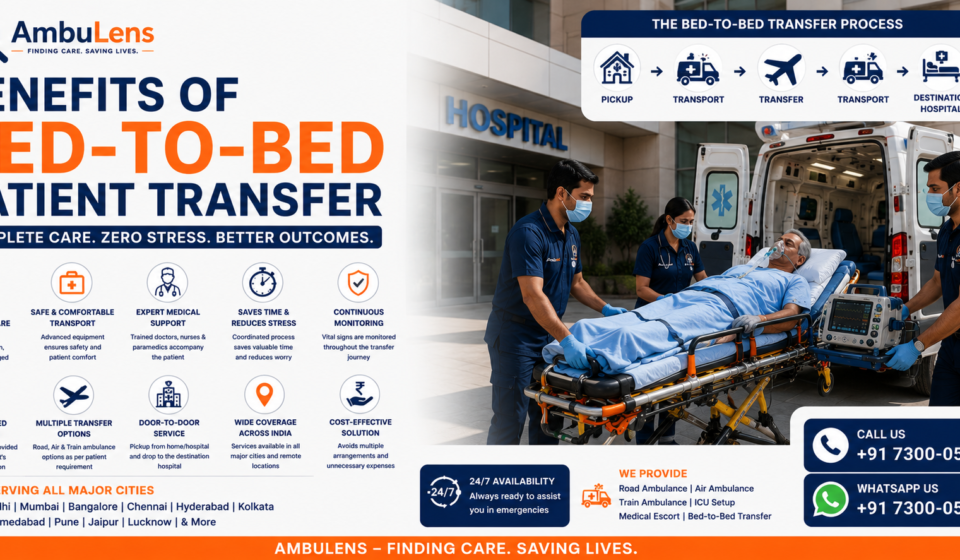

Medical transportation can become challenging when a patient needs to move from one hospital to another. The journey becomes even more difficult when the patient has limited mobility or requires medical supervision.
A bed-to-bed patient transfer provides a coordinated solution. The patient receives support from the starting hospital until arrival at the destination hospital. Therefore, families do not need to manage every stage of transportation themselves.
This service can include hospital coordination, ground ambulance, airport assistance, medical escort, air ambulance, and destination hospital handover.
What Is Bed-to-Bed Patient Transfer?
Bed-to-bed patient transfer means transporting a patient from their current hospital bed to the bed at the receiving hospital.
The process can involve several transportation stages:
Current Hospital → Ambulance → Airport → Air Ambulance/Commercial Flight → Destination Ambulance → Receiving Hospital
The exact route depends on the patient’s medical condition, distance, urgency, and transportation requirements.
For shorter routes, a Road Ambulance Service may provide the complete transfer.
For longer distances, an Air Ambulance Service or commercial medical escort may be considered.
Key Benefits of Bed-to-Bed Patient Transfer
1. Complete Journey Coordination
One of the biggest benefits is coordinated transportation.
Families may otherwise need to arrange an ambulance, airport assistance, flight, and destination transport separately.
With bed-to-bed coordination, these stages can be planned together. As a result, the patient’s journey becomes easier to manage.
2. Reduced Stress for Families
Patient transportation can create significant pressure for family members.
They may need to manage:
- Hospital communication
- Ambulance booking
- Medical documents
- Airport arrangements
- Flight coordination
- Destination transportation
A coordinated transfer reduces these responsibilities.
Therefore, families can focus more on supporting the patient.
3. Continuous Medical Support
Some patients cannot travel without professional assistance.
Depending on the patient’s condition, the transfer may include:
- Doctor
- ICU nurse
- Paramedic
- Medical escort
- Critical care team
The level of support depends on the medical assessment.
For critically ill patients, an ICU Ambulance Service may be required.
4. Safer Hospital-to-Hospital Movement
Moving a patient between hospitals involves more than simply arranging transportation.
The medical team needs to consider the patient’s condition, mobility, equipment, medication, and monitoring needs.
A coordinated bed-to-bed transfer helps connect the medical and transportation teams.
Consequently, unnecessary gaps during the journey can be reduced.
5. Suitable for Long-Distance Transfers
Bed-to-bed services can support both local and long-distance transportation.
For example, patients may travel between:
- Jaipur and Delhi
- Jaipur and Mumbai
- Mumbai and Delhi
- Delhi and Chennai
- Hyderabad and Mumbai
- Ahmedabad and Delhi
For long-distance critical transfers, an Air Ambulance Service in Jaipur can provide specialised medical transportation.
6. Better Support for Critical Patients
Critical patients may require continuous medical attention during transportation.
For example, patients with respiratory failure, serious trauma, neurological conditions, or cardiac problems may require advanced support.
An ICU-equipped ambulance or air ambulance can provide appropriate equipment and trained professionals.
For more information, read How ICU Patient Transfer Works in India.
7. Support for Patients With Limited Mobility
Some patients cannot walk or sit without assistance.
Bed-to-bed transportation can support patients who require:
- Wheelchair assistance
- Stretcher transportation
- Patient lifting
- Ambulance transfer
- Airport assistance
- Medical supervision
This support can make the overall journey more comfortable and organised.
8. Smooth Airport Transfers
Air travel adds another layer to medical transportation.
A patient may need assistance while moving from the hospital to the airport. After landing, the patient may also need immediate transportation to the receiving hospital.
Bed-to-bed coordination connects these stages.
Therefore, families do not have to arrange separate transportation at each airport.
Who May Need Bed-to-Bed Patient Transfer?
Bed-to-bed transportation can benefit different types of patients.
Critical Care Patients
Patients requiring intensive medical supervision may need coordinated transportation between hospitals.
Post-Surgery Patients
Patients recovering from major procedures may need assistance during intercity travel.
Elderly Patients
Older patients may require additional mobility and medical support.
Ventilator-Dependent Patients
Patients who depend on ventilator support require specialised transportation and careful medical planning.
Patients Seeking Specialised Treatment
Some patients travel to another city because a particular treatment or specialist is unavailable locally.
Patients Returning Home
Patients who complete treatment may require assistance while travelling back to their home city.
Bed-to-Bed Transfer Options
The best transportation method depends on the patient’s condition and journey distance.
Road Ambulance
Road ambulance services can work well for shorter distances and locations with good road connectivity.
AmbuLens provides Road Ambulance Services in Jaipur and supports patient transportation across different locations.
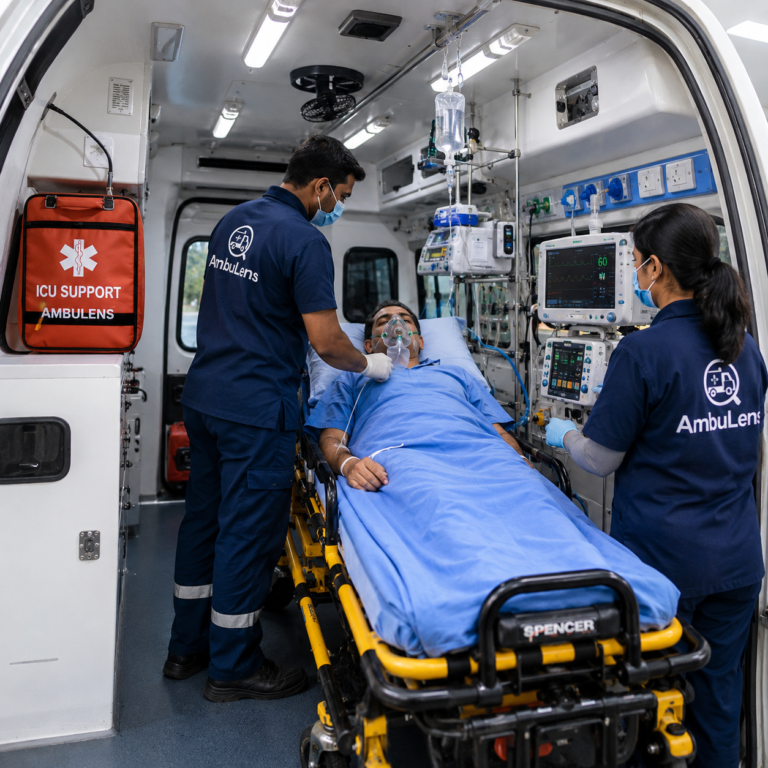
ICU Ambulance
An ICU ambulance may be appropriate when a patient needs continuous critical-care support during road transportation.
It can include advanced equipment and trained medical professionals.
Air Ambulance
For long-distance critical transfers, an air ambulance can reduce travel time.
It can also provide ICU-level medical support during the flight.
Commercial Medical Escort
Medically stable patients may sometimes travel on commercial flights with a trained medical professional.
Read Commercial Flight Medical Escort Service in India to understand this option.
How Does Bed-to-Bed Patient Transfer Work?
A coordinated transfer generally follows these steps.
Step 1: Patient Assessment
The medical team reviews the patient’s condition and transportation needs.
Step 2: Destination Confirmation
The receiving hospital and treatment requirements are confirmed.
Step 3: Transportation Planning
The suitable ambulance, aircraft, medical team, and equipment are arranged.
Step 4: Hospital Pickup
The patient is transferred from the hospital bed to the appropriate ambulance.
Step 5: Main Transportation
The patient travels by road, air ambulance, or commercial flight, depending on medical suitability.
Step 6: Destination Pickup
A destination ambulance receives the patient when required.
Step 7: Hospital Handover
The patient reaches the receiving hospital and is handed over to the medical team.
This process creates a connected transportation journey from one hospital bed to another.
Bed-to-Bed Patient Transfer in Jaipur
Patients in Jaipur may require transportation to major healthcare centres in Delhi, Mumbai, Ahmedabad, Bangalore, Chennai, or other cities.
AmbuLens can coordinate different transportation options according to the patient’s requirements.
For critical cases, families can also explore the Air Ambulance Service in Jaipur.
For road-based transportation, the Road Ambulance Service in Jaipur can be considered.
Bed-to-Bed Patient Transfer in Mumbai
Mumbai is a major healthcare destination for specialised treatment.
Patients arriving from other cities may need airport-to-hospital transportation after landing.
Similarly, patients leaving Mumbai may require hospital pickup and airport coordination.
A coordinated bed-to-bed service can connect these stages and reduce transportation-related stress.
What Factors Affect Bed-to-Bed Patient Transfer?
Several factors influence transportation planning.
Patient Condition
The patient’s medical condition determines the level of support required.
Distance
Short-distance journeys may suit road ambulances. Longer transfers may require air transportation.
Medical Equipment
Ventilator support, oxygen, cardiac monitoring, and other requirements affect planning.
Medical Team
Some patients may need a doctor, ICU nurse, paramedic, or medical escort.
Destination Hospital
The receiving hospital should be prepared to accept the patient.
Travel Requirements
Air travel may involve airline approvals, medical documents, and airport coordination.
Why Choose AmbuLens for Bed-to-Bed Patient Transfer?
AmbuLens provides coordinated medical transportation support across India and internationally.
Services can include:
- Air ambulance
- Road ambulance
- ICU ambulance
- Ventilator ambulance
- Medical escort
- Hospital-to-hospital transfer
- Airport transfer
- Medical travel assistance
The team can help coordinate transportation according to the patient’s medical requirements and destination.
You can also explore the Medical Transportation Service for broader patient travel assistance.
Conclusion
Bed-to-bed patient transfer provides a coordinated approach to medical transportation.
It can reduce family stress, support continuous medical care, simplify airport transfers, and connect hospital pickup with destination handover.
Moreover, patients can receive the appropriate transportation based on their medical condition. Road ambulances, ICU ambulances, air ambulances, and commercial medical escorts can all play a role.
However, the safest option should always depend on a proper medical assessment. The patient’s condition, distance, equipment requirements, and destination should guide the final transportation plan.
Frequently Asked Questions
1. What does bed-to-bed patient transfer mean?
Bed-to-bed patient transfer means moving a patient from their current hospital bed to the bed at the receiving hospital with coordinated transportation support.
2. Who can use bed-to-bed patient transportation?
Patients requiring hospital-to-hospital transportation can use this service. It can support stable patients, elderly patients, post-surgery patients, and critical-care patients.
3. Can bed-to-bed transfer include an air ambulance?
Yes. An air ambulance can form part of a bed-to-bed transfer for patients who require medically supervised long-distance transportation.
4. Can ventilator patients receive bed-to-bed transportation?
Yes, ventilator-dependent patients can receive specialised transportation. However, the medical team must assess the patient before selecting the appropriate transport method.
5. Is bed-to-bed transfer available in Jaipur?
Yes. Bed-to-bed patient transportation can be coordinated in Jaipur and between Jaipur and other cities, depending on the patient’s requirements.