
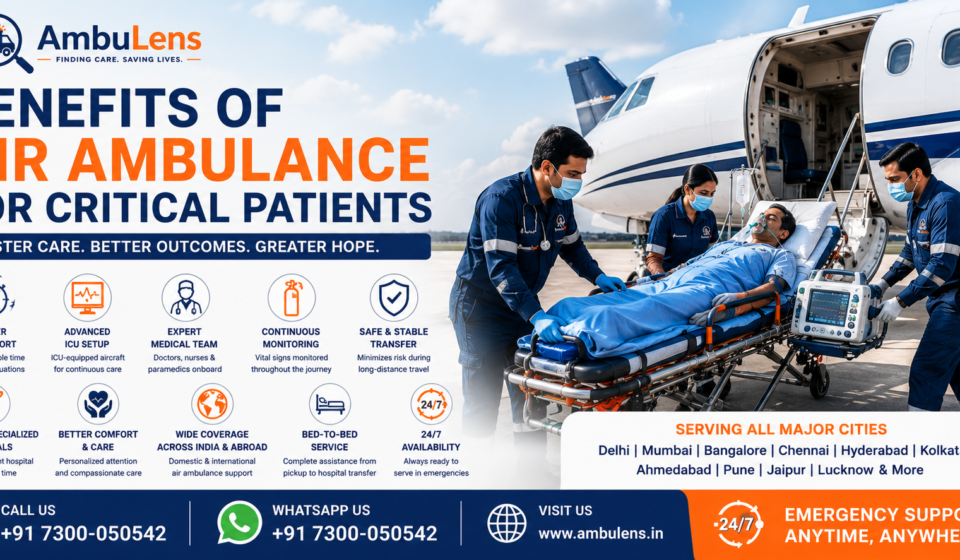

When a patient faces a critical medical condition, every minute can matter. Long-distance transportation can become difficult when the patient needs continuous medical care.
In such situations, an air ambulance for critical patients can provide faster and medically supervised transportation. Unlike standard travel, an air ambulance carries the patient in a dedicated medical aircraft. It also provides equipment and trained medical professionals during the journey.
Therefore, families can arrange safer transfers when specialised treatment is required in another city or country.
What Is an Air Ambulance for Critical Patients?
An air ambulance is a specially equipped aircraft used to transport patients who require medical supervision during travel.
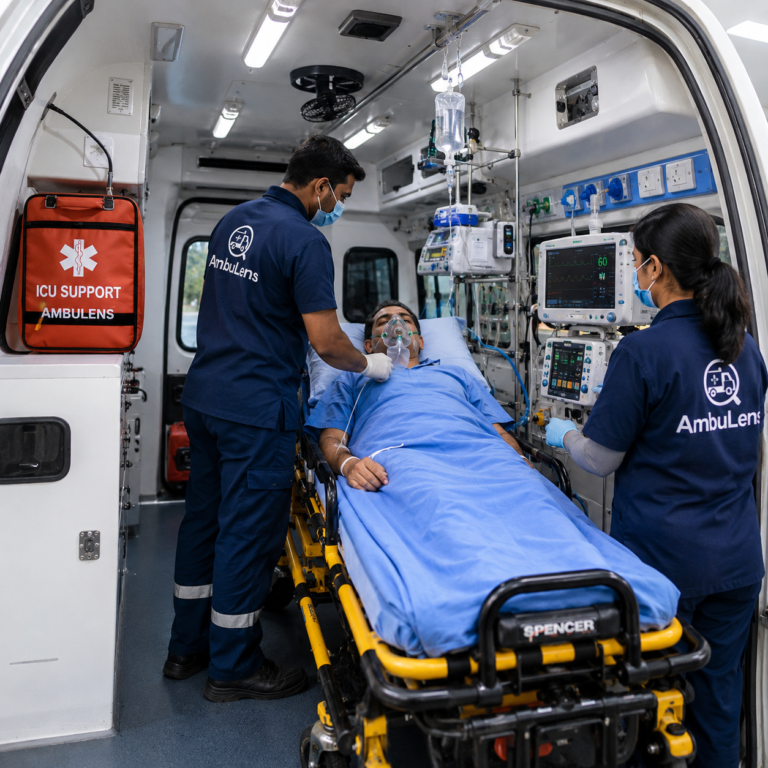
Depending on the patient’s condition, the aircraft may include:
- ICU equipment
- Ventilator support
- Oxygen supply
- Cardiac monitoring
- Infusion pumps
- Suction equipment
- Emergency medicines
- Patient stretcher
A medical team can also accompany the patient. The team may include critical care doctors, nurses, paramedics, or other trained professionals.
However, the exact equipment and medical team depend on the patient’s condition and transfer requirements.
Major Benefits of Air Ambulance for Critical Patients
1. Faster Long-Distance Patient Transfer
One of the biggest benefits of an air ambulance is reduced travel time.
Road transportation can take several hours between distant cities. Traffic, road conditions, and long distances can further increase the journey time.
By comparison, air transportation can connect major cities much faster. Therefore, critical patients may reach specialised medical facilities sooner.
For example, patients may require transfers between Jaipur and Delhi, Mumbai and Delhi, or Jaipur and Mumbai.
2. Continuous Medical Monitoring
Critical patients may require continuous observation during transportation.
An air ambulance allows the medical team to monitor important parameters throughout the journey. Depending on the patient’s condition, monitoring may include heart rate, oxygen saturation, blood pressure, and other vital signs.
As a result, the patient receives medical attention throughout the transfer instead of travelling without professional supervision.
3. Advanced ICU Equipment During Travel
Critical patients may require more than basic transportation support.
An ICU-equipped air ambulance can carry advanced medical equipment. This equipment may support patients who require respiratory assistance, cardiac monitoring, oxygen, or other critical-care support.
For instance, ventilator-dependent patients may need specialised equipment throughout the journey.
You can learn more about Air Ambulance Services in India and the medical support available for long-distance transfers.
4. Suitable for Ventilator-Dependent Patients
Some critically ill patients cannot travel without respiratory support.
In such cases, a properly equipped air ambulance can provide ventilator support during transportation. The medical team can monitor the patient and manage the equipment throughout the journey.
However, every ventilator patient requires individual medical assessment before transportation.
For related information, read our guide on How to Shift a Ventilator Patient Safely.
5. Access to Specialised Treatment
Patients sometimes need treatment that may not be available locally.
For example, a patient in Jaipur may need specialised treatment in Delhi or Mumbai. Similarly, patients from smaller cities may need transportation to major healthcare centres.
An air ambulance can support such transfers while providing medical care during the journey.
Therefore, families can consider air transportation when distance makes road travel unsuitable.
6. Bed-to-Bed Patient Transfer
Air ambulance transportation does not have to start or finish at the airport.
A coordinated bed-to-bed patient transfer can include:
Hospital → Ground Ambulance → Airport → Air Ambulance → Destination Airport → Ground Ambulance → Hospital
This approach reduces the burden on families. Moreover, professional coordination can help connect different stages of the patient’s journey.
7. Medical Team During the Journey
Another important benefit is the presence of trained medical professionals.
Depending on the patient’s requirements, the team may include:
- Critical care doctor
- Emergency physician
- ICU nurse
- ALS paramedic
- Respiratory therapist
The team can monitor the patient and provide appropriate medical support during transportation.
However, the final team composition depends on the medical assessment.
8. Better Option for Time-Sensitive Transfers
Some medical transfers require careful timing.
Patients with serious conditions may need specialised treatment without unnecessary travel delays. Therefore, air transportation can become valuable when distance creates a major challenge.
The treating doctor should always assess whether air transportation is medically appropriate.
Which Critical Patients May Need an Air Ambulance?
An air ambulance may be considered for patients with conditions such as:
Cardiac Emergencies
Patients requiring specialised cardiac treatment may need rapid transportation between cities.
Stroke and Neurological Conditions
Patients with serious neurological conditions may require specialised hospitals and continuous medical supervision.
Severe Trauma
Patients with major injuries may require advanced monitoring and critical-care transportation.
Respiratory Failure
Patients requiring ventilator or advanced respiratory support may need an ICU-equipped air ambulance.
Post-Surgical Complications
Some patients may require transfer to a specialised facility after surgery.
Organ Failure
Patients with serious organ-related conditions may need specialised treatment and continuous monitoring.
The suitability of air ambulance transportation should always be decided after medical evaluation.
Air Ambulance Services in Major Indian Cities
Air Ambulance Service in Jaipur
An Air Ambulance Service in Jaipur can support critical patients travelling from Jaipur to major healthcare centres across India.
Common destinations can include Delhi, Mumbai, Bangalore, Chennai, Hyderabad, Ahmedabad, Kolkata, and other cities.
Air Ambulance Service in Mumbai
Patients in Mumbai may require air transportation when specialised treatment is needed outside the city.
A coordinated transfer can include hospital pickup, airport coordination, medical flight support, and destination ambulance transportation.
Air Ambulance Service in Delhi
Delhi is an important healthcare destination for patients requiring specialised treatment.
Patients from Jaipur, Lucknow, Chandigarh, Ahmedabad, and other cities may require medically supervised air transportation to Delhi.
Air Ambulance Service for Intercity Transfers
Air ambulances can support long-distance transfers across India.
For example:
- Jaipur to Delhi
- Jaipur to Mumbai
- Mumbai to Delhi
- Delhi to Chennai
- Hyderabad to Mumbai
- Ahmedabad to Delhi
The best transportation option depends on the patient’s condition, distance, urgency, and medical requirements.
Air Ambulance vs Road Ambulance for Critical Patients
Both transportation methods can support patients. However, they serve different situations.
| Feature | Air Ambulance | Road Ambulance |
|---|---|---|
| Best for | Long-distance transfers | Shorter or accessible routes |
| Travel time | Usually faster over long distances | Depends on road conditions |
| Medical support | ICU-level options available | Basic to ICU options available |
| Traffic impact | Minimal | Can affect journey time |
| Patient monitoring | Continuous medical supervision | Continuous medical supervision |
| Destination reach | Requires airport coordination | Direct road access |
For road-based transfers, you can explore the Road Ambulance Service offered by AmbuLens.
What Factors Affect Air Ambulance Planning?
Several factors should be considered before arranging an air ambulance.
Patient Condition
The patient’s diagnosis and current stability determine the required medical setup.
Distance and Destination
Longer distances may require different aircraft and operational planning.
Medical Equipment
Ventilator support, oxygen, monitoring equipment, and other requirements can affect the arrangement.
Medical Team
The required number and type of medical professionals depend on the patient’s condition.
Ground Transportation
Ground ambulances may be required at both departure and destination locations.
Airport Coordination
The medical transfer team needs to coordinate airport-related requirements before departure.
How Does an Air Ambulance Transfer Work?
The process generally follows several stages.
1. Medical Assessment
The medical team reviews the patient’s condition and transportation requirements.
2. Flight Planning
The appropriate aircraft and medical equipment are arranged according to the assessment.
3. Ground Ambulance Pickup
A suitable ambulance transfers the patient from the hospital to the departure airport.
4. Medical Flight
The patient travels with the required medical team and equipment.
5. Destination Transfer
A ground ambulance receives the patient at the destination airport.
6. Hospital Handover
The patient is transferred to the receiving hospital and medical team.
This coordinated approach helps maintain continuity of care throughout the journey.
Why Choose AmbuLens for Critical Patient Transfers?
AmbuLens provides medical transportation support across India and internationally.
The service network can support:
- Air ambulance
- ICU ambulance
- Ventilator ambulance
- Road ambulance
- Medical escort
- Hospital-to-hospital transfers
- Airport transfers
- Patient transportation
For patients requiring intensive care during road travel, explore the ICU Ambulance Service in Jaipur.
You can also read our Complete Guide to Air Ambulance Services in India for more information about equipment, medical teams, routes, and planning.
Conclusion
An air ambulance can provide important benefits for critical patients who need long-distance medical transportation.
It can reduce travel time, provide continuous monitoring, carry advanced medical equipment, and support specialised medical teams. Moreover, bed-to-bed coordination can make the entire transfer easier for patients and families.
However, air ambulance transportation should always follow a proper medical assessment. The patient’s condition, equipment needs, destination, and travel distance should guide the transportation decision.
Frequently Asked Questions
1. What are the main benefits of an air ambulance for critical patients?
The main benefits include faster long-distance transportation, continuous medical monitoring, ICU equipment, trained medical professionals, and coordinated bed-to-bed transfers.
2. Can an air ambulance transport ventilator patients?
Yes, an appropriately equipped air ambulance can support ventilator-dependent patients. However, medical assessment must be completed before transportation.
3. Is an air ambulance faster than a road ambulance?
For long-distance transfers, air transportation can significantly reduce travel time. However, total transfer time also includes ground transportation and airport coordination.
4. Can air ambulance services operate from Jaipur?
Yes. Air ambulance services can be arranged from Jaipur for transfers to cities such as Delhi, Mumbai, Chennai, Bangalore, Hyderabad, and other destinations.
5. Can an air ambulance provide bed-to-bed transportation?
Yes. A coordinated transfer can include hospital pickup, ground ambulance, medical flight, destination ambulance, and hospital handover.