
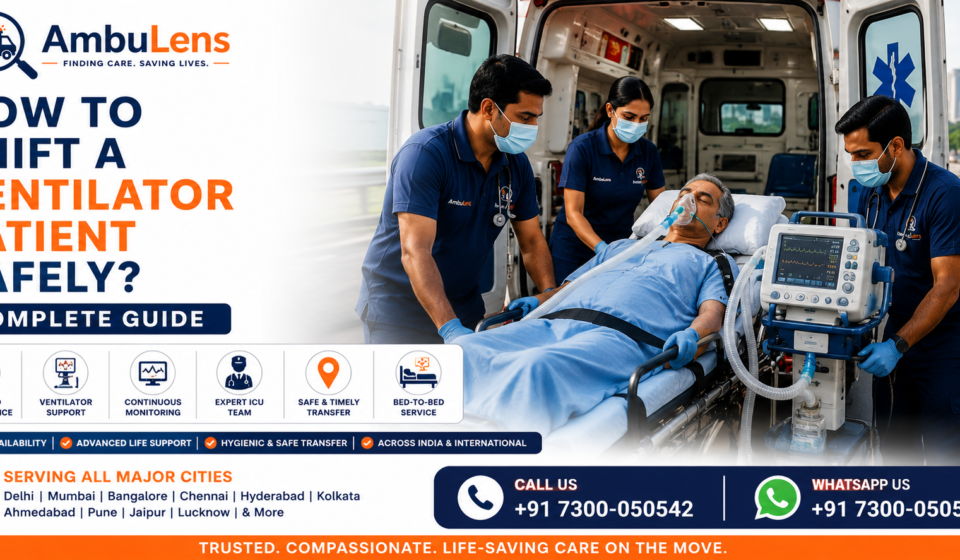

Moving a patient who depends on a ventilator requires careful planning, medical supervision, and the right equipment. A ventilator supports breathing, so the transfer team must maintain respiratory support throughout the journey.
Whether the patient needs a transfer within Jaipur, from Jaipur to Delhi, or between Mumbai and another city, families should never arrange a regular vehicle for a ventilator-dependent patient.
Instead, the treating doctor should assess the patient first. Then, the medical transportation team can select the right ambulance, equipment, medical staff, and travel route.
Important: Ventilator patient transfers should follow the treating doctor’s advice and a professional medical transport plan. The information below is general guidance and does not replace medical advice.
What Is a Ventilator Patient Transfer?
A ventilator patient transfer means moving a patient who requires mechanical ventilation from one location to another while continuing the required respiratory and medical support.
The transfer may happen:
- From one hospital to another
- From ICU to ICU
- From Jaipur to Delhi
- From Mumbai to Pune
- From Jaipur to Mumbai
- Between different states
- From a hospital to a specialised treatment centre
The main goal is continuity of critical care.
Therefore, the team must plan the patient’s airway, ventilation, oxygen supply, monitoring, medicines, and emergency support before starting the journey.
Why Does a Ventilator Patient Need Special Transportation?
A ventilator-dependent patient may not be able to breathe adequately without mechanical support.
Consequently, even a short interruption in respiratory support can create a serious medical emergency.
A specialised transfer helps provide:
- Continuous ventilator support
- Oxygen supply
- Vital-sign monitoring
- Airway management
- Medication support
- Emergency equipment
- Trained medical professionals
AmbuLens lists ventilator ambulances with ICU ventilators, oxygen support, critical-care equipment, and trained medical professionals for patient transportation.
Step-by-Step Guide to Shifting a Ventilator Patient Safely
1. Get Medical Clearance First
The treating doctor should assess the patient before transportation.
The medical team may review:
- Current diagnosis
- Respiratory condition
- Oxygen saturation
- Blood pressure
- Heart rate
- Ventilator settings
- Current medications
- Recent procedures
- Overall stability
The doctor can then determine whether transportation is appropriate and what level of support the patient needs.
2. Confirm the Receiving Hospital
Before leaving the current hospital, confirm the destination hospital.
This becomes especially important when the patient needs ICU admission.
The receiving hospital should know:
- Patient diagnosis
- Current medical condition
- Ventilator requirement
- Expected arrival time
- Required ICU facilities
- Current treatment
- Important medical history
This coordination can help reduce delays after arrival.
3. Choose a Ventilator Ambulance
A regular ambulance may not provide the equipment required for a ventilator-dependent patient.
Instead, consider a specialised Ventilator Ambulance Service.
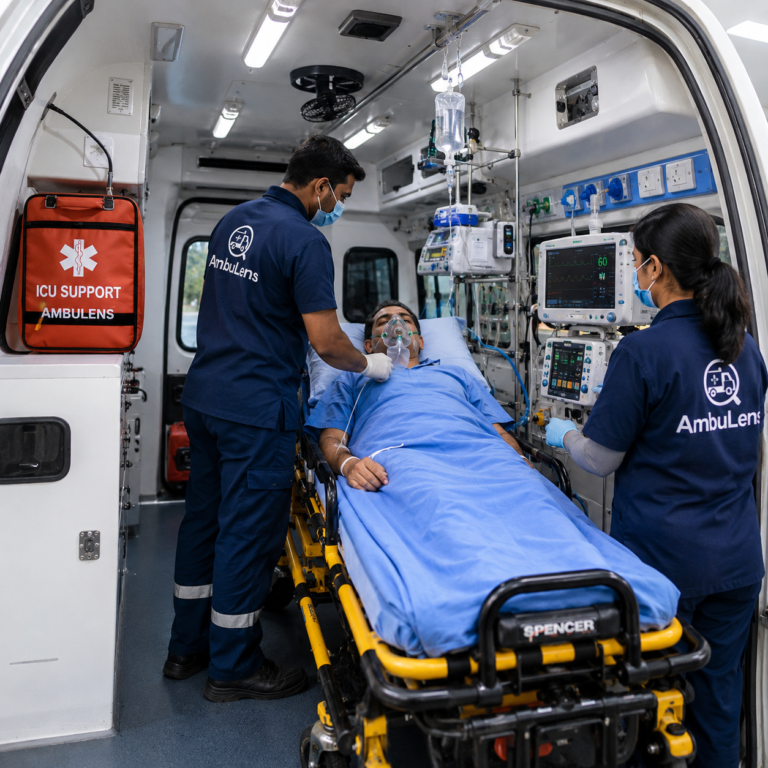
A ventilator ambulance can include:
- ICU ventilator
- Oxygen supply
- Cardiac monitor
- Pulse oximeter
- Suction equipment
- Infusion pumps
- Emergency medicines
- Airway-management equipment
- ICU stretcher
The exact equipment should match the patient’s clinical needs.
When Should You Choose an ICU Ambulance?
An ICU ambulance may suit a patient who needs intensive medical support during ground transportation.
For example, patients may require an ICU ambulance after:
- Major surgery
- Severe respiratory illness
- Stroke
- Brain injury
- Serious trauma
- Cardiac emergencies
- Respiratory failure
- Multiple-organ complications
AmbuLens provides ICU ambulance services in Jaipur with ventilator support, ICU equipment, and critical-care professionals.
When Is an Air Ambulance Better?
For long-distance transfers, an air ambulance may reduce travel time.
For example, a ventilator patient may need transportation from:
- Jaipur to Delhi
- Jaipur to Mumbai
- Mumbai to Delhi
- Bangalore to Mumbai
- Hyderabad to Delhi
- Kolkata to Mumbai
An air ambulance provides a dedicated medical environment. Depending on the patient’s condition, it can include a ventilator, oxygen, cardiac monitoring, infusion pumps, and other critical-care equipment.
However, air ambulance is not automatically suitable for every ventilator patient. A medical assessment should come first.
How Does a Ventilator Patient Travel by Air Ambulance?
A well-planned transfer can follow a coordinated process.
Step 1: Hospital Pickup
An ICU or ventilator ambulance collects the patient from the current hospital.
Step 2: Transfer to the Airport
The patient remains under medical supervision while travelling to the airport.
Step 3: Aircraft Transfer
The medical team carefully moves the patient from the ground ambulance to the air ambulance.
Step 4: Medical Flight
The team continues appropriate ventilator support and monitoring during the flight.
Step 5: Destination Transfer
After landing, another medical ambulance takes the patient to the receiving hospital.
Therefore, the complete journey can follow a bed-to-bed transfer model.
Bed-to-Bed Ventilator Patient Transfer
Bed-to-bed transportation can simplify a complex medical journey.
A typical transfer may look like:
Current Hospital → Ventilator Ambulance → Airport → Air Ambulance → Destination Airport → ICU Ambulance → Receiving Hospital
The medical team coordinates each stage.
As a result, families do not need to arrange separate transportation for every part of the journey.
AmbuLens provides bedside-to-bedside ventilator transportation, including hospital pickup, continuous support, airport transfer, flight support, and destination hospital transfer.
What Medical Team Should Accompany the Patient?
The required team depends on the patient’s condition.
It may include:
- Critical care physician
- Anesthesiologist
- ICU nurse
- ALS paramedic
- Respiratory therapist
The team monitors the patient’s respiratory status, vital signs, medications, and other critical-care requirements during transportation.
For this reason, families should discuss the required medical team with the treating doctor and transport provider before departure.
What Should Be Checked Before Transportation?
Preparation can reduce avoidable problems during the journey.
Ventilator Requirements
The team should confirm:
- Current ventilator settings
- Oxygen requirement
- Battery or backup power
- Airway security
- Backup ventilation equipment
- Monitoring requirements
The destination hospital should also receive the patient’s current ventilator information before arrival.
Medical Records
Keep important medical documents ready.
These may include:
- Diagnosis reports
- Discharge summary
- Recent investigation reports
- Medication list
- Doctor’s referral
- Ventilator details
- Patient identification
- Hospital contact details
Keeping these documents together can make the transfer process smoother.
How to Shift a Ventilator Patient from Jaipur to Delhi?
A ventilator patient travelling from Jaipur to Delhi needs careful coordination.
First, the treating doctor should assess the patient’s condition. Next, the receiving hospital in Delhi should confirm admission.
Depending on the patient’s condition, the transfer may use a ventilator ambulance or air ambulance.
For a long-distance critical transfer, an air ambulance can provide continuous medical support while reducing travel time.
Related Blog
Air Ambulance from Jaipur to Delhi
How to Shift a Ventilator Patient from Mumbai to Delhi?
Mumbai to Delhi is another long-distance medical transfer route.
A ventilator patient may need transportation when advanced treatment or specialised ICU care is available in Delhi.
The transfer plan can include:
- Medical assessment
- Receiving hospital confirmation
- Ventilator ambulance pickup
- Airport coordination
- Air ambulance transportation
- Destination ICU ambulance
- Hospital handover
AmbuLens also provides patient transfer services between Mumbai and Delhi with medical supervision and critical-care support.
Related Blog
Patient Transfer from Mumbai to Delhi by Air Ambulance
Can a Ventilator Patient Travel by Road?
Yes, selected ventilator patients can travel by road when the treating medical team considers the journey appropriate.
A specialised ventilator or ICU ambulance should provide the required respiratory support.
Road transportation may work well when:
- The destination is within a manageable distance
- The patient is medically stable enough for the journey
- Continuous ventilation can continue
- The ambulance has the required equipment
- A suitable medical team accompanies the patient
AmbuLens offers ventilator and ICU road ambulance services for local, interstate, and long-distance transfers.
Common Mistakes to Avoid
Families should avoid taking unnecessary risks during a ventilator transfer.
Do Not Use a Regular Vehicle
A private car cannot provide the medical support required by a ventilator-dependent patient.
Do Not Change Ventilator Settings Yourself
Ventilator settings should remain under qualified medical supervision.
Do Not Start Travel Without Hospital Coordination
The receiving hospital should know about the patient’s arrival and ICU requirements.
Do Not Delay Medical Assessment
The patient’s condition should determine the transportation plan.
Do Not Focus Only on Price
The cheapest option may not provide the medical equipment or staff the patient requires.
Safety and clinical suitability should come first.
How AmbuLens Supports Ventilator Patient Transfers
AmbuLens provides medical transportation support across India.
Depending on the patient’s condition, the service can coordinate:
- Ventilator ambulances
- ICU ambulances
- Air ambulances
- Ground ambulance transfers
- Critical-care doctors
- ICU nurses
- Paramedics
- Oxygen support
- Hospital coordination
- Airport coordination
- Bed-to-bed transfers
The service covers major cities such as Jaipur, Delhi, Mumbai, Bangalore, Chennai, Hyderabad, Kolkata, Ahmedabad, and Pune.
Conclusion
Shifting a ventilator patient requires much more than arranging an ambulance. The patient needs continuous respiratory support, appropriate monitoring, trained medical professionals, and careful coordination.
First, the treating doctor should assess the patient. Then, the transport team can select the right ambulance and medical setup.
For shorter journeys, a Ventilator Ambulance or ICU Ambulance may be suitable. For longer transfers, an Air Ambulance may provide a faster, medically supervised option.
Whether the journey starts in Jaipur, Mumbai, Delhi, Ahmedabad, Bangalore, Chennai, or another Indian city, proper planning can help maintain continuity of care throughout the transfer.
Frequently Asked Questions
1. Can a ventilator patient be shifted safely?
Yes, selected patients can be transported with appropriate medical planning, ventilator support, monitoring, equipment, and trained professionals. The treating doctor should assess the patient first.
2. Which ambulance is best for a ventilator patient?
A ventilator ambulance or ICU ambulance may be appropriate, depending on the patient’s condition and required medical support.
3. Can a ventilator patient travel by air ambulance?
Yes. Air ambulances can provide ventilator support and ICU-level monitoring during transportation. However, medical assessment should determine whether air travel is suitable.
4. Can a ventilator patient travel from Jaipur to Delhi?
Yes. A ventilator patient can be transferred from Jaipur to Delhi through an appropriately planned road or air medical transfer.
5. Can a ventilator patient travel from Mumbai to Delhi?
Yes. Depending on the patient’s condition, a ventilator ambulance or air ambulance can be considered for the transfer.