

When a patient needs medical transportation, choosing the right ambulance matters. However, many families do not know the difference between a Basic Ambulance and an ICU Ambulance.
Both services transport patients safely. However, their medical equipment, staff, and purpose differ significantly.
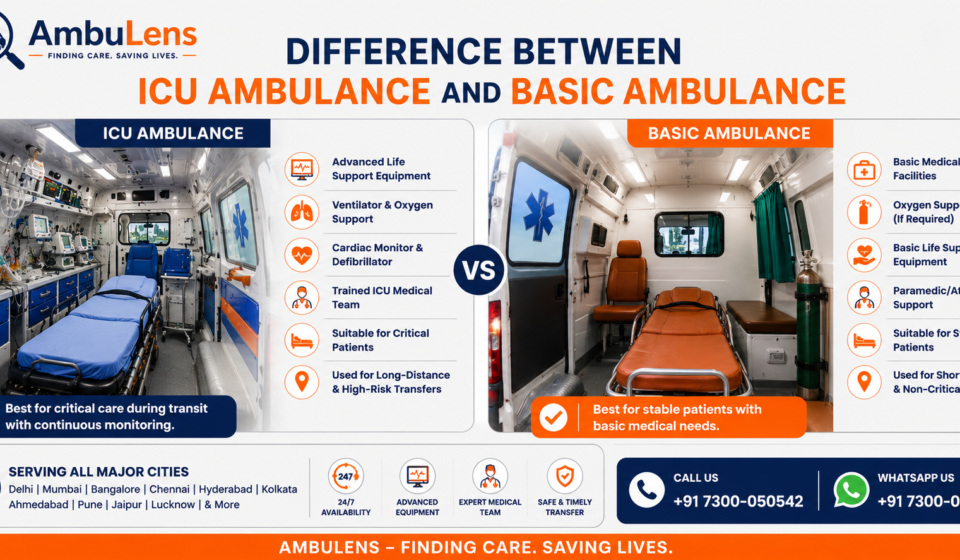
A basic ambulance generally suits stable patients. On the other hand, an ICU ambulance supports patients who need continuous monitoring and advanced medical care during transportation.
Therefore, the patient’s medical condition should guide the choice.
What Is a Basic Ambulance?
A Basic Ambulance provides essential transportation for patients who do not need intensive medical intervention during the journey.
It can work well for stable patients who need assistance while travelling to or from a healthcare facility.
Common Uses of a Basic Ambulance
A basic ambulance may suit:
- Hospital discharge
- Routine patient transfers
- Elderly patient transportation
- Wheelchair transfers
- Non-emergency medical travel
- Home-to-hospital transportation
- Stable hospital-to-hospital transfers
These ambulances can provide basic oxygen, a stretcher, wheelchair assistance, first-aid supplies, and an emergency medical technician.
What Is an ICU Ambulance?
An ICU Ambulance works as a mobile intensive care unit.
It supports critically ill patients who require continuous observation and advanced medical equipment during transportation.
For example, ICU ambulance services can support patients with:
- Ventilator dependency
- Heart emergencies
- Stroke
- Brain injury
- Severe trauma
- Respiratory failure
- Organ failure
- Post-operative complications
- Critical care requirements
AmbuLens provides ICU ambulance services with ventilator support, advanced equipment, doctors, ICU nurses, and bed-to-bed patient transportation.
Internal Link
ICU Ambulance Service in Jaipur
ICU Ambulance vs Basic Ambulance: Key Differences
Understanding the differences can help families make better decisions during stressful situations.
| Feature | Basic Ambulance | ICU Ambulance |
|---|---|---|
| Patient condition | Stable patients | Critically ill patients |
| Medical support | Basic | Advanced |
| Oxygen | Basic oxygen support | Advanced oxygen support |
| Ventilator | Usually not available | Available |
| Cardiac monitoring | Limited/basic | Advanced monitoring |
| Infusion pumps | Usually not available | Available |
| Defibrillator | Usually not included | Available |
| Suction equipment | Basic or limited | Available |
| Medical team | EMT/paramedic | Critical-care professionals |
| ICU-level care | No | Yes |
| Suitable for ventilator patients | Generally unsuitable | Suitable when medically approved |
The exact equipment can vary between ambulance providers and patient requirements. Therefore, families should confirm the available equipment before booking.
Difference in Medical Equipment
Equipment creates one of the biggest differences between these ambulance types.
Equipment in a Basic Ambulance
A basic ambulance may provide:
- Stretcher
- Wheelchair
- Oxygen cylinder
- First-aid kit
- Basic emergency supplies
- Emergency medical technician
These facilities generally support stable patients during transportation.
Equipment in an ICU Ambulance
An ICU ambulance can provide a much more advanced medical setup.
Depending on the patient’s condition, equipment may include:
- Portable ICU ventilator
- Multi-parameter monitor
- Cardiac monitor
- Defibrillator
- Oxygen systems
- Infusion pumps
- Syringe pumps
- Suction machine
- Emergency medicines
- Airway-management equipment
This setup allows the medical team to continue critical care during transportation.
Difference in Medical Staff
The medical team also depends on the patient’s condition.
Basic Ambulance
A basic ambulance generally operates with an emergency medical technician or trained ambulance staff.
The team focuses on safe transportation and basic medical support.
ICU Ambulance
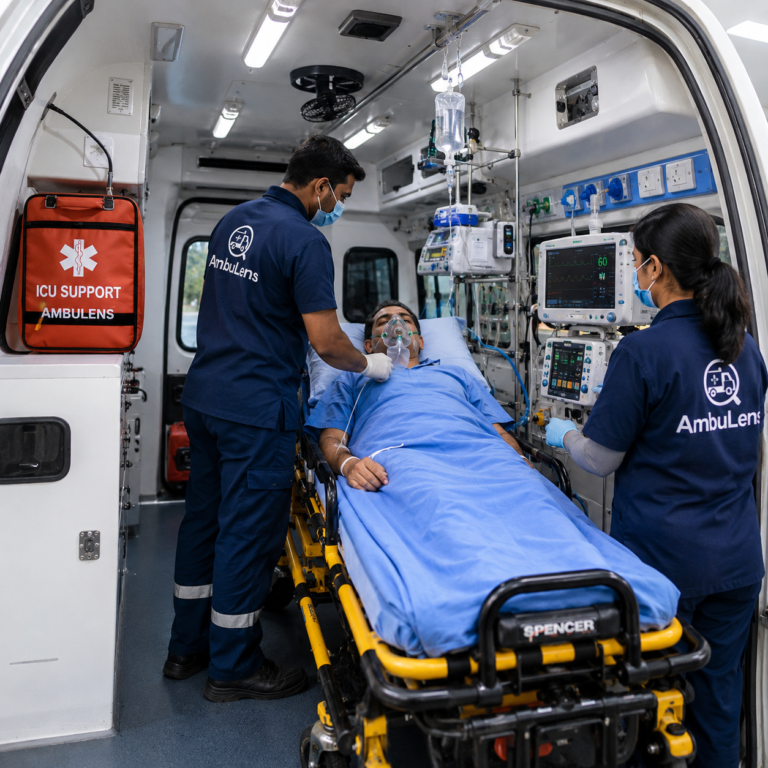
An ICU ambulance can include trained critical-care professionals.
Depending on the patient’s condition, the team may include:
- Critical-care doctor
- ICU nurse
- ALS paramedic
- Emergency medical technician
- Other specialised healthcare professionals
Therefore, critically ill patients can receive closer medical supervision during transportation.
When Should You Choose a Basic Ambulance?
A basic ambulance may be appropriate when the patient remains medically stable.
For example, it can suit:
Hospital Discharge
Patients who are stable after treatment may need an ambulance to return home.
Routine Hospital Transfer
Some stable patients need transportation between healthcare facilities.
Elderly Patient Transportation
Elderly patients who need assistance but do not require intensive medical care may use basic ambulance transportation.
Wheelchair Transportation
Patients with limited mobility can receive assistance with boarding and transportation.
However, the treating medical team should guide the decision when the patient’s condition is uncertain.
When Should You Choose an ICU Ambulance?
An ICU ambulance becomes more important when the patient requires continuous critical-care support.
It may be considered for:
Ventilator Patients
Patients dependent on mechanical ventilation need specialised respiratory support during transportation.
Cardiac Emergencies
Patients with serious cardiac conditions may require continuous cardiac monitoring and emergency equipment.
Stroke and Brain Injury
Patients with neurological emergencies may need close monitoring during transfer.
Severe Trauma
Accident victims with serious injuries may require advanced life-support equipment.
ICU-to-ICU Transfer
Patients moving between intensive-care units may require uninterrupted critical-care support.
AmbuLens identifies ICU ambulances as an option for ventilator patients, cardiac emergencies, stroke, trauma, respiratory failure, and other critical conditions.
Can a Ventilator Patient Travel in a Basic Ambulance?
A ventilator-dependent patient generally needs a specialised ambulance with appropriate ventilation and critical-care equipment.
Therefore, a basic ambulance should not be selected simply because it is available or less expensive.
Instead, discuss the patient’s condition with the treating doctor and transportation provider.
A Ventilator Ambulance or ICU Ambulance can provide the equipment needed for continued respiratory support.
Related Blog
How to Shift a Ventilator Patient Safely?
ICU Ambulance for Long-Distance Patient Transfer
Long-distance transfers require additional planning.
For example, a patient may need transportation from:
- Jaipur to Delhi
- Jaipur to Mumbai
- Mumbai to Pune
- Mumbai to Delhi
- Delhi to Jaipur
- Ahmedabad to Mumbai
- Bangalore to Chennai
An ICU road ambulance can provide door-to-door transportation when the journey is medically suitable.
For longer or time-sensitive transfers, an Air Ambulance may provide another option.
ICU Ambulance in Jaipur
Families looking for an ICU Ambulance Service in Jaipur may need transportation for critical patients, ventilator patients, cardiac cases, stroke patients, or post-surgery transfers.
AmbuLens offers ICU ambulance services in Jaipur with advanced equipment, medical professionals, and bed-to-bed transportation across Rajasthan and India.
The service can support transfers from Jaipur to cities such as Delhi, Mumbai, Ahmedabad, Bangalore, Chennai, Hyderabad, and other destinations.
ICU Ambulance in Mumbai
Mumbai also has a wide range of medical transportation requirements.
An ICU Ambulance Service in Mumbai can support critical patient transfers, hospital-to-hospital transportation, long-distance transfers, and ventilator-supported patients.
AmbuLens provides ICU ambulance transportation across Mumbai and can coordinate transfers to other cities in India.
Basic Ambulance vs ICU Ambulance: Which One Is Right?
The simplest way to understand the difference is this:
Choose a Basic Ambulance when the patient is stable and needs transportation with basic medical support.
Choose an ICU Ambulance when the patient requires continuous monitoring, advanced equipment, or critical-care support.
However, the final choice should depend on the patient’s medical condition.
If the patient requires a ventilator, cardiac monitoring, intensive supervision, or advanced life support, discuss an ICU ambulance with the medical team.
Why Choosing the Right Ambulance Matters
Selecting the wrong ambulance can create unnecessary difficulties during transportation.
For instance, a stable patient may not need an ICU-level setup. Likewise, a critically ill patient may require much more than basic transportation.
Therefore, consider:
- Patient’s current condition
- Medical support required
- Oxygen requirement
- Ventilator requirement
- Travel distance
- Emergency level
- Required medical team
- Receiving hospital facilities
This approach helps families select transportation according to actual medical needs.
What Information Should You Give Before Booking?
Before booking an ambulance, provide accurate patient information.
Share:
- Patient’s current location
- Destination
- Medical condition
- Diagnosis
- Oxygen requirement
- Ventilator requirement
- Mobility status
- Recent medical reports
- Treating doctor’s advice
- Required travel date and time
This information helps the provider identify the appropriate ambulance category.
Basic Ambulance or ICU Ambulance for Hospital Transfer?
Hospital transfers vary from patient to patient.
A stable patient moving from one hospital to another may only need a basic ambulance.
However, an ICU patient moving from one hospital to another may require an ICU ambulance.
For example:
Stable Patient: Hospital → Basic Ambulance → Destination Hospital
Critical Patient: ICU → ICU Ambulance → Destination ICU
For complex transfers, a bed-to-bed service can coordinate the complete journey and reduce unnecessary movement between vehicles.
Conclusion
The difference between an ICU Ambulance and a Basic Ambulance mainly comes down to the patient’s medical needs.
A basic ambulance suits stable patients who need essential transportation support. In contrast, an ICU ambulance functions as a mobile intensive care unit and provides advanced equipment and medical supervision.
Therefore, families should not choose an ambulance based only on availability or price.
Instead, consider the patient’s condition, required equipment, travel distance, and medical supervision.
Whether you need an ICU Ambulance in Jaipur, ICU Ambulance in Mumbai, Basic Ambulance in Delhi, or intercity patient transportation, choosing the appropriate service can make the transfer more organised and medically suitable.
Frequently Asked Questions
1. What is the main difference between an ICU ambulance and a basic ambulance?
A basic ambulance provides essential transportation and basic medical support. An ICU ambulance provides advanced equipment and critical-care support for patients who need continuous monitoring.
2. Is an ICU ambulance suitable for ventilator patients?
Yes, an ICU ambulance can support ventilator-dependent patients when the medical team considers transportation appropriate. It can provide ventilator support, oxygen, monitoring, and other critical-care equipment.
3. Is a basic ambulance suitable for stable patients?
Yes. Basic ambulances can suit stable patients who need transportation but do not require intensive medical intervention.
4. Does an ICU ambulance have a ventilator?
ICU ambulances can include portable ICU ventilators. However, families should confirm the equipment before booking because configurations can vary.
5. When should I choose an ICU ambulance?
Consider an ICU ambulance when the patient requires continuous monitoring, ventilator support, advanced life support, or intensive medical supervision.