

When a loved one passes away in another country, families face an emotional and difficult time. Along with funeral arrangements, they must coordinate the return of human remains to India. Proper documentation can help families avoid preventable delays at the destination airport.
However, requirements vary by country, airline, transit route, and individual circumstances. Therefore, families should confirm the latest checklist with the relevant Indian embassy or consulate, airline, cargo agent, and airport health authorities before the shipment begins.
This guide explains the main documents to prepare before an international repatriation arrival in India and how families can plan onward transportation.
Why Is Document Preparation Important?
International repatriation involves several parties. These may include local authorities in the country of death, the Indian embassy or consulate, the airline, cargo handlers, and public health officials in India.
Each party may need specific records before it can complete its part of the process. For example, public health clearance and airline cargo release are separate procedures. Families should plan for both rather than assuming one approval covers every requirement.
Early preparation can help families:
Identify missing or incorrect documents.
Coordinate with the airline and cargo agent.
Confirm public health clearance requirements.
Plan airport pickup and onward transportation.
Reduce avoidable delays before funeral arrangements.
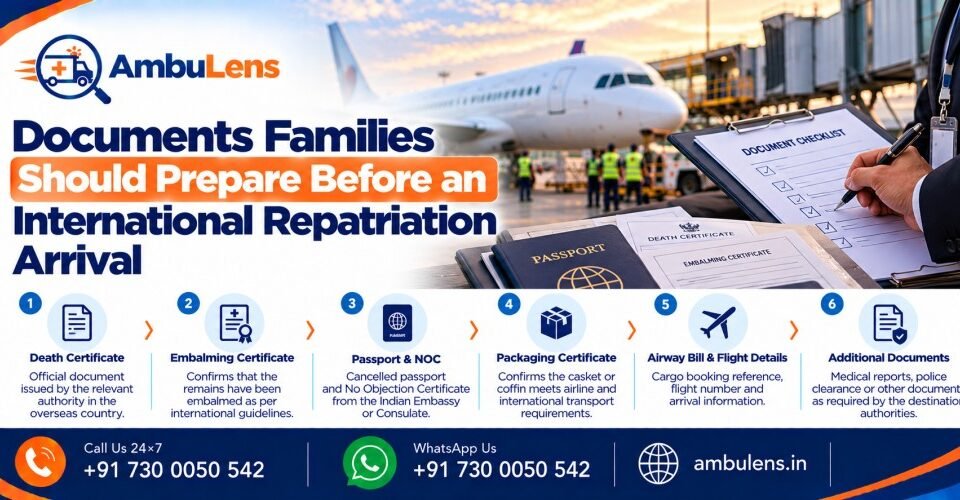
1. Death Certificate
The death certificate is one of the most important documents in an international repatriation case. The local authority in the country where the death occurred generally issues this certificate.
Families should check that the document contains the required personal details and information about the death. If authorities issue it in a language other than English, they may require an official English translation.
Before departure, confirm:
Whether the original certificate is required.
Whether an English translation is necessary.
Whether authorities require authentication or legalisation.
Whether the stated cause of death meets the destination requirements.
Requirements can differ by country and case. Therefore, confirm the exact format with the relevant consular mission and authorities.
2. Embalming Certificate
The embalming certificate confirms that an authorised provider has completed the required preservation procedure. Authorities and airlines may request this certificate before accepting human remains for international transportation.
Families should ask the funeral service provider to prepare the certificate in the required format. They should also confirm that the packaging and casket meet applicable transport standards.
For arrivals in India, public health clearance requirements can include evidence that the remains are in a hermetically sealed casket. Check the current official checklist before the shipment leaves the country of origin.
3. Consular Documents and No-Objection Certificate
The Indian embassy or consulate in the country of death may provide or verify documents needed for repatriation. Depending on the case, the family may need consular registration, a no-objection certificate (NOC), or other supporting paperwork.
The exact requirements depend on the circumstances of the death and the local procedure. Families should contact the relevant Indian mission early to confirm which documents it needs.
Useful starting points include the Ministry of External Affairs guidance on Transfer of Mortal Remains and its FAQ on bringing mortal remains to India.
4. Passport and Identity Documents
Authorities may request a copy of the deceased person’s passport or other identity records. These documents help verify identity and support consular and transportation procedures.
Families should keep clear copies of the relevant passport pages and any additional identity documents requested by the authorities. The original passport may also require specific handling under consular procedures.
Prepare the following where applicable:
Deceased person’s passport copy.
Relevant visa or immigration pages, if requested.
Identity documents required by the consulate.
Details of the next of kin or authorised representative.
Do not assume that every document applies to every case. Confirm the current requirements before submitting originals.
5. Public Health Clearance Documents
Before human remains arrive in India, families or their appointed representatives should confirm the applicable public health clearance process.
India’s eCARe system provides a process for public health clearance for human remains arriving from abroad. The official checklist may include a death certificate, embalming certificate, and other supporting records. Requirements can vary, so use the latest instructions rather than an old checklist.
Visit the official eCARe website and review its required documents page.
Important: Public health clearance does not automatically mean that the airline or cargo terminal has released the shipment. Families should coordinate each step separately.
6. Packaging Certificate and Casket Documentation
Airlines and authorities may require documents confirming that the casket and packaging comply with applicable transportation requirements.
Ask the funeral service provider and airline to confirm whether they need a packaging certificate, a sealed-casket declaration, or any additional technical documentation. The required wording and format may differ by route and carrier.
Before departure, check that the paperwork matches the actual shipment. Any mismatch in names, certificate details, or shipment information can lead to further checks.
7. Airline and Cargo Shipment Documents
International transportation usually involves an airline and its cargo-handling team. Families or their appointed representatives should obtain the shipment details and confirm the arrival arrangements before the flight lands.
Depending on the airline and route, relevant records may include:
Air waybill or cargo reference number.
Flight details and expected arrival time.
Consignee or authorised recipient information.
Cargo agent contact details.
Confirmation of the destination airport and handling arrangements.
The airline or cargo agent can explain the applicable release procedure. Families should also ask whether the receiving representative needs to submit documents before arrival.
8. Authorisation for Airport Release and Pickup
The person arranging the pickup may need to prove that they can receive the shipment. This is particularly important when a family member cannot attend the airport personally.
Ask the airline, cargo agent, or authorised handling representative whether they require an authorisation letter, identity proof, or other release documents.
For help understanding the arrival process, read What Happens When a Dead Body Reaches the Destination Airport?. You can also review How to Coordinate Airport Release and Final Delivery of Human Remains.
9. Documents for Onward Transportation Within India
After the relevant authorities and cargo handlers release the shipment, families may need to arrange transportation from the airport to the final destination.
For example, a shipment arriving in Mumbai may need onward transportation to Pune. Another family may require dead body transportation in Delhi or Jaipur, depending on where the funeral will take place.
Before booking a mortuary ambulance, confirm the arrival airport, release arrangements, destination address, and any documents required by the transport provider.
AmbuLens provides information about its dead body transportation services in India and dead body transportation services.

City-Wise Planning for Airport Pickup
Families should plan the pickup based on the actual arrival airport and final destination.
Mumbai: Confirm cargo release and arrange dead body transportation in Mumbai or onward transport to Pune and nearby locations.
Delhi: Coordinate the airport pickup and arrange dead body transportation in Delhi or onward road transport to another city.
Jaipur: Confirm whether the shipment will arrive directly or through another airport, then arrange dead body transportation in Jaipur.
Other Indian cities: Confirm the airport release process first, then plan the onward journey with an appropriate transportation provider.
These are planning examples, not guarantees of a particular airport’s procedures. Always verify the current requirements for the specific route.
Common Mistakes Families Should Avoid
Even when families gather the main documents, small errors can still delay the process. Therefore, review the paperwork carefully before the shipment departs.
Missing documents: Compare the paperwork with the latest eCARe and consular checklists.
Incorrect personal details: Check the deceased person’s name, passport number, and date of death across documents.
Untranslated certificates: Arrange an authorised English translation when required.
Late coordination: Contact the airline, cargo agent, and receiving representative before arrival.
Assuming all approvals are the same: Public health clearance, customs or immigration formalities, and airline cargo release may involve different authorities.
No onward transport plan: Confirm the pickup arrangements before the shipment reaches the airport.
The official eCARe document checklist explains specific document requirements, including details for the embalming certificate, death certificate, embassy NOC, and cancelled passport.
The Ministry of External Affairs also notes that procedures can differ between countries.
How AmbuLens Can Help With Onward Transportation
After a family confirms the required clearances and the airline or cargo terminal releases the shipment, the next step is to arrange suitable transportation to the final destination.
AmbuLens offers information about dead body transportation services in India. Families can discuss their route, arrival airport, destination city, and pickup requirements when planning the journey.
Whether the destination is Delhi, Mumbai, Jaipur, Pune, or another Indian city, early coordination helps families prepare for the transfer from the airport. For service details, visit the AmbuLens dead body transportation in India page.
Please remember that a transportation provider can help coordinate the journey, but only the relevant authorities can issue official clearances or approvals.
International Repatriation Document Checklist
Use this checklist as a starting point. The exact documents depend on the case, route, and current official requirements.
The eCARe portal lists core documents for public health clearance, while the Ministry of External Affairs describes additional documents that may apply to consular registration and repatriation. Confirm the final checklist with the relevant authorities before departure.
Conclusion
Preparing documents before an international repatriation arrival can help families coordinate the process more smoothly. Start with the official eCARe and consular checklists, confirm the airline’s requirements, and keep the receiving representative informed.
Finally, arrange onward transportation only after confirming the airport release process and the requirements for the destination city. Careful preparation can reduce avoidable confusion during an already difficult time.
Related Resources
Frequently Asked Questions
1. What documents are required to bring human remains to India from another country?
The eCARe checklist includes an embalming certificate, death certificate, NOC from the Indian embassy, and cancelled passport copy. Authorities may also request packaging documentation or other supporting records.
2. Is an embalming certificate mandatory for international repatriation to India?
The official eCARe checklist lists an embalming certificate among the mandatory documents for human remains clearance. Families should confirm the current requirements for their specific case before arranging transportation.
3. Do families need an NOC from the Indian embassy?
The eCARe checklist lists an NOC from the Indian embassy of the country concerned. Families should contact the relevant mission to confirm the procedure and the details required on the document.
4. Does the death certificate need to be in English?
If the certificate is in another language, an English translation may be required. The eCARe guidance specifies translation requirements for relevant certificates, so families should check the latest instructions before submission.
5. Is public health clearance the same as airport cargo release?
No. Public health clearance and airline or cargo release are separate steps. Families should confirm the status of each process with the relevant authority and cargo handling team.
6. Can documents differ depending on the country of death?
Yes. Local legal procedures, investigations, consular requirements, and airline rules can affect the paperwork. The Ministry of External Affairs advises that procedures vary by country.
7. Can a family arrange a mortuary ambulance before the shipment arrives?
Yes, families can contact a transportation provider in advance to discuss the expected arrival and onward journey. However, they should coordinate the final pickup timing with the airline or cargo agent because release may depend on clearance procedures.
8. Can AmbuLens help arrange transportation to cities such as Delhi, Mumbai, or Jaipur?
Families can contact AmbuLens to discuss dead body transportation requirements and onward travel within India. Confirm the route, timing, and service availability directly with the provider.