
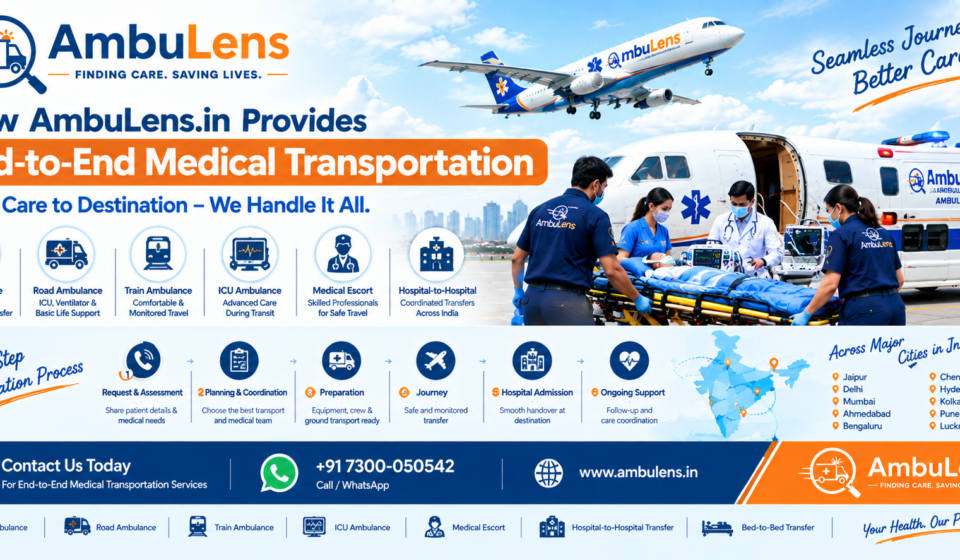

Medical transportation involves more than simply moving a patient from one place to another. Patients may need hospital coordination, suitable medical equipment, trained professionals, ground transfers, and continuous support.
AmbuLens.in provides end-to-end medical transportation by coordinating different parts of the journey according to the patient’s medical needs. From the initial assessment to hospital arrival, each stage receives careful attention.
What Does End-to-End Medical Transportation Mean?
End-to-end medical transportation covers the complete patient journey.
It can include:
- Medical assessment
- Transport planning
- Ambulance selection
- Medical team coordination
- Hospital coordination
- Airport transfers
- Air ambulance arrangements
- Road ambulance services
- Medical escort services
- Bed-to-bed transfers
- Arrival coordination
Therefore, families do not have to manage every part of the journey separately.
How AmbuLens Starts the Transportation Process
The process begins when the family or hospital contacts AmbuLens with the patient’s requirements.
The team collects important information such as:
- Patient’s medical condition
- Current hospital
- Destination hospital
- Travel distance
- Mobility status
- Oxygen requirement
- Ventilator requirement
- Required medical team
- Preferred travel date
This information helps the team identify a suitable transportation option.
Step 1: Medical Assessment
First, the team reviews the patient’s medical condition.
The assessment helps determine whether the patient needs:
- Basic road ambulance
- ICU ambulance
- Ventilator ambulance
- Air ambulance
- Medical escort
Moreover, the treating doctor can provide important clinical information for the transfer plan.
The transportation method should always match the patient’s medical condition.
Step 2: Choosing the Right Medical Transport
Different patients require different levels of support.
Road Ambulance
Road ambulances can support local and intercity transfers. They can also provide medical supervision during suitable long-distance journeys.
Explore the Road Ambulance Service.
ICU Ambulance
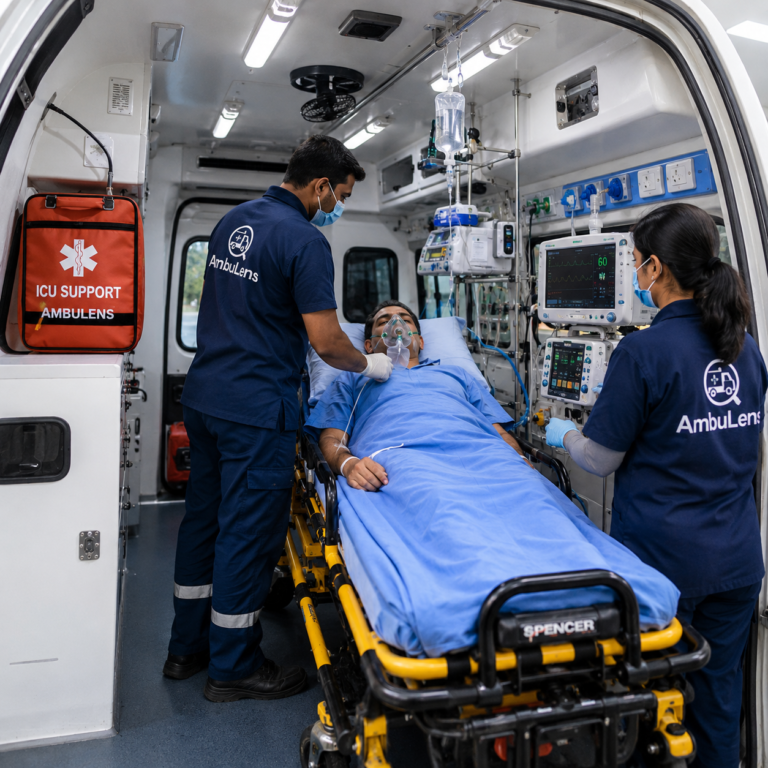
An ICU ambulance provides advanced medical support for patients who need continuous monitoring during transportation.
For example, critically ill patients may require monitoring, oxygen, ventilator support, or emergency equipment.
Read our guide on ICU Ambulance Service in Jaipur.
Ventilator Ambulance
Patients who depend on mechanical ventilation may need a ventilator-equipped ambulance.
The medical team monitors the patient’s respiratory status during the journey.
Learn more about Ventilator Ambulance Service in Jaipur.
Air Ambulance
Air ambulance services can support long-distance and critical patient transfers.
They can provide specialized medical equipment and trained medical professionals during the flight.
Visit the Air Ambulance Service page for more information.
Step 3: Hospital-to-Hospital Coordination
Hospital coordination plays an important role in medical transportation.
AmbuLens can coordinate with the referring and receiving facilities regarding:
- Patient details
- Medical condition
- Transfer requirements
- Admission arrangements
- Medical records
- Required equipment
- Arrival timing
As a result, the receiving hospital can prepare for the patient’s arrival.
Read more about Hospital-to-Hospital Patient Transfer Service.
Step 4: Medical Team Arrangement
The medical team depends on the patient’s condition.
Depending on the case, transportation may involve:
- Doctor
- Critical-care doctor
- Nurse
- Critical-care nurse
- Paramedic
- Medical escort professional
Furthermore, the team can monitor the patient during transportation and respond to changes when required.
Step 5: Equipment Planning
The team identifies the medical equipment needed before departure.
Depending on the patient’s condition, this may include:
- Patient monitor
- Oxygen system
- Ventilator
- Infusion pump
- Suction unit
- Defibrillator
- Emergency medicines
- Stretcher
Therefore, equipment planning remains an important part of safe medical transportation.
Step 6: Ground Ambulance Transfers
An end-to-end journey can involve several transportation stages.
For example, a patient may travel:
Hospital → Airport → Air Ambulance → Destination Airport → Hospital
Ground ambulances can connect these stages.
This approach helps provide a coordinated journey instead of arranging each transfer separately.
Step 7: Airport Medical Coordination
Air transfers require additional planning.
The team may coordinate:
- Airport arrival
- Ambulance access
- Patient transfer
- Stretcher requirements
- Medical equipment
- Flight arrangements
- Destination ambulance
Moreover, airport coordination can help reduce unnecessary delays during patient movement.
For patients arriving in Mumbai, see our guide on Airport to Hospital Ambulance Service in Mumbai.
Step 8: Bed-to-Bed Medical Transportation
Bed-to-bed transportation focuses on the complete patient journey.
The process can start at the patient’s hospital bed and continue until arrival at the destination hospital.
For example:
- Medical team reaches the hospital.
- Patient receives appropriate transfer support.
- Ground ambulance takes the patient to the airport.
- Medical team supervises the air transfer.
- Destination ambulance receives the patient.
- Patient reaches the receiving hospital.
- Medical team supports the final handover.
Therefore, families can receive coordinated assistance throughout the transfer.
Medical Transportation Across India
AmbuLens can coordinate medical transportation across multiple Indian cities.
Common locations include:
- Jaipur
- Mumbai
- Delhi
- Gurgaon
- Noida
- Ahmedabad
- Pune
- Bangalore
- Chennai
- Hyderabad
- Kolkata
- Indore
- Lucknow
- Chandigarh
For example, a patient may need an intercity ambulance from Jaipur to Delhi or an air ambulance from Mumbai to another city.
End-to-End Medical Transportation in Jaipur
Patients in Jaipur may require transportation to Delhi, Mumbai, Ahmedabad, Bangalore, Chennai, or other cities.
AmbuLens can coordinate road ambulances, ICU ambulances, ventilator ambulances, air ambulances, and medical escorts according to the patient’s requirements.
For air transfers, explore Air Ambulance in Jaipur.
Additionally, patients can learn about Medical Escort Service in Jaipur.
End-to-End Medical Transportation in Mumbai
Mumbai serves as an important healthcare destination for patients from India and abroad.
Patients may require transportation between:
- Hospitals
- Mumbai Airport
- Homes
- Rehabilitation facilities
- Other cities
AmbuLens can coordinate suitable medical transportation based on the patient’s condition.
For long-distance transfers, read Intercity Ambulance Service from Mumbai.
Medical Escort for Stable Patients
Not every patient needs an air ambulance.
A medically stable patient may sometimes travel on a commercial flight with a medical escort. The escort can provide support during the journey based on the patient’s needs.
Read Medical Escort Service in India to understand this option.
You can also compare the two options in Air Ambulance vs Medical Escort Service.
International Medical Transportation
AmbuLens can also coordinate medical transportation for international journeys.
International transfers may require:
- Medical assessment
- Receiving hospital coordination
- Aircraft planning
- Medical team
- Ground ambulance
- Airport coordination
- Travel documentation
- Bed-to-bed support
For example, patients may travel between Mumbai, Delhi, Jaipur, London, Dubai, Singapore, or other destinations depending on their medical requirements.
Read our guide on Air Ambulance Mumbai to London.
Why End-to-End Medical Transportation Matters
A coordinated transportation plan can simplify a complex medical journey.
One Coordinated Process
Families can coordinate multiple transportation requirements through one service.
Appropriate Medical Support
The transportation plan can match the patient’s medical condition.
Better Hospital Coordination
Communication between hospitals can support a smoother transfer.
Continuous Medical Supervision
Medical professionals can monitor patients during supported transfers.
Reduced Family Stress
Families can focus more on the patient’s care instead of arranging separate transportation stages.
What Information Is Needed for Booking?
To plan transportation properly, families should provide:
- Patient’s diagnosis
- Current medical condition
- Current hospital
- Destination
- Doctor’s recommendation
- Recent medical reports
- Oxygen requirement
- Ventilator requirement
- Mobility status
- Preferred travel date
The more complete the information, the easier it becomes to plan suitable transportation.
Factors That Affect Medical Transportation Cost
The cost depends on several factors.
These may include:
- Transport type
- Travel distance
- Patient’s condition
- Medical team
- Equipment
- Oxygen requirement
- Ventilator support
- Ground ambulance transfers
- Aircraft type
- Airport handling
- Domestic or international route
Therefore, families should request a patient-specific quotation.
Conclusion
AmbuLens.in provides end-to-end medical transportation by coordinating the major stages of a patient’s journey. The process can include medical assessment, transport selection, hospital coordination, medical teams, equipment, airport transfers, and bed-to-bed support.
Whether the journey starts in Jaipur, Mumbai, Delhi, Ahmedabad, Bangalore, Chennai, or another city, the transportation plan should match the patient’s medical needs.
For complex patient transfers, coordinated medical transportation can make the journey more organized and easier for families to manage.
Frequently Asked Questions
1. What does end-to-end medical transportation include?
It can include medical assessment, transport planning, ambulance services, hospital coordination, airport transfers, medical teams, and bed-to-bed transportation.
2. Does AmbuLens provide medical transportation across India?
Yes. AmbuLens coordinates medical transportation across multiple Indian cities based on patient requirements and destination.
3. Can AmbuLens arrange hospital-to-hospital transfers?
Yes. Hospital-to-hospital patient transfers can include suitable ambulances, medical teams, equipment, and coordination with both facilities.
4. Can AmbuLens arrange air ambulance services?
Yes. Air ambulance transportation can be coordinated for suitable patients who require long-distance medical transportation.
5. Can critically ill patients receive ICU ambulance support?
Yes. ICU ambulance services can support suitable critical patients with appropriate monitoring and critical-care equipment.