


When a newborn or child needs medical care in another city, safe transportation becomes a major concern. Air ambulance services for neonatal and pediatric patients can provide specialized medical support during long-distance transfers.
Unlike routine travel, critically ill children may need continuous monitoring, oxygen, ventilation, medication, or other critical-care support. Therefore, the medical team must assess the child before selecting the right mode of transport.
What Is a Pediatric Air Ambulance?
A pediatric air ambulance is a medically equipped aircraft used to transfer infants, newborns, and children who require supervised medical transportation.
Depending on the child’s condition, the transfer may include:
- Pediatric monitoring
- Oxygen support
- Ventilator assistance
- Cardiac monitoring
- Infant incubator support
- Medication management
- Airway support
- Trained pediatric medical professionals
- Ground ambulance coordination
Moreover, the medical team plans the journey according to the child’s age, weight, diagnosis, stability, and treatment needs.
When Does a Child Need an Air Ambulance?
An air ambulance may become suitable when a child needs specialized treatment at a distant hospital.
For example, medical teams may consider air transportation for:
- Premature or critically ill newborns
- Babies requiring incubator support
- Children dependent on ventilators
- Serious respiratory conditions
- Congenital heart conditions
- Neurological emergencies
- Severe infections
- Major injuries or trauma
- Post-operative pediatric patients
- Children requiring specialist treatment
- Patients needing transfer to a higher-level pediatric ICU
However, the final decision should always follow a medical assessment.
Neonatal Air Ambulance Services
Newborn patients need additional care because their condition can change quickly. Therefore, neonatal transfers require specialized equipment and trained medical professionals.
A neonatal transfer may include:
- Transport incubator
- Temperature control
- Oxygen support
- Respiratory support
- Vital-sign monitoring
- Infusion pumps
- Emergency medication
- Neonatal-trained medical staff
Furthermore, the team coordinates with the referring and receiving hospitals before departure.
Pediatric Air Ambulance Equipment
The equipment depends on the child’s medical condition. However, a critical pediatric transfer may require:
| Equipment | Purpose |
|---|---|
| Pediatric monitor | Tracks vital signs |
| Ventilator | Supports breathing |
| Oxygen system | Provides respiratory support |
| Transport incubator | Maintains a newborn’s temperature |
| Infusion pumps | Deliver medications and fluids |
| Suction equipment | Supports airway management |
| Emergency medicines | Helps manage medical emergencies |
Therefore, the aircraft setup should match the child’s specific requirements.
Medical Team for Pediatric Air Transfers
A pediatric transfer requires more than transportation. The medical team provides continuous care throughout the journey.
Depending on the patient’s condition, the team may include:
- Pediatric doctor
- Neonatal specialist
- Critical-care doctor
- Pediatric nurse
- Critical-care nurse
- Trained paramedic
Moreover, the team monitors the child during the flight and responds to changes in the patient’s condition.
How a Pediatric Air Ambulance Transfer Works
The transfer generally follows several important steps.
1. Medical Assessment
First, the medical team reviews the child’s diagnosis, current condition, age, weight, medications, and respiratory requirements.
2. Hospital Coordination
Next, the referring hospital and receiving hospital coordinate the transfer. The receiving facility should have the required pediatric or neonatal treatment facilities.
3. Aircraft and Equipment Planning
Afterward, the medical team selects the appropriate aircraft setup and equipment.
4. Ground Ambulance Arrangement
The journey does not end at the airport. Therefore, ground ambulances can be arranged for hospital-to-airport and airport-to-hospital transportation.
5. Bed-to-Bed Transfer
Finally, the medical team supervises the child from the referring hospital through the flight and into the receiving hospital.
This approach helps maintain continuity of care throughout the journey.
Pediatric Air Ambulance Services in Jaipur
Families in Jaipur may require pediatric medical transportation when a child needs specialized treatment in another city.
AmbuLens can coordinate medical transportation from Jaipur to destinations such as Delhi, Mumbai, Ahmedabad, Bangalore, Chennai, Hyderabad, and other major cities, depending on the patient’s requirements.
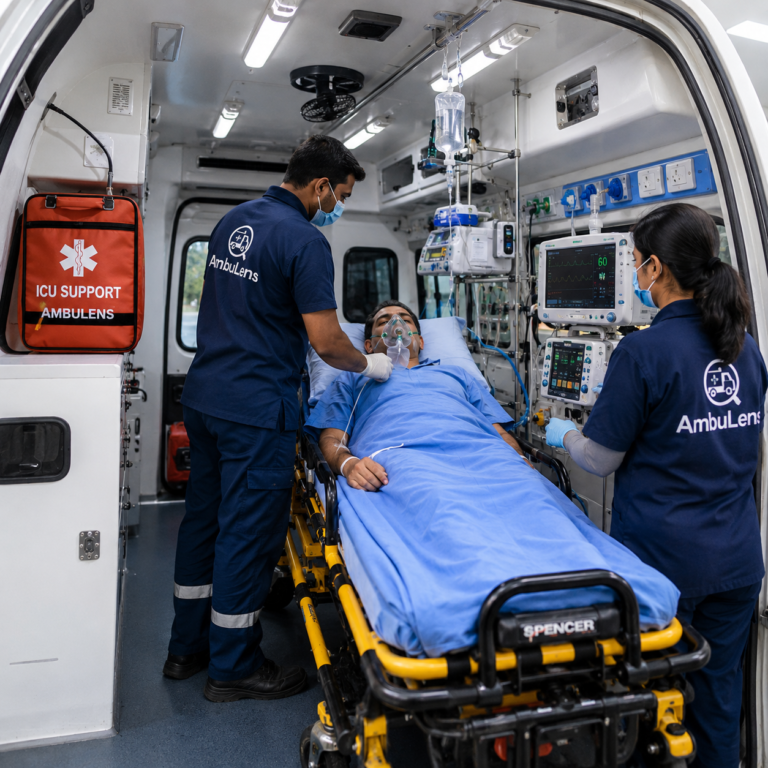
Pediatric Air Ambulance Services in Mumbai
Mumbai has several advanced hospitals that provide specialized pediatric and neonatal care. However, some children may need transfer to another city or specialized facility.
Therefore, an air ambulance can support long-distance transfers when road transportation may not be suitable.
For more information, see our ICU Ambulance Service in Mumbai guide.
When Is a Medical Escort a Better Option?
Not every child needs a dedicated air ambulance.
If a child is medically stable, a medical escort on a commercial flight may sometimes be considered. The decision depends on the child’s medical condition, mobility, oxygen requirements, airline rules, and doctor’s recommendation.
Read more about Medical Escort Service in India.
You can also compare both options in our guide on Air Ambulance vs Medical Escort Service.
Benefits of Air Ambulance for Children
Air ambulance transportation can offer several benefits for children who need supervised medical travel.
Faster Long-Distance Transportation
Air travel can reduce journey time compared with long road transfers. As a result, children can reach specialized hospitals sooner when medically appropriate.
Continuous Medical Monitoring
The medical team can monitor vital signs throughout the journey.
Specialized Equipment
The aircraft can carry equipment selected according to the child’s condition.
Hospital-to-Hospital Coordination
The transfer team can coordinate with both hospitals to support a smoother transition.
Reduced Travel Stress
A medically planned transfer can reduce some of the challenges associated with long-distance transportation.
Factors That Affect Pediatric Air Ambulance Cost
The cost of a neonatal or pediatric air ambulance depends on several factors.
These may include:
- Child’s medical condition
- Type of aircraft
- Distance and route
- Medical team required
- Incubator requirement
- Ventilator requirement
- Oxygen consumption
- Ground ambulance transfers
- Airport handling
- Medical equipment
- Domestic or international transfer
- Special permissions and coordination
Therefore, families should request a patient-specific assessment instead of relying on a general price estimate.
Air Ambulance vs Road Ambulance for Children
The appropriate transportation method depends on the child’s medical condition and travel distance.
| Air Ambulance | Road Ambulance |
|---|---|
| Suitable for long-distance transfers | Suitable for shorter or accessible routes |
| Faster for many intercity journeys | Useful for local and intercity transfers |
| Can provide specialized onboard care | Can provide ICU and ventilator support |
| Requires airport coordination | Provides direct road-to-hospital transport |
| Useful for distant specialized hospitals | Useful for nearby hospitals |
For road-based critical care, see our Road Ambulance Service.
Preparing for a Neonatal or Pediatric Air Transfer
Before the transfer, families should keep important medical information ready.
This may include:
- Recent medical reports
- Current medication list
- Doctor’s transfer recommendation
- Diagnosis details
- Recent investigation reports
- Identification documents
- Receiving hospital details
- Emergency contact information
Moreover, the medical team should receive complete information before planning the journey.
Conclusion
Air ambulance services for neonatal and pediatric patients provide a specialized option for children who need medically supervised long-distance transportation. With suitable equipment, trained medical professionals, hospital coordination, and ground ambulance support, the transfer can be planned around the child’s medical needs.
Whether the journey starts in Jaipur, Mumbai, Delhi, Ahmedabad, Bangalore, Chennai, or another city, the right transportation option should be selected after medical assessment.
Frequently Asked Questions
1. Can newborn babies travel by air ambulance?
Yes. Critically ill newborns can be transferred by specialized neonatal air ambulance when medically appropriate. The team may use an incubator, respiratory support, monitoring, and other required equipment.
2. Can a child on a ventilator travel by air ambulance?
Yes, ventilator-dependent children may be transferred by air ambulance when the medical team determines that air transportation is appropriate.
3. Is an incubator available in a neonatal air ambulance?
A neonatal transfer can include a transport incubator when the newborn’s condition requires temperature-controlled care.
4. Can AmbuLens arrange pediatric air ambulance services in Jaipur?
AmbuLens can coordinate medical transportation from Jaipur and other Indian cities based on the patient’s medical requirements and destination.
5. Can children travel internationally by air ambulance?
Yes. International pediatric transfers can be arranged when the child’s condition, aircraft, medical team, documentation, and destination hospital requirements are suitable.