
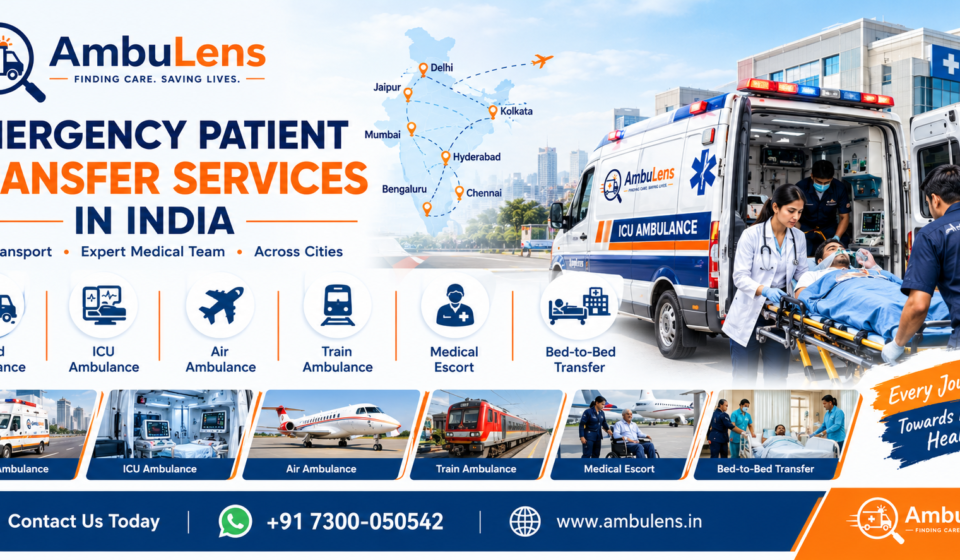

Medical emergencies can change within minutes. When a patient needs treatment at another hospital, emergency patient transfer services in India can help arrange safe and medically appropriate transportation.
However, moving a critically ill patient requires more than a vehicle. The patient may need trained medical staff, monitoring equipment, oxygen, ventilator support, or an ICU ambulance.
Therefore, families should choose transportation according to the patient’s condition, distance, and medical requirements.
What Is Emergency Patient Transfer?
Emergency patient transfer means moving a patient from one healthcare facility or location to another when timely medical treatment is required.
The transfer may take place:
- From home to a hospital
- From one hospital to another
- From an emergency department to a specialised centre
- From a smaller city to a metropolitan hospital
- From an airport to a hospital
- Between hospitals in different states
The goal is to maintain appropriate medical support throughout the journey.
For example, a patient in Jaipur may need transfer to Delhi for specialised treatment. Similarly, a patient in Mumbai may need transfer to another hospital with advanced critical care facilities.
When Is Emergency Patient Transfer Required?
Doctors may recommend a transfer when the current facility cannot provide the required treatment.
Common situations include:
Need for Specialised Treatment
A patient may require a specialist, procedure, or advanced facility that is unavailable at the current hospital.
Critical Medical Condition
Patients with severe medical conditions may require continuous monitoring during transportation.
ICU Requirement
Some patients need ICU-level support at the destination hospital.
Advanced Surgery
A patient may need to reach a hospital with specialised surgical facilities.
Organ or Transplant Care
Patients requiring transplant-related treatment may need transportation to a specialised centre.
Post-Surgery Complications
A patient with complications may require transfer to a hospital with advanced critical care.
Types of Emergency Patient Transfer Services
Different patients require different levels of medical support. Therefore, the transportation method should be selected after assessing the patient’s condition.
Road Ambulance
A road ambulance in India can provide short and long-distance patient transportation.
It can be useful for transfers within a city or between nearby cities.
Ambulance options may include basic, advanced, ICU, and ventilator-equipped vehicles.
Learn more about Road Ambulance Services.
ICU Ambulance
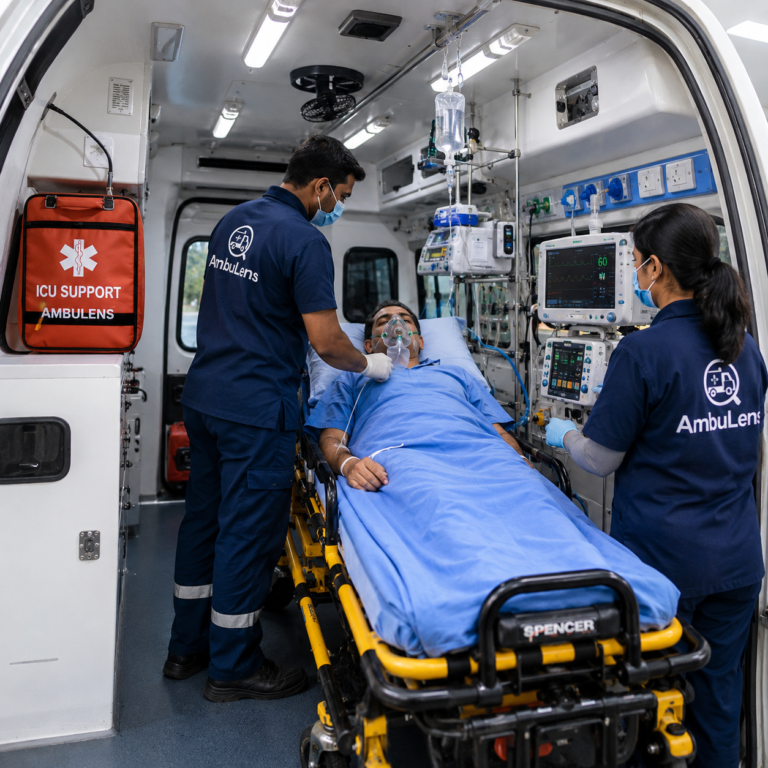
An ICU ambulance works like a mobile critical-care unit.
It can support patients who need close monitoring during transportation.
Depending on the patient’s requirements, the ambulance may include:
- Cardiac monitoring
- Oxygen support
- Ventilator
- Emergency medicines
- Infusion pumps
- Airway equipment
- Life-support equipment
- Trained medical professionals
For example, a critically ill patient travelling from Jaipur to Delhi may require an ICU ambulance.
You can also read our guide on How ICU Patient Transfer Works in India.
Ventilator Ambulance
Patients who depend on mechanical ventilation need specialised transportation.
A ventilator ambulance provides respiratory support throughout the journey. Medical staff can also monitor the patient’s condition and manage the equipment during transportation.
This option may be required for patients with:
- Severe respiratory problems
- Respiratory failure
- Prolonged ventilator dependence
- Serious neurological conditions
- Critical post-operative complications
Read more about Ventilator Ambulance Services in Jaipur.
Air Ambulance
Long-distance transfers can become difficult by road, especially when the patient needs urgent treatment.
In such cases, an air ambulance in India may provide faster transportation.
Air ambulances use specially equipped aircraft and medical teams for patients who require dedicated medical care during flight.
They can support domestic and international transfers.
Learn more about Air Ambulance Services in India.
You can also read our Complete Guide to Air Ambulance Services in India.
Hospital-to-Hospital Patient Transfer
Hospital-to-hospital transfers are common when a patient needs treatment at a facility with better resources.
For instance, a patient may need to move from a district hospital to a tertiary-care centre.
The transfer process can involve:
- Medical assessment
- Destination hospital confirmation
- Ambulance selection
- Medical team coordination
- Equipment preparation
- Patient pickup
- Safe transportation
- Hospital handover
Proper communication between both hospitals helps reduce delays.
Read our detailed guide on Hospital-to-Hospital Patient Transfer Service.
Emergency Patient Transfer Across Indian Cities
India has a large healthcare network. However, specialised treatment may not always be available in every city.
Therefore, patients may need transfers between cities.
Jaipur to Delhi
Patients may require transfer from Jaipur to Delhi for specialised treatment or advanced critical care.
Depending on the condition, road or air ambulance services may be considered.
Read about Air Ambulance from Jaipur to Delhi.
Jaipur to Mumbai
Some patients may need specialised treatment available in Mumbai.
Medical transportation can be arranged according to the patient’s stability and support requirements.
Read more about Patient Transfer from Jaipur to Mumbai.
Mumbai to Other Cities
Mumbai has several advanced hospitals. Patients may still need transfers to another city based on specialist availability or treatment requirements.
AmbuLens can help coordinate suitable transportation for such journeys.
How Emergency Patient Transfer Works
A well-planned transfer usually follows several steps.
Step 1: Patient Assessment
The medical team reviews the patient’s condition, diagnosis, mobility, oxygen needs, and current treatment.
Step 2: Destination Confirmation
The receiving hospital should confirm that it can accept the patient.
Step 3: Transportation Selection
The appropriate ambulance or aircraft is selected according to the patient’s condition.
Step 4: Medical Team Planning
The provider arranges suitable doctors, nurses, or paramedics when required.
Step 5: Equipment Preparation
The team prepares oxygen, monitoring devices, ventilators, medicines, and other required equipment.
Step 6: Patient Pickup
The medical team collects the patient from the agreed location.
Step 7: Continuous Monitoring
During transportation, the team monitors the patient’s condition and provides required medical support.
Step 8: Hospital Handover
At the destination, the medical team hands over the patient and relevant medical information to the receiving hospital.
What Equipment May Be Required?
Equipment depends on the patient’s condition.
An emergency transfer may require:
- Oxygen cylinders
- Cardiac monitor
- Pulse oximeter
- Ventilator
- Defibrillator
- Infusion pump
- Suction equipment
- Emergency medicines
- Airway management equipment
- Stretcher
- Wheelchair
Not every patient needs all these items.
Therefore, medical assessment should happen before transportation.
Medical Team for Patient Transfer
The medical team depends on the patient’s clinical needs.
A stable patient may need basic assistance. On the other hand, a critically ill patient may require a doctor, critical-care nurse, or trained paramedic.
The team can help with:
- Vital-sign monitoring
- Medication administration
- Oxygen management
- Ventilator management
- Airway support
- Emergency response
- Patient positioning
- Hospital handover
This medical support becomes especially important during long-distance transfers.
Bed-to-Bed Emergency Patient Transfer
Bed-to-bed transportation provides coordinated support from the patient’s current bed to the destination hospital bed.
The process may include:
Current hospital → Ambulance → Airport → Air ambulance/commercial flight → Destination airport → Ambulance → Receiving hospital
For road transfers, the journey can move directly from the current hospital to the destination hospital.
This approach reduces the need for families to coordinate multiple transportation providers.
Emergency Patient Transfer for International Patients
International patients may require transportation after arriving in India.
For example, a patient may arrive at Mumbai Airport, Delhi Airport, or Jaipur Airport and need immediate transfer to a hospital.
Depending on the medical condition, the patient may require:
- Airport medical assistance
- Wheelchair support
- Road ambulance
- ICU ambulance
- Medical escort
- Air ambulance
- Hospital admission coordination
AmbuLens also supports Medical Escort Services in India for medically stable patients who can travel on commercial flights with professional medical assistance.
Emergency Patient Transfer vs Regular Transportation
Regular transportation is generally unsuitable for patients who need medical monitoring or emergency support.
| Emergency Medical Transfer | Regular Transportation |
|---|---|
| Medical assessment | Usually no medical assessment |
| Trained medical staff | No medical team |
| Medical equipment | Standard vehicle equipment |
| Oxygen support when required | Usually unavailable |
| Patient monitoring | Usually unavailable |
| Emergency response capability | Limited |
| Hospital coordination | Can be coordinated |
Therefore, families should not choose regular transportation simply because the journey appears short.
How to Prepare for an Emergency Transfer
Families can help the process move smoothly by keeping important information ready.
Keep Medical Reports Ready
Collect prescriptions, test reports, scans, discharge summaries, and treatment records.
Share the Patient’s Condition
Tell the ambulance provider about oxygen requirements, mobility limitations, ventilator dependence, and current treatment.
Confirm the Destination Hospital
Make sure the receiving hospital has accepted the patient.
Prepare Current Medicines
Keep the patient’s current medication information available.
Keep Emergency Contacts Ready
Save the treating doctor’s number, hospital contact, family contacts, and ambulance provider’s number.
Why Choose AmbuLens for Emergency Patient Transfer?
AmbuLens provides medical transportation solutions across India.
The services include:
- Road ambulance
- ICU ambulance
- Ventilator ambulance
- Air ambulance
- Train ambulance
- Medical escort
- Hospital-to-hospital transfer
- International medical transportation
- Human repatriation
AmbuLens can coordinate transfers across cities such as Jaipur, Delhi, Mumbai, Bangalore, Chennai, Hyderabad, Kolkata, Ahmedabad, and Pune.
The team can help assess transportation requirements and coordinate the appropriate medical support.
For critical cases, timely coordination can help families reach the required healthcare facility without unnecessary transportation delays.
Frequently Asked Questions
What is emergency patient transfer?
Emergency patient transfer involves moving a patient to another location or hospital when timely medical treatment or specialised care is required.
When does a patient need an ICU ambulance?
A patient may need an ICU ambulance when continuous monitoring, advanced life support, oxygen, or other critical-care support is required during transportation.
Can a critical patient be transferred between cities?
Yes. Critical patients can be transferred between cities when medically appropriate. Road or air ambulance transportation can be selected according to the patient’s condition and distance.
Can AmbuLens transfer patients between hospitals?
Yes. AmbuLens provides hospital-to-hospital patient transfer services across India.
Can patients travel from Jaipur to Delhi by ambulance?
Yes. Patients can travel from Jaipur to Delhi by suitable road ambulance. Depending on the patient’s condition, an ICU or ventilator ambulance may be required.
Is air ambulance suitable for every patient?
No. Air ambulance transportation is generally considered when the patient’s condition, distance, urgency, and medical requirements make dedicated air transportation appropriate.