
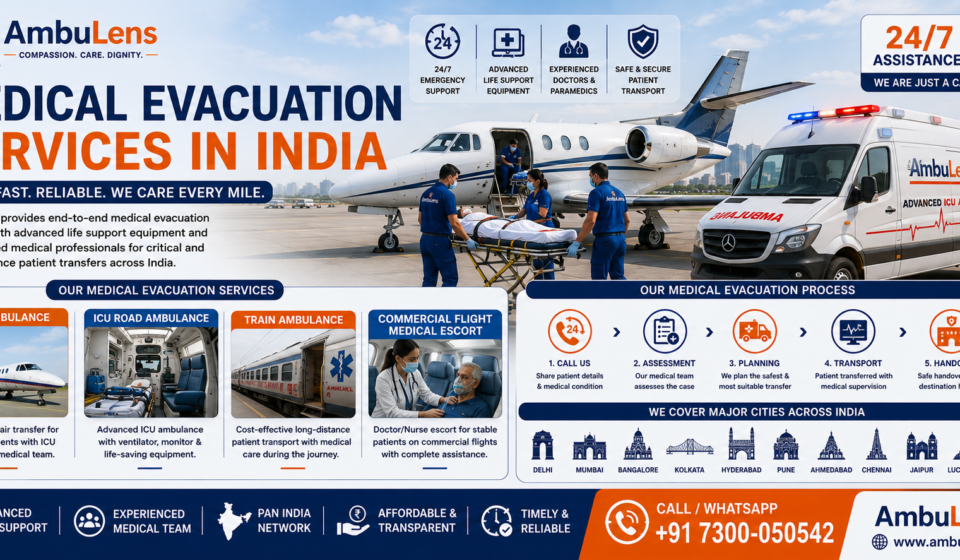

A medical emergency can become even more challenging when the required treatment is not available nearby. In such situations, medical evacuation services in India can help move a patient safely from one location to another while providing appropriate medical support during the journey.
Medical evacuation may involve an air ambulance, ICU ambulance, train ambulance, commercial flight medical escort, or another medically supervised transport option. The right choice depends on the patient’s condition, distance, urgency, and required level of care.
AmbuLens provides medical transportation and emergency transfer support across major Indian cities, including Delhi, Mumbai, Bangalore, Kolkata, Hyderabad, Pune, Ahmedabad, Chennai, Jaipur, Lucknow, Bhopal, Indore, Kochi, Nagpur, Bhubaneswar, and Patna.
What Is Medical Evacuation?
Medical evacuation is the planned transportation of a patient from one location to another when medical supervision or specialised transportation is required.
The destination may be:
- A specialised hospital
- An ICU facility
- A trauma centre
- A rehabilitation centre
- A diagnostic centre
- The patient’s home
- Another city or state
Unlike ordinary transportation, medical evacuation focuses on maintaining the patient’s safety and medical stability throughout the journey.
Depending on the patient’s condition, the transfer may require:
- Doctor support
- Nurse or paramedic support
- Oxygen
- Ventilator
- Cardiac monitoring
- Infusion pumps
- Emergency medicines
- Stretcher support
- ICU-level equipment
Therefore, medical evacuation should begin with a proper assessment of the patient’s condition.
When Does a Patient Need Medical Evacuation?
Not every patient requires specialised medical evacuation.
However, it can become necessary when the patient needs medical supervision during long-distance travel.
Common situations include:
Critical Illness
Patients with serious medical conditions may require continuous monitoring during transportation.
Trauma
Patients involved in major accidents may need supervised transportation to a specialised trauma centre.
Cardiac Emergencies
Some cardiac patients may require oxygen, monitoring, and medical supervision during transfer.
Stroke
Patients with neurological emergencies may require careful handling and rapid access to specialised care.
Ventilator Support
Patients dependent on mechanical ventilation cannot usually travel through ordinary transportation.
Post-Surgery Transfer
Some patients need transfer to another hospital after major surgery.
ICU-to-ICU Transfer
A patient may need to move from one ICU to another because the receiving hospital has specialised facilities.
Long-Distance Medical Travel
A patient may need to travel from one state to another for advanced treatment.
In such cases, a medically equipped ambulance or air ambulance may provide a safer option.
Types of Medical Evacuation Services in India
India has several medical transportation options.
The most suitable option depends on the patient’s condition and travel distance.
1. Air Ambulance Services
Air ambulances can transport critically ill patients over long distances in significantly less travel time than road transportation.
They may include:
- ICU equipment
- Ventilator
- Oxygen
- Cardiac monitor
- Infusion pumps
- Emergency medicines
- Doctor
- Critical-care nurse
- Paramedic
AmbuLens describes its air ambulance service as rapid medical transportation for critically ill or injured patients across long distances.
Air ambulance services can be particularly useful for interstate and time-sensitive transfers.
2. ICU Road Ambulance
An ICU ambulance provides advanced medical support during road transportation.
It can be suitable for:
- ICU patients
- Ventilator patients
- Cardiac patients
- Stroke patients
- Post-operative patients
- Trauma patients
The vehicle may include:
- Ventilator
- Oxygen
- Cardiac monitor
- Defibrillator
- Infusion pump
- Suction equipment
- Emergency medicines
Road ambulance evacuation can work well when the destination is within practical driving distance.
3. Train Ambulance Services
Train ambulances can provide an economical option for long-distance patient transportation.
They can be considered when:
- The patient is stable enough for rail travel.
- The journey is long.
- Air ambulance costs are not suitable.
- Continuous medical support is still required.
Depending on medical requirements, train ambulance arrangements can include doctors, nurses, paramedics, oxygen, monitors, and other equipment.
4. Commercial Flight Medical Escort
Some patients do not require a dedicated air ambulance.
Instead, a medically trained professional can accompany the patient on a commercial flight.
This option can work for patients who are medically stable enough to fly but still require assistance.
The service may involve:
- Doctor escort
- Nurse escort
- Wheelchair assistance
- Stretcher arrangements
- Oxygen coordination
- Airport assistance
- Ground ambulance transfers
However, airline approval and medical fitness requirements must be confirmed before travel.
Air Ambulance vs Medical Escort
Families often confuse these two services.
| Air Ambulance | Medical Escort |
|---|---|
| Dedicated aircraft | Commercial passenger flight |
| Suitable for critical patients | Generally for medically stable patients |
| ICU-level setup can be available | Equipment depends on airline approval |
| Dedicated medical team | Medical professional accompanies patient |
| Faster point-to-point medical transfer | Uses scheduled commercial flight |
| Higher cost | Usually more economical |
Therefore, the patient’s medical condition should guide the decision.
How Medical Evacuation Works in India
A professional medical evacuation generally follows several stages.
Step 1: Medical Assessment
First, the patient’s condition is reviewed.
The medical team may ask for:
- Diagnosis
- Current treatment
- Vital signs
- Oxygen requirement
- Ventilator requirement
- Recent medical reports
- Medication details
- Hospital information
This information helps determine the appropriate transportation method.
Step 2: Choose the Transportation Mode
The medical team considers:
- Medical condition
- Distance
- Urgency
- Destination
- Required equipment
- Flight availability
- Ground accessibility
The options may include:
Road Ambulance → Train Ambulance → Medical Escort → Air Ambulance
The safest practical option should be selected.
Step 3: Coordinate With the Current Hospital
Hospital coordination is important before transferring a patient.
The team may arrange:
- Medical records
- Discharge summary
- Transfer documents
- Medication details
- Patient reports
- Doctor-to-doctor communication
This helps the receiving hospital prepare for admission.
Step 4: Arrange the Ambulance or Aircraft
Once the transportation method is confirmed, the team coordinates the required vehicle or aircraft.
For air ambulance transportation, this can include:
- Aircraft availability
- Medical crew
- Equipment
- Flight permissions
- Airport coordination
- Ground ambulances
Step 5: Prepare Medical Equipment
Equipment depends on the patient’s condition.
Possible equipment includes:
- Ventilator
- Oxygen
- Cardiac monitor
- Defibrillator
- Infusion pumps
- Suction unit
- Emergency medicines
- Portable ICU equipment
Not every patient needs every piece of equipment.
Therefore, the medical assessment should determine the setup.
Step 6: Hospital Pickup
The patient is transferred from the hospital bed to the transportation vehicle.
Medical staff monitor the patient during the transfer.
For critical patients, the team should maintain appropriate life-support measures throughout the process.
Step 7: Medical Transportation
During transportation, the medical team monitors the patient’s condition.
Depending on the case, they may monitor:
- Heart rate
- Blood pressure
- Oxygen saturation
- Respiratory status
- Temperature
- Medication requirements
The team responds to changes according to the patient’s medical plan.
Step 8: Destination Hospital Transfer
After reaching the destination, the patient is transferred to the receiving medical facility.
The medical team communicates important information to the receiving hospital.
This creates continuity between the two facilities.
Medical Evacuation from Mumbai
Mumbai is one of India’s major healthcare centres.
Patients may require medical evacuation from Mumbai to:
- Delhi
- Bangalore
- Chennai
- Hyderabad
- Kolkata
- Jaipur
- Ahmedabad
- Lucknow
- Pune
- Kochi
Medical evacuation from Mumbai may involve road ambulance, train ambulance, commercial medical escort, or air ambulance.
AmbuLens currently lists Mumbai among its major service locations and provides medical transportation support across India.
Medical Evacuation from Delhi
Delhi serves as an important medical hub for patients from northern and central India.
Patients may travel from Delhi to specialised hospitals in other cities.
Medical evacuation can support:
- ICU transfers
- Trauma transfers
- Post-surgical transfers
- Ventilator transfers
- Long-distance patient transportation
Medical Evacuation from Jaipur
Patients from Rajasthan may require transportation to Delhi, Mumbai, Ahmedabad, Bangalore, or other healthcare centres.
Depending on the patient’s condition, families can consider:
- ICU road ambulance
- Train ambulance
- Medical escort
- Air ambulance
AmbuLens lists Jaipur among the cities it serves.
Medical Evacuation from Bangalore
Bangalore has numerous specialised hospitals and receives patients from across southern India.
Medical evacuation services can help transfer patients between hospitals or bring patients to specialised treatment centres.
The appropriate transportation method depends on medical stability and distance.
Medical Evacuation from Hyderabad
Patients in Hyderabad may require long-distance transfers to Mumbai, Delhi, Bangalore, Chennai, or other cities.
Air ambulance services can reduce travel time for patients who require urgent long-distance transportation.
Medical Evacuation from Kolkata
Medical evacuation from Kolkata can connect patients with specialised treatment facilities across India.
For long-distance transfers, families can consider air ambulance or train ambulance services depending on the patient’s condition.
Medical Evacuation from Chennai
Patients requiring advanced treatment outside Chennai may need supervised transportation.
Road, rail, commercial flight medical escort, and air ambulance options can be considered after medical assessment.
Medical Evacuation from Ahmedabad
Ahmedabad serves as an important healthcare centre in western India.
Patients may require evacuation to Mumbai, Delhi, Bangalore, Jaipur, or other cities.
The safest option depends on medical urgency and stability.
Medical Evacuation from Pune
Pune is well connected to Mumbai and other major cities.
For stable patients, road transportation may be practical.
For critical patients travelling longer distances, air ambulance or another medically supervised option may be more appropriate.
Who Can Accompany the Patient?
The medical team depends on the patient’s condition.
It may include:
- Emergency physician
- Critical-care doctor
- Nurse
- Paramedic
- Respiratory therapist
A stable patient may require less intensive medical staffing.
Meanwhile, a ventilator-dependent or critically ill patient may require a higher level of clinical support.
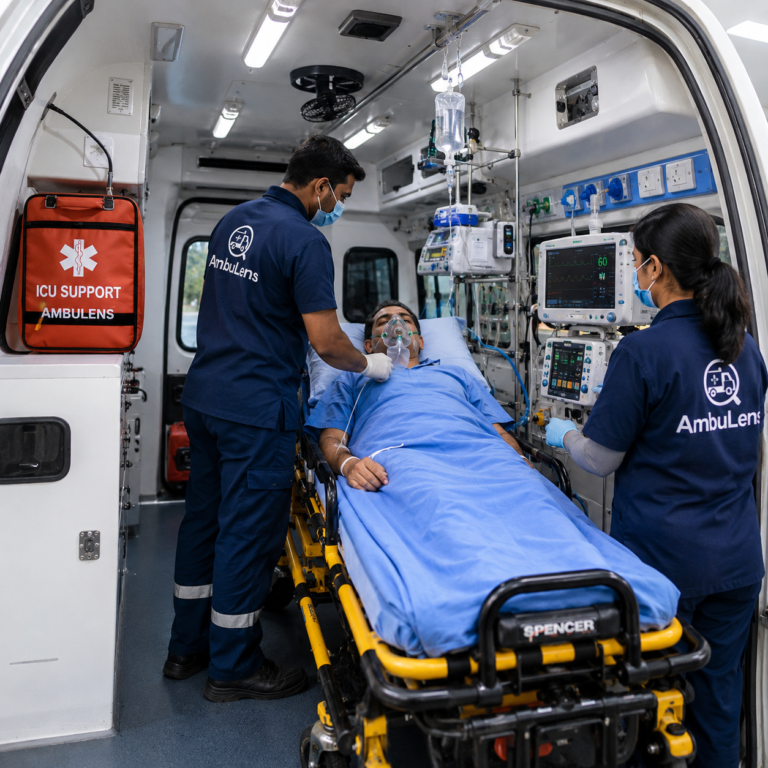
Medical Equipment Used During Evacuation
Medical evacuation equipment varies according to the patient’s needs.
Common equipment can include:
Ventilator
Provides mechanical breathing support when required.
Cardiac Monitor
Allows the medical team to monitor heart rhythm and vital signs.
Oxygen
Supports patients who require supplemental oxygen.
Defibrillator
Provides emergency cardiac support when clinically indicated.
Infusion Pump
Helps deliver medications or fluids at controlled rates.
Suction Unit
Helps clear secretions from the airway.
Emergency Medicines
The medical team carries medicines according to the patient’s condition and clinical requirements.
Documents Required for Medical Evacuation
The exact documentation depends on the transportation method and receiving facility.
Families should generally keep:
- Patient identification
- Medical reports
- Diagnosis documents
- Prescription
- Discharge summary
- Doctor’s referral
- Recent investigation reports
- Medication details
- Receiving hospital information
- Insurance documents, where applicable
For commercial flights, the airline may require additional medical clearance.
Therefore, families should confirm airline requirements before booking.
Medical Evacuation for Ventilator Patients
Ventilator-dependent patients require specialised planning.
The team should assess:
- Ventilator settings
- Oxygen requirement
- Patient stability
- Airway management
- Medication requirements
- Monitoring needs
- Transport duration
For long-distance transfers, an ICU-equipped air ambulance may be considered when clinically appropriate.
A road or train ICU ambulance may also be suitable for certain stable patients.
Medical Evacuation for ICU Patients
An ICU patient should not be transported through ordinary means without appropriate medical assessment.
The transfer plan may include:
- ICU equipment
- Critical-care doctor
- Nurse or paramedic
- Oxygen
- Ventilator support
- Cardiac monitoring
- Medication
- Hospital-to-hospital coordination
The receiving ICU should also confirm bed availability before departure.
Medical Evacuation for Stable Patients
Not every medical transfer requires an air ambulance.
A stable patient may travel by:
- Road ambulance
- Train ambulance
- Commercial flight with medical escort
The medical team should assess whether the patient can safely tolerate the selected mode of travel.
This approach can help families choose a medically appropriate and cost-conscious option.
How Much Does Medical Evacuation Cost in India?
There is no single fixed price.
The total cost depends on:
- Distance
- Transportation method
- Patient’s condition
- Medical equipment
- Medical team
- Aircraft type
- Airport charges
- Ground ambulance requirements
- Flight availability
- Destination
For example, air ambulance transportation generally costs more than road or train transportation because it involves aircraft operations and specialised medical support.
AmbuLens states that ambulance charges depend on factors such as distance, ambulance type, medical equipment, and location.
Therefore, families should request a case-specific quotation.
How Long Does Medical Evacuation Take?
The timeline depends on the transportation method and urgency.
Road transfers depend on:
- Distance
- Traffic
- Route
- Weather
Train transfers depend on:
- Train availability
- Railway coordination
- Route
Air ambulance transfers depend on:
- Aircraft availability
- Medical clearance
- Flight permissions
- Weather
- Airport availability
Commercial medical escort transfers depend on:
- Airline schedule
- Medical clearance
- Stretcher or wheelchair availability
- Airline approval
Therefore, a confirmed timeline should be provided after reviewing the patient’s case.
Benefits of Professional Medical Evacuation Services
Professional coordination offers several benefits.
Medical Supervision
Patients receive appropriate medical support during transportation.
Faster Long-Distance Transfer
Air transportation can significantly reduce travel time.
Appropriate Equipment
Equipment can be selected according to the patient’s medical needs.
Hospital Coordination
The team can coordinate with both the sending and receiving hospitals.
Door-to-Door Support
Ground ambulances can connect the hospital, airport, and destination facility.
24/7 Assistance
Medical emergencies can occur at any time. AmbuLens states that it provides 24/7 assistance and patient transportation support.
Why Choose AmbuLens for Medical Evacuation in India?
AmbuLens describes itself as an emergency medical transportation company providing patient transfer services across India and internationally. Its listed services include air ambulance, road ambulance, medical support, and human repatriation.
Its medical transportation support can include:
- Air ambulance
- Road ambulance
- Train ambulance
- Medical travel
- ICU patient transfers
- Long-distance patient transportation
- Hospital coordination
- 24/7 assistance
AmbuLens lists service coverage across major cities, including Mumbai, Delhi, Bangalore, Kolkata, Hyderabad, Chennai, Jaipur, Ahmedabad, Pune, Lucknow, and other locations.
How to Arrange Medical Evacuation in India
The process can be simple when you have the necessary information ready.
Step 1: Call the Medical Evacuation Team
Share the patient’s current location and destination.
Step 2: Explain the Patient’s Condition
Provide the diagnosis, oxygen requirement, ventilator status, and recent medical reports.
Step 3: Share the Medical Records
The medical team reviews the patient’s condition.
Step 4: Select the Transportation Method
The team helps determine whether road ambulance, train ambulance, medical escort, or air ambulance is appropriate.
Step 5: Coordinate With Hospitals
The sending and receiving hospitals are contacted.
Step 6: Arrange Medical Equipment
The required equipment and medical professionals are assigned.
Step 7: Transfer the Patient
The patient travels under the planned level of medical supervision.
Step 8: Handover at the Destination
The patient is transferred to the receiving hospital or facility.
Important Factors to Consider Before Booking
Before selecting a medical evacuation service, check:
- Patient’s current medical condition
- Required medical equipment
- Medical team qualifications
- Transportation method
- Hospital bed availability
- Flight availability
- Ground ambulance arrangements
- Total estimated cost
- Documentation requirements
- Destination hospital coordination
Most importantly, do not choose transportation based on price alone.
The patient’s medical requirements should remain the priority.
Conclusion
Medical evacuation services in India provide an important solution when a patient needs safe, medically supervised transportation between hospitals, cities, or states.
Depending on the patient’s condition, the right option may be an ICU road ambulance, train ambulance, commercial flight medical escort, or air ambulance.
Therefore, families should arrange a medical assessment before selecting the transportation method. Proper hospital coordination, suitable medical equipment, trained professionals, and destination planning can make the transfer safer and more organised.
AmbuLens provides medical transportation support across major Indian cities and states, with 24/7 assistance for patients requiring emergency or long-distance transfers.
Frequently Asked Questions
1. What are medical evacuation services in India?
Medical evacuation services transport patients who require medical supervision or specialised support during travel. Options can include road ambulance, train ambulance, medical escort, and air ambulance.
2. When is an air ambulance required?
An air ambulance may be considered when a patient requires rapid long-distance transportation and needs medical monitoring or advanced support during the journey.
3. Can ventilator patients be transported?
Yes, ventilator-dependent patients can be transported with appropriate medical equipment and trained medical professionals, provided the patient is assessed as fit for the selected mode of transportation.
4. Is medical evacuation available between Indian cities?
Yes. Medical transportation can be arranged between many Indian cities, subject to availability and the patient’s medical requirements.
5. Is an air ambulance faster than a road ambulance?
For long-distance journeys, an air ambulance can significantly reduce travel time. However, the complete journey also includes ground transfers and airport procedures.