
During a medical emergency, one of the most important decisions doctors make is selecting the safest mode of transportation for the patient. While road ambulances are suitable for many situations, some patients require much faster transportation with uninterrupted intensive care. Therefore, doctors carefully evaluate several medical and logistical factors before recommending an Air Ambulance.
Understanding how this decision is made helps families appreciate why Air Ambulance Services can become essential in critical situations.
At AmbuLens, we provide 24/7 Air Ambulance Services across India with ICU-equipped aircraft, experienced doctors, critical care nurses, ventilator support, and advanced life-support equipment.
What is an Air Ambulance?
An Air Ambulance is a specially equipped aircraft designed to transport critically ill or injured patients while providing continuous medical treatment during the journey.
Unlike commercial flights, Air Ambulances function as flying intensive care units.
Each aircraft includes:
- Portable ventilator
- Cardiac monitor
- Defibrillator
- Oxygen support
- Infusion pumps
- Syringe pumps
- Emergency medicines
- Experienced medical team
Consequently, patients continue receiving critical care without interruption.
Why Do Doctors Recommend an Air Ambulance?
Doctors recommend Air Ambulance only after carefully evaluating whether the benefits outweigh other transportation options.
Their goal remains simple:
Transport the patient safely while minimizing treatment delays.
Therefore, every recommendation is based on medical necessity rather than convenience.
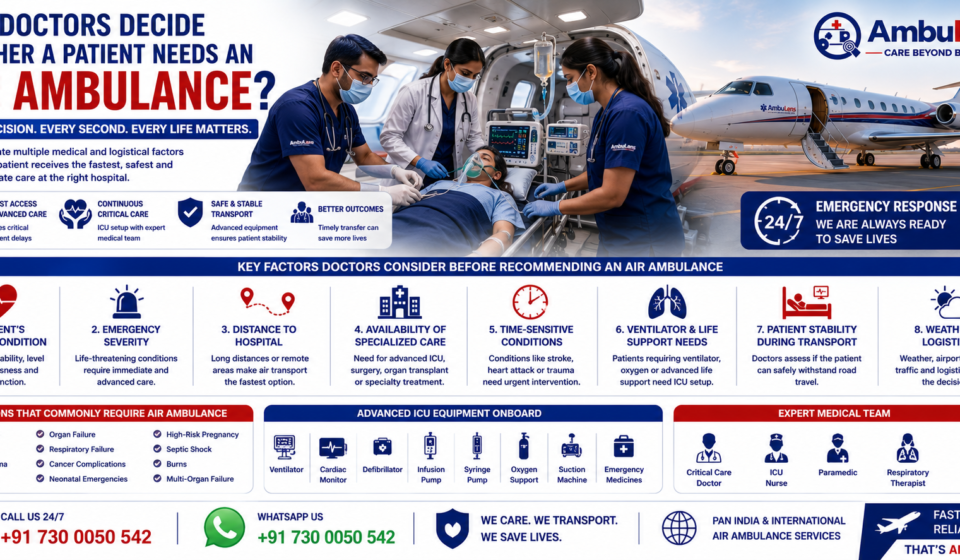
Factors Doctors Consider Before Choosing an Air Ambulance
1. Patient’s Medical Condition
The patient’s condition is the most important deciding factor.
Doctors evaluate:
- Level of consciousness
- Blood pressure
- Heart rate
- Oxygen saturation
- Respiratory function
- Neurological condition
- Organ function
Patients with unstable vital signs often require faster transportation.
2. Medical Emergency Severity
Air Ambulance becomes necessary during severe emergencies such as:
- Heart attack
- Stroke
- Polytrauma
- Brain injury
- Organ failure
- Respiratory failure
- Septic shock
Therefore, rapid transportation improves access to specialized treatment.
3. Distance to the Receiving Hospital
Doctors compare travel time by road and air.
When road transportation could significantly delay treatment, Air Ambulance becomes the preferred option.
Examples include:
- Interstate transfers
- Remote villages
- Mountain regions
- Island locations
Consequently, patients reach advanced hospitals much faster.
4. Availability of Specialized Treatment
Some hospitals cannot provide advanced treatment.
Doctors may recommend transfer when patients require:
- Cardiac surgery
- Neurosurgery
- Organ transplantation
- Advanced ICU
- Neonatal intensive care
- Burn treatment
Therefore, Air Ambulance helps patients reach specialty hospitals without delay.
5. Time-Sensitive Medical Conditions
Certain treatments have limited time windows.
Examples include:
- Stroke thrombolysis
- Heart attack intervention
- Organ transplantation
- Trauma surgery
In these situations, every minute matters.
6. Ventilator Dependency
Patients dependent on ventilators require uninterrupted respiratory support.
Doctors evaluate:
- Ventilator settings
- Oxygen requirement
- Airway stability
- Respiratory reserve
Accordingly, ICU-equipped Air Ambulances become the safest option.
7. Patient Stability During Transportation
Before approving transportation, doctors assess whether patients can tolerate travel.
They monitor:
- Blood pressure stability
- Cardiac rhythm
- Oxygen levels
- Neurological status
If road transportation presents greater risk, Air Ambulance may be recommended.
8. Weather and Logistics
Doctors also consider practical factors.
These include:
- Weather conditions
- Airport accessibility
- Road congestion
- Travel distance
- Emergency response time
Therefore, transportation decisions balance medical urgency with operational feasibility.
Conditions That Frequently Require Air Ambulance
Doctors commonly recommend Air Ambulance for:
- Heart attack
- Stroke
- Severe trauma
- Organ transplant
- Cancer complications
- Neonatal emergencies
- High-risk pregnancy
- Brain injury
- Respiratory failure
- Multi-organ failure
Consequently, patients receive faster access to specialized care.
Medical Team Onboard
Air Ambulances include experienced healthcare professionals.
Depending on the patient’s condition, the team may include:
- Critical care doctor
- Emergency physician
- ICU nurse
- Paramedic
- Respiratory therapist
As a result, continuous medical care remains available throughout the flight.
Equipment Available in an Air Ambulance
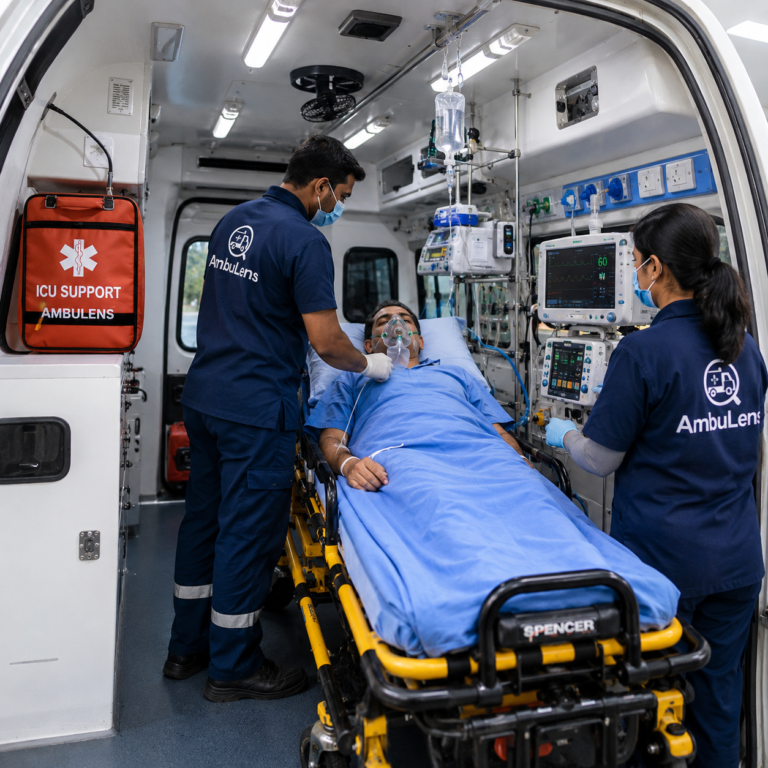
Every Air Ambulance functions like a flying ICU.
Equipment includes:
- Portable ventilator
- Cardiac monitor
- Defibrillator
- Oxygen support
- Infusion pumps
- Syringe pumps
- Suction machine
- Emergency medicines
- Portable ICU equipment
Therefore, critically ill patients remain medically stable during transportation.
Benefits of Doctor-Supervised Air Ambulance Transport
Professional Air Ambulance transportation offers several advantages.
These include:
- Faster transportation
- Reduced treatment delays
- Continuous ICU monitoring
- Advanced life support
- Experienced medical professionals
- Better survival chances
Consequently, patients receive uninterrupted emergency care.
Why Choose AmbuLens?
AmbuLens provides trusted Air Ambulance Services throughout India.
We offer:
- 24/7 emergency response
- ICU-equipped aircraft
- Experienced doctors
- Critical care nurses
- Medical Escort Services
- Nationwide coverage
- International patient transfers
- Transparent pricing
Therefore, families receive complete medical transportation support.
Cost of Air Ambulance
Several factors determine pricing.
These include:
- Travel distance
- Aircraft type
- Medical equipment
- Ventilator support
- Medical team
- Airport charges
- Patient condition
Accordingly, customized quotations are provided after medical assessment.
Conclusion
Doctors recommend an Air Ambulance only after carefully assessing the patient’s medical condition, travel distance, treatment urgency, and transportation risks. Their objective is to ensure the safest and fastest transfer while maintaining uninterrupted critical care.
AmbuLens provides 24/7 Air Ambulance Services across India with experienced healthcare professionals, advanced life-support equipment, and comprehensive medical coordination for every emergency.
Frequently Asked Questions (FAQs)
Who decides whether a patient needs an Air Ambulance?
The treating doctor evaluates the patient’s medical condition, transportation risks, travel distance, and urgency before recommending an Air Ambulance.
Is Air Ambulance only for critically ill patients?
Most Air Ambulance patients are critically ill, but doctors also recommend it for organ transplants, neonatal care, and long-distance emergency transfers.
Can ventilator patients travel by Air Ambulance?
Yes. Air Ambulances carry portable ventilators and advanced ICU equipment.
Does AmbuLens provide doctor accompaniment?
Yes. Depending on the patient’s condition, experienced doctors, ICU nurses, and trained paramedics accompany every Air Ambulance mission.
Is Air Ambulance available across India?
Yes. AmbuLens provides Air Ambulance Services throughout India as well as international patient transportation.