
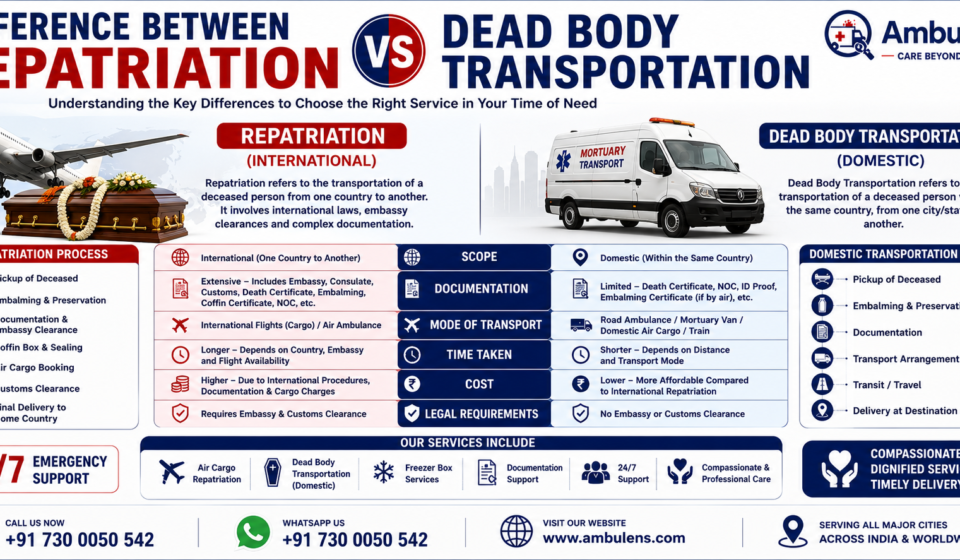

Losing a loved one is one of life’s most difficult experiences. However, families often become confused when they hear terms like repatriation and dead body transportation. Although both services involve transferring human remains, they differ significantly in terms of distance, legal procedures, and documentation.
Therefore, understanding the difference between repatriation and dead body transportation helps families choose the right service during an emotional and challenging time.
What Is Repatriation?
Repatriation refers to transporting a deceased person from one country to another. In most cases, families choose repatriation when a loved one passes away abroad and they wish to bring the body back to their home country.
For example:
- Bringing a deceased Indian citizen from the UAE to Mumbai.
- Transporting a body from the United States to Delhi.
- Returning human remains from Singapore to Chennai.
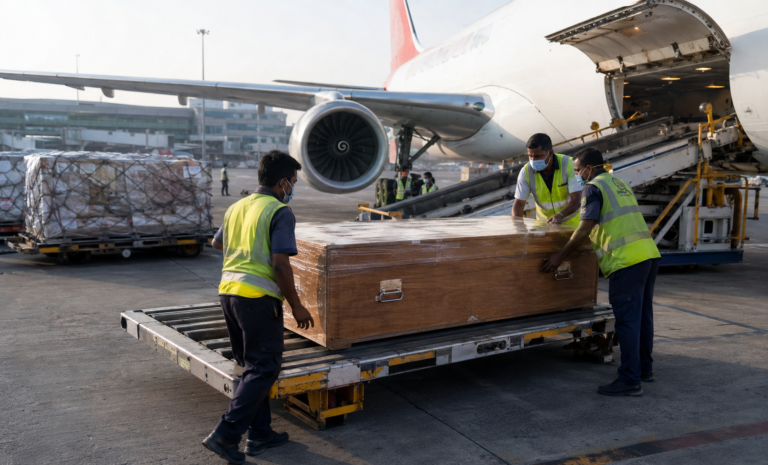
International transportation involves extensive documentation, embassy coordination, and airline cargo procedures.
Learn more about our International Repatriation Services in India.
What Is Dead Body Transportation?
Dead body transportation refers to transferring human remains within the same country. The transportation may occur between cities, districts, or states.
For example:
- Dead Body Transportation from Mumbai to Patna
- Dead Body Transportation from Delhi to Kolkata
- Dead Body Transportation from Bangalore to Chennai
- Dead Body Transportation from Mumbai to Srinagar
Professional providers arrange transportation through road ambulances, mortuary vans, and domestic air cargo services.
Explore our Dead Body Transportation Services in India.
Key Difference Between Repatriation and Dead Body Transportation
| Feature | Repatriation | Dead Body Transportation |
|---|---|---|
| Coverage | International transfer | Domestic transfer |
| Documentation | Embassy and international documents | State and domestic documents |
| Transportation Mode | International flights | Air cargo or road transportation |
| Processing Time | Usually longer | Generally faster |
| Legal Procedures | More complex | Comparatively simpler |
| Customs Clearance | Required | Not required |
| Consular Approval | Required in most cases | Not required |
| Cost | Higher | More affordable |
Therefore, the main difference lies in whether the transportation occurs internationally or within India.
When Is Repatriation Required?
Families generally require repatriation services in the following situations:
Death During Overseas Employment
Many Indian citizens work abroad. Therefore, families often need repatriation services to bring their loved ones home.
Death During International Travel
Tourists and business travelers may require international transportation arrangements.
Medical Emergencies Abroad
Patients who pass away during treatment overseas may require repatriation.
Foreign Nationals Passing Away in India
International transportation also becomes necessary when foreign citizens die in India.
When Is Dead Body Transportation Required?
Domestic transportation becomes necessary in various situations.
Interstate Transportation
Families may wish to perform final rites in their hometown.
Religious Preferences
Many people prefer cremation or burial in their native city.
Family Convenience
Transportation allows relatives and friends to participate in funeral ceremonies.
Hospital Referrals
Patients may pass away while receiving treatment in another state.
Documents Required for Repatriation
International transportation requires extensive documentation.
Generally, families need:
- Original Death Certificate
- Passport of the deceased
- Embalming Certificate
- Coffin Box Certificate
- Police Clearance Certificate
- No Objection Certificate
- Consular Mortuary Certificate
- Embassy Clearance
- Identity proof of family members
These requirements vary depending on the country involved.
For assistance, visit our International Human Remains Transportation Services page.
Documents Required for Domestic Dead Body Transportation
Domestic transportation requires fewer documents.
Families generally need:
- Original Death Certificate
- Aadhaar Card or Government ID
- No Objection Certificate
- Hospital documents
- Identity proof of family members
- Embalming Certificate for air transportation
- Coffin Box Certificate for air transportation
Consequently, domestic transportation often takes less time.
Transportation Methods Used in Both Services
Repatriation Services
International transportation generally uses:
- International airline cargo services
- Air ambulances in special situations
- International mortuary services
- Embassy coordination
Dead Body Transportation Services
Domestic transportation generally uses:
- Road ambulance services
- Mortuary vans
- Domestic air cargo services
- Train transportation services
Learn more about our Air Cargo Dead Body Transportation Services.
How Long Do These Services Take?
Repatriation Timeline
International transportation may take between 24 and 96 hours depending on documentation and embassy approvals.
Domestic Transportation Timeline
Domestic transportation generally takes:
- Air Cargo: A few hours after documentation
- Road Transportation: 12 to 48 hours depending on distance
Therefore, domestic transfers usually happen faster.
Cost Difference Between Repatriation and Dead Body Transportation
Several factors influence the cost of both services.
Repatriation Costs Depend On:
- Country of origin
- International flight charges
- Embassy fees
- Documentation requirements
- Local transportation
Domestic Transportation Costs Depend On:
- Distance between cities
- Transportation method
- Freezer box requirements
- Embalming services
- Air cargo charges
As a result, international repatriation generally costs more than domestic transportation.
Why Professional Assistance Is Important
Both services involve sensitive procedures and legal requirements. Therefore, professional providers ensure:
- Complete documentation support
- Transportation coordination
- Preservation arrangements
- Airport assistance
- Compassionate guidance
- Timely transportation
Families can focus on emotional and religious responsibilities while experts handle the logistics.
Why Choose AmbuLens?
AmbuLens offers:
- 24/7 assistance across India
- Domestic and international transportation services
- Air cargo and road transportation solutions
- Embalming and freezer box services
- End-to-end documentation support
- Compassionate and experienced teams
Consequently, families receive reliable assistance during difficult moments.
Conclusion
Understanding the difference between repatriation and dead body transportation helps families choose the appropriate service during emergencies.
Repatriation involves international transportation and extensive documentation, whereas dead body transportation refers to domestic transfers within India. Although both services share the same objective of transporting human remains respectfully, their procedures, timelines, and costs differ significantly.
Professional transportation providers simplify the entire process and ensure safe, dignified, and timely transportation.
Frequently Asked Questions (FAQs)
What is the main difference between repatriation and dead body transportation?
Repatriation involves international transportation of human remains, while dead body transportation refers to domestic transfers within the same country.
Does repatriation require embassy approval?
Yes. Most international transportation cases require embassy or consular clearance.
Which service costs more?
International repatriation generally costs more because of airline charges and legal procedures.
Can air cargo services transport bodies within India?
Yes. Domestic air cargo services transport human remains between major Indian cities.
Are both services available 24/7?
Yes. Professional transportation providers offer round-the-clock assistance for domestic and international transportation.