
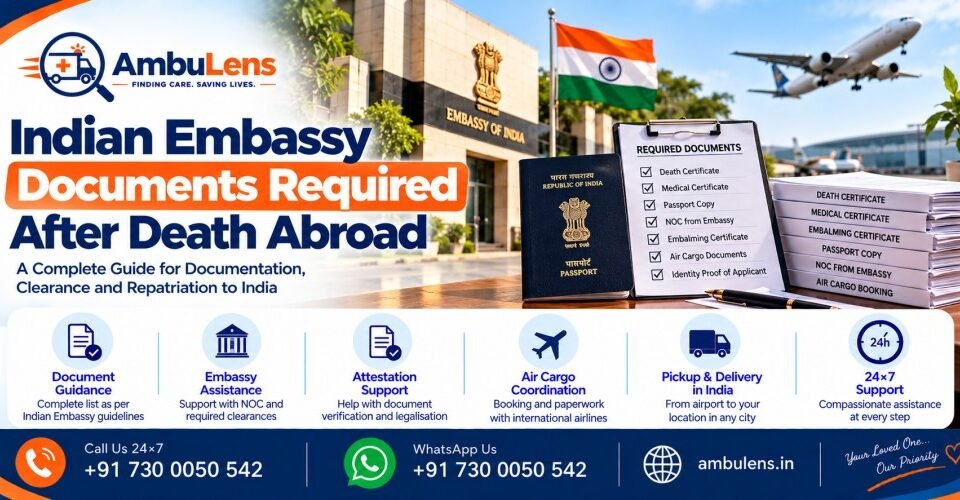

When an Indian national dies overseas, the family may need to register the death with the responsible Indian Embassy or Consulate before bringing the mortal remains to India.
The Embassy helps families understand consular procedures and coordinate with local authorities. In addition, it may help facilitate transportation or local burial according to the family’s wishes. The required documents vary by country and the circumstances of the death.
Families should first decide whether they wish to repatriate the deceased to India or arrange local final rites. If they choose repatriation, they can use the following checklist as a starting point.
Indian Embassy Documents Required After Death Abroad
The exact checklist depends on the country, but the following documents commonly play an important role.
1. Medical Report or Death Certificate
Obtain the medical report or official death certificate from the hospital or relevant local authority. The document should include accurate details about the deceased.
Check whether the receiving authorities require an English translation. For example, India’s eCARe portal specifies English translations for relevant documents issued in another language.
2. Police Report for Accidental or Unnatural Death
If the death resulted from an accident or other unnatural circumstances, authorities may require a detailed police report.
If the report uses another language, arrange an English translation where required. Moreover, police investigations may delay the release of the deceased, so families should follow the local authority’s instructions.
3. Consent Letter from the Next of Kin
The Indian Embassy may ask the next of kin to provide written consent for transporting the mortal remains to India. The family may also need to specify whether it prefers local burial or cremation.
The Ministry of External Affairs lists a notarised consent letter among the usual documents for registering a death at the Indian Mission. Confirm the required wording and attestation process with the relevant Embassy or Consulate.
4. Passport and Visa Copies
Keep copies of the deceased’s passport and relevant visa pages. The authorities use these documents to confirm identity and process the required formalities.
The family may also need to arrange passport cancellation or submit a cancelled passport copy for transportation clearance in India. Requirements can differ for Indian citizens, NRIs and OCI cardholders, so check the applicable instructions.
5. Embalming Certificate
International air transportation commonly requires an embalming certificate that meets the relevant authorities’ requirements.
The certificate may need to identify the procedure, chemicals used and packaging details. Therefore, ask the local funeral service provider to confirm the required format before issuing it.
6. No Objection Certificate (NOC) from the Indian Embassy
The NOC forms an important part of the documentation for bringing mortal remains to India. The responsible Indian Mission or Consulate issues it after reviewing the relevant requirements.
The NOC should contain accurate details about the deceased. Check the name, passport information, date of death and place of death before submitting it for clearance.
7. Packaging Certificate and Health Documents
Air transportation requires suitable packaging and compliance with the applicable rules. The service provider should coordinate the relevant certificates with the authorities.
Depending on the case, officials may also request a non-infectious disease certificate, transit permit or additional medical records. The eCARe portal lists packaging and other supporting documents among the requirements that authorities may request.
8. Legal Heir Consent or Power of Attorney
The family may need to provide consent from the legal heir or a power of attorney authorising a representative to manage the transportation process.
The exact requirement depends on the circumstances and the authority handling the case. Confirm whether notarisation, attestation or a prescribed format applies before submitting the documents.
Documents Required for Clearance After Arrival in India
Consular registration and transportation approval are not the only steps. The receiving team must also coordinate the required public health clearance at the Indian airport.
The eCARe portal lists these documents for human remains arriving in India:
Embalming certificate
Death certificate
NOC from the Indian Embassy of the country concerned
Cancelled passport copy
Certificate confirming packaging according to applicable WHO guidelines
Officials may also request a consignee endorsement or additional supporting documents.
For a broader overview of domestic documentation, read our guide on documents required for dead body transportation in India.
Step-by-Step Process After a Death Abroad
Step 1: Report the Death to the Local Authorities
First, contact the hospital, police or relevant authority in the country where the death occurred. Obtain the official medical and death records.
If an investigation is underway, follow the authorities’ instructions before arranging release.
Step 2: Contact the Indian Embassy or Consulate
Next, contact the Indian Mission responsible for the location. Ask about death registration, the NOC, consent forms and the latest document checklist.
The Embassy can also explain the appropriate consular process and coordinate with local authorities when necessary.
Step 3: Arrange Document Translation and Attestation
If local documents use another language, arrange certified English translations where required. In addition, confirm whether the Embassy or another authority needs notarisation or attestation.
Review every document for consistent names, dates and passport details. This can help reduce avoidable queries.
Step 4: Arrange Embalming and Transportation Documents
Coordinate with a suitable local funeral service provider for preparation, embalming and compliant packaging. Obtain the required certificates and release documents.
Then confirm the airline’s cargo requirements before finalising the booking.
Step 5: Apply for Clearance in India
The receiving person or authorised service provider should coordinate the eCARe application and upload the required documents.
Step 6: Arrange Airport Collection and Final Delivery
After clearance, the receiving team can coordinate collection and onward transportation. Confirm the destination address and road transfer requirements in advance.
For more details, read What Happens When a Dead Body Reaches the Destination Airport?.
Dead Body Transportation Services to Major Indian Cities
After completing the required consular and clearance formalities, families may arrange transportation to their preferred city in India. The arrival airport and final road journey will depend on the available route and delivery address.
Dead Body Transportation in Delhi
Families arranging dead body transportation to Delhi should confirm the receiving airport, clearance arrangements and final delivery address. If the deceased needs transportation beyond Delhi, ask about the additional road transfer.
Dead Body Transportation in Mumbai
For dead body transportation to Mumbai, confirm the cargo route, airport collection and local delivery arrangements. A detailed quotation can help families understand the included services.
Dead Body Transportation in Jaipur
Families requesting dead body transportation to Jaipur should check the arrival airport and road transportation options. The provider can explain whether the route requires an additional transfer.
For local arrangements, visit our Dead Body Transportation Service in Jaipur.
Dead Body Transportation in Chennai
For Chennai, confirm the receiving arrangements and any documents needed before collection. Also, check whether the quoted service includes airport handling and delivery to the final address.
Dead Body Transportation in Bengaluru
Families arranging dead body transportation to Bengaluru should share the destination address and receiving contact details. This helps the provider assess the required transportation arrangements.
For these cities, confirm the complete route and all charges before proceeding. You can also review the AmbuLens Dead Body Transportation Service and Dead Body Transportation in India service pages.
What If the Family Cannot Afford Repatriation?
International repatriation can create financial pressure, especially when families must arrange documentation, preparation and air cargo.
First, check whether the deceased had insurance that covers transportation. Next, contact the Indian Embassy or Consulate to ask about possible assistance.
The Ministry of External Affairs states that an Indian Mission may consider requests for financial assistance based on the circumstances and applicable assessment. Families should contact the relevant Mission for current eligibility and procedures.
Related Resources
Frequently Asked Questions
1. What documents does the Indian Embassy require after a death abroad?
Common documents include a medical report or death certificate, passport and visa copies, next-of-kin consent and, in cases involving accidents or unnatural deaths, a police report. Repatriation may also require embalming records, a transportation permit and an Embassy NOC.
2. Is an Indian Embassy NOC required to bring a dead body to India?
Yes. The NOC is part of the documents required for public health clearance of human remains arriving in India. Families should contact the responsible Indian Mission for the procedure.
3. Is a police report mandatory after every death abroad?
A detailed police report is commonly required for accidental or unnatural deaths. Requirements may differ depending on the circumstances and local regulations.
4. Do foreign death certificates need English translation?
The authorities may require an English translation when the original certificate uses another language. Check the relevant Embassy’s requirements and the eCARe document guidelines before submitting it.
5. What documents are required at the Indian airport?
The eCARe process generally requires an embalming certificate, death certificate, Indian Embassy NOC and cancelled passport copy. Officials may also request packaging certification and additional supporting documents.
6. How long does the Indian Embassy process take after a death abroad?
There is no single timeline for every country. Local investigations, document availability, translations, consular processing and transportation arrangements can affect the duration. Ask the responsible Embassy and service provider for a case-specific estimate.
7. Can the Indian Embassy help arrange transportation if the family has no money?
The Indian Mission may consider assistance in eligible cases. Families should contact the relevant Embassy or Consulate to understand the application process and whether support is available.