


Losing a loved one in another country is an extremely difficult experience. Along with grief, families may need to arrange international transportation, complete legal formalities and coordinate with authorities. Understanding how to bring a dead body from another country to India can make this process easier to manage.
The procedure usually involves obtaining a death certificate, completing embassy formalities, arranging embalming and a suitable sealed coffin, securing the required clearances and booking air cargo. However, the exact requirements depend on the country where the death occurred.
AmbuLens provides human repatriation support to help families coordinate documentation, transportation arrangements and delivery in India. With the right guidance, families can manage the necessary steps while giving their loved one a dignified farewell.
What Is International Dead Body Transportation?
International dead body transportation, also called human repatriation of mortal remains, refers to transporting a deceased person from one country to another for final rites.
For example, if an Indian citizen passes away in the United States, the United Kingdom, Canada, Australia or the United Arab Emirates, their family may wish to bring the mortal remains to India. This requires coordination between local authorities, the Indian Embassy or Consulate, the airline and the receiving family.
Moreover, families must follow the regulations of both the departure country and India. Therefore, it is important to confirm the requirements before making travel arrangements.
How to Bring a Dead Body from Abroad to India: Step-by-Step Process
Step 1: Obtain the Death Certificate
The first step is to obtain an official death certificate from the relevant hospital, local authority or government department in the country where the death occurred.
The document should clearly state the deceased person’s details and cause of death. If the certificate is issued in another language, an English translation may also be required.
In cases involving an accident, an unnatural death or an ongoing investigation, the authorities may request additional documents. These may include a police report, post-mortem report or other official records.
Step 2: Contact the Indian Embassy or Consulate
Next, contact the Indian Embassy or Consulate responsible for the country where the death occurred. The relevant mission can explain the local procedure for registering the death and obtaining the necessary no-objection certificate (NOC).
The family may need to submit the deceased person’s passport, death certificate, consent from the next of kin and other supporting documents. Requirements can vary by country.
The embassy or consulate can also explain the procedure for passport cancellation and other consular formalities. Therefore, contact the relevant mission before finalising the transportation arrangements.
Step 3: Arrange Embalming and a Suitable Coffin
International air transportation generally requires the body to undergo embalming by an authorised provider. The remains must also be placed in suitable packaging and a properly sealed coffin or casket according to applicable regulations.
The service provider should arrange the required embalming certificate and packaging documentation. Depending on the country, authorities may also request a certificate confirming that the remains are safe for transportation.
Additionally, some countries require the coffin to be sealed or inspected under official supervision. Confirm these requirements with the local authorities, embassy and airline before booking the shipment.
Step 4: Prepare the Required Documents
Proper documentation is essential for bringing mortal remains to India. Missing or inconsistent records can delay the process.
The commonly required documents include:
- Official death certificate mentioning the cause of death.
- Embalming certificate.
- No-objection certificate issued by the relevant Indian Embassy, High Commission or Consulate.
- Cancelled passport of the deceased, or other documentation accepted by the authorities.
- Certificate of packaging in accordance with applicable guidelines.
- Police report or post-mortem report, where applicable.
- Consent or authorisation from the next of kin, where required.
- Other documents requested by the departure country, airline or Indian authorities.
The precise list may differ according to the circumstances. Therefore, verify the latest requirements before submitting an application.
Step 5: Apply for eCARe Clearance in India
India uses the e-Clearance for Afterlife Remains (eCARe) portal for the public health clearance of human remains arriving from abroad.
The receiving party or authorised representative should check the current application process and submit the required documents through the official portal.
The standard documents listed by the Ministry of Health and Family Welfare include the death certificate, embalming certificate, NOC from the relevant Indian diplomatic mission and the cancelled passport. Additional documents may be requested where applicable.
Importantly, eCARe clearance and embassy formalities serve different purposes. Completing one does not automatically mean that every other approval has been obtained.
Step 6: Book International Air Cargo
Once the necessary documents and clearances are being processed, arrangements can be made with an airline or an authorised human repatriation service provider.
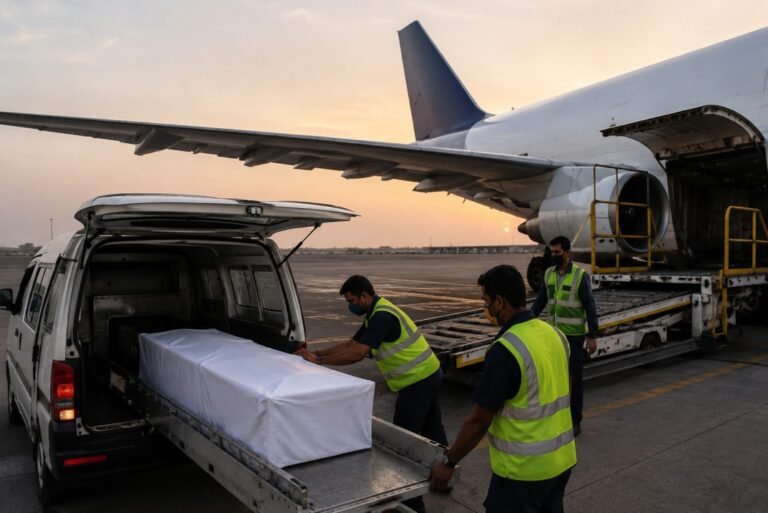
International air cargo is commonly used to transport mortal remains over long distances. The booking depends on the departure airport, destination airport, airline requirements, available routes and documentation status.
The service provider can help coordinate the shipment, confirm the required paperwork and communicate with the airline. The family should also identify who will receive the remains at the Indian airport.
Before confirming the booking, ask for a clear explanation of the charges, expected schedule and any additional requirements.
Step 7: Arrange Collection and Transportation in India
After the remains arrive in India, the receiving party must follow the airport’s clearance and collection procedure.
Once the necessary approvals are complete, the remains can be collected by the authorised person or service provider. Further transportation can then be arranged to the family’s home city or the location where the final rites will take place.
For example, families may require dead body transportation in Mumbai, Delhi, Jaipur, Bengaluru, Chennai, Hyderabad or another Indian city.
Depending on the distance and circumstances, the onward journey may be arranged by road or another suitable transport option. Coordination between the airport, transporter and family helps reduce avoidable complications.
Documents Required to Bring a Dead Body to India
The following table provides a general overview of the documents that families may need.
| Document | Purpose |
|---|---|
| Death certificate | Official confirmation of the death and its cause |
| Embalming certificate | Confirms that embalming has been completed |
| Embassy or Consulate NOC | Supports authorisation for transportation |
| Cancelled passport | Forms part of the standard clearance documentation |
| Packaging certificate | Documents compliance with applicable packaging requirements |
| Police or post-mortem report | May be required for accidental, unnatural or investigated deaths |
| Family consent or authorisation | Establishes permission or authority where required |
| Additional local permits | May be required by the departure country or other authorities |
This is a general checklist, not a universal list. Always confirm the exact documents with the relevant embassy, local authorities, airline and eCARe portal.
How Long Does It Take to Bring Mortal Remains to India?
The time required depends on the country, documentation, airline schedules and clearance procedures.
A straightforward case may progress faster than a case involving an investigation or additional approvals. Furthermore, weekends, public holidays, translation requirements and missing paperwork may affect the schedule.
Deaths involving police investigations or post-mortem procedures can take longer because the local authorities may need to complete their inquiries before releasing the remains.
For this reason, families should avoid relying on a fixed timeline until the relevant authorities and service provider have reviewed the case.
What Is the Cost of Bringing a Dead Body from Another Country to India?
The cost of international dead body transportation depends on several factors. These include the country of departure, distance, airline cargo charges, embalming, coffin preparation, documentation, local handling and onward transportation within India.
Additional expenses may arise if the case requires translations, special permits, extended storage or further investigation-related formalities.
For an accurate estimate, share the departure country and city, destination city in India, and current documentation status with a repatriation service provider.
Families arranging dead body transportation in Mumbai, Delhi, Jaipur or other Indian cities should also confirm whether the quotation includes airport collection and final delivery.
How AmbuLens Can Help with International Dead Body Repatriation
Managing international transportation during bereavement can be emotionally and administratively demanding. AmbuLens offers human repatriation support to help families coordinate the process.
Depending on the case and applicable requirements, assistance may include:
- Guidance on the required documentation.
- Coordination for embalming and coffin arrangements.
- Assistance with airline cargo booking.
- Coordination with relevant authorities and airport teams.
- Support with international transportation arrangements.
- Onward dead body transportation to the required destination in India.
The exact service scope, feasibility, costs and timelines should be confirmed after reviewing the case details.
To learn more, visit the AmbuLens International Human Repatriation service page.
Families who need onward transportation can also explore AmbuLens Domestic Dead Body Transportation Services.
Important Things to Remember Before Arranging Transportation
Before booking international transportation, keep these points in mind:
- Contact the relevant Indian Embassy or Consulate early.
- Check the departure country’s rules for releasing and exporting mortal remains.
- Confirm the current eCARe requirements.
- Ensure that names and other details match across all documents.
- Ask the airline about packaging, cargo acceptance and booking requirements.
- Confirm who will receive the remains at the Indian airport.
- Obtain a written quotation that explains the services and charges.
- Keep copies of the documents and contact details of everyone coordinating the process.
Most importantly, do not assume that the procedure is identical in every country. Official requirements may change, so confirm them before proceeding.
Internal Links
International human repatriation services
Dead body transportation across India
Frequently Asked Questions
1. How can I bring a dead body from another country to India?
Obtain the death certificate, contact the relevant Indian Embassy or Consulate, arrange embalming and compliant packaging, collect the required approvals, complete eCARe clearance and book international transportation. The exact steps depend on the country and circumstances.
2. What documents are required to bring a dead body to India?
Common requirements include the death certificate, embalming certificate, embassy or consulate NOC and cancelled passport. Packaging documents, police reports, family authorisation and other permits may also be required.
3. Is an embassy NOC required for international dead body transportation?
The Indian eCARe portal lists an NOC from the relevant Indian Embassy, High Commission or Consulate among the standard documents for clearance. Confirm the current requirements with the responsible authorities.
4. Is eCARe clearance necessary to bring mortal remains to India?
Public health clearance is required for human remains arriving in India. The eCARe portal provides the relevant electronic clearance process, subject to its current rules and applicable exceptions.
5. How long does international dead body transportation take?
There is no single timeline for every case. Processing depends on documentation, local release procedures, official clearances, airline schedules and whether an investigation is underway.
6. How much does it cost to bring a dead body to India?
The cost varies according to the departure country, airline charges, embalming, coffin arrangements, documentation and onward transportation. Request a case-specific quotation before confirming the service.
7. Can AmbuLens arrange dead body transportation from abroad to cities such as Mumbai, Delhi or Jaipur?
AmbuLens lists international human repatriation and domestic transportation services. Contact the team to confirm availability, destination coverage, documentation support and the arrangements required for your specific case.