
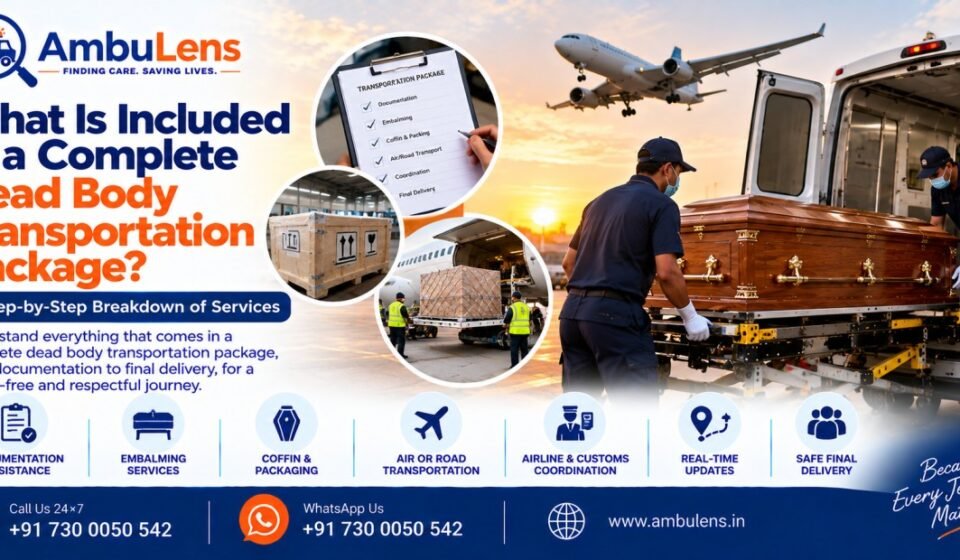

Arranging transportation after a death can feel overwhelming. Families must manage documents, preparation, transport, and final delivery.
A complete dead body transportation package brings these steps together. The exact services depend on the route, airline, road transport, and case requirements.
This guide explains what families can expect from a complete package.
What Is a Dead Body Transportation Package?
A dead body transportation package covers the main arrangements needed to move human remains.
It may include:
- Body collection
- Documentation support
- Embalming coordination
- Coffin or approved packaging
- Road ambulance or hearse
- Airline cargo booking
- Airport coordination
- Destination pickup
- Final delivery
- Human repatriation support
However, every case is different. Therefore, the final package should match the route and transport method.
1. Body Collection and Initial Coordination
First, the service provider collects basic details about the case.
These details may include:
- Place of death
- Destination
- Date of transportation
- Cause of death
- Contact details of the family
- Preferred transport method
The deceased may be collected from a hospital, mortuary, residence, or another approved location.
In addition, the team can coordinate with the concerned facility before collection.
2. Documentation Support
Documents are an important part of the process.
Therefore, families should prepare the required paperwork before booking transportation.
Documents may include:
- Death certificate
- Identification documents
- Embalming certificate
- Police certificate or clearance, when applicable
- Coffin or packaging certificate
- Airline documents
- Consular documents for international movement
Requirements can vary by airline, destination, and case.
For example, Air India currently lists a death certificate and police certificate for domestic human remains. It also lists an embalming certificate when remains travel in a coffin.
For human remains arriving in India from abroad, the MoHFW eCARe portal lists an embalming certificate, death certificate, Indian Embassy NOC, cancelled passport, and packaging certificate among the clearance documents.
3. Embalming Coordination
Embalming may be required before air transportation.
An authorised facility should perform the procedure when required.
The embalming certificate is also important for documentation.
For example, the MoHFW eCARe portal requires the certificate to include details about the chemical used and the procedure. It also asks for packaging information.
Therefore, families should check these details before submitting documents.
4. Coffin and Packaging Preparation
Proper packaging is another key part of the package.
For air transportation, the coffin must meet the airline’s requirements.
Air India states that used coffins are not accepted. It also requires suitable packing material and specific handling labels for non-cremated remains.
The package may include:
- Coffin arrangement
- Protective packing
- Sealing
- Required labels
- Shipper details
- Consignee details
- Handling instructions
However, requirements can differ between airlines.
Therefore, the selected airline should confirm the current packaging rules.
5. Road Ambulance or Hearse Service
Road transportation may be required at several stages.
For example, a vehicle may collect the deceased from a hospital. It may also transport the remains to an airport.
After arrival, another vehicle may take the deceased to the final destination.
This is especially useful for dead body transportation in Jaipur, Mumbai, Delhi, Bangalore, Chennai, Hyderabad, and other cities.
For local and interstate movement, families can review the Dead Body Transportation Service offered by AmbuLens.
6. Airline Cargo Booking
Air transportation requires coordination with the airline’s cargo department.
Human remains generally travel through cargo arrangements rather than regular passenger baggage.
Air India confirms that it carries human remains as bodies in coffins or ashes in urns.
The booking may require:
- Origin airport
- Destination airport
- Deceased person’s details
- Consignor details
- Consignee details
- Required certificates
- Coffin details
- Air waybill information
Therefore, airline requirements should be checked before final booking.
7. Airport Coordination
Airport coordination can simplify the transportation process.
The service provider may help coordinate:
- Cargo acceptance
- Document submission
- Airline communication
- Airport reporting
- Cargo handling
- Destination arrangements
For example, dead body transportation from Mumbai may require coordination with the airline cargo team at the airport.
Likewise, dead body transportation from Jaipur may involve road movement to the selected airport before the air transfer.
8. Destination Pickup
The journey does not end when the flight lands.
The receiving team must collect the human remains from the destination airport.
Therefore, destination planning is an important part of the package.
The service may include:
- Airport cargo coordination
- Document verification
- Local hearse arrangement
- Family coordination
- Final destination delivery
You can also read What Happens When a Dead Body Reaches the Destination Airport? for more information.
9. Final Delivery
Finally, the deceased is transported to the family’s chosen destination.
This may be:
- Home
- Funeral facility
- Cremation ground
- Burial location
- Mortuary
The final road journey depends on the destination and local requirements.
Therefore, families should confirm the final delivery location before booking.
Air vs Road Transportation Package
Both air and road options can be arranged for long-distance movement.
However, the services included can differ.
| Service | Air Transportation | Road Transportation |
|---|---|---|
| Body collection | Usually available | Usually available |
| Documentation support | Important | Important |
| Embalming | May be required | Depends on route and case |
| Coffin | Required for air cargo | Depends on transport rules |
| Airport coordination | Required | Not required |
| Cargo booking | Required | Not required |
| Destination vehicle | Usually needed | May be included |
| Long-distance movement | Possible | Possible |
The right option depends on distance, urgency, airline availability, cost, and family requirements.

City-Based Dead Body Transportation Services
A complete package can also support city-to-city transportation.
For example:
Dead Body Transportation in Jaipur
Families may need collection, documentation, coffin preparation, and road or air coordination.
Dead Body Transportation in Mumbai
Mumbai offers access to major airport cargo facilities. Therefore, air cargo may be considered for distant destinations.
Dead Body Transportation in Delhi
Delhi can serve as an important point for interstate and international human remains transportation.
Dead Body Transportation in Bangalore
Families can arrange road or air movement based on the destination and current transport requirements.
Dead Body Transportation in Chennai
Both local coordination and long-distance transportation may be arranged based on the case.
What Is Usually Not Included Automatically?
A complete package does not mean every service is included at one fixed price.
Some services may have separate charges.
For example:
- Embalming
- Coffin
- Airline cargo
- Airport handling
- Police documentation
- Consular clearance
- Destination ambulance
- Long-distance road transfer
Therefore, families should request a clear quotation before confirming the service.
Documents Families Should Keep Ready
Before arranging transportation, keep the main documents available.
A simple checklist includes:
- Death certificate
- Deceased person’s identification
- Hospital documents
- Embalming certificate, if applicable
- Police documents, if applicable
- Airline forms
- Packaging documents
- Passport and consular documents for international cases
For international arrivals into India, the MoHFW eCARe portal has specific documentation requirements.
You can also read Air Cargo Documents for Human Remains: Complete Checklist for a detailed document guide.
Common Mistakes to Avoid
Families should avoid last-minute arrangements whenever possible.
Here are some common mistakes:
- Booking before checking airline rules
- Missing important certificates
- Using incomplete documents
- Delaying embalming arrangements
- Ignoring coffin requirements
- Forgetting destination pickup
- Not confirming the final delivery address
Therefore, early coordination can make the process easier to manage.
How AmbuLens Can Help
AmbuLens can help families coordinate different parts of human remains transportation.
Support may include:
- Dead body transportation
- Road ambulance arrangements
- Air cargo coordination
- Embalming coordination
- Coffin arrangements
- Documentation support
- Airport coordination
- Destination pickup
- Interstate transportation
- Human repatriation
For international cases, requirements can be more detailed. Therefore, families should confirm the current airline and government requirements before transportation.
For more information, visit the Dead Body Transportation Service.
Internal Links
Frequently Asked Questions
What does a complete dead body transportation package include?
It may include body collection, documents, embalming coordination, coffin preparation, transportation, airport coordination, and final delivery.
Is embalming included in every package?
Not always. Embalming depends on the transport method, airline, destination, and case requirements.
Is a coffin required for air transportation?
For non-cremated human remains, airlines have specific coffin and packaging requirements. Air India currently requires an embalming certificate when a body travels in a coffin.
Does the package include airport handling?
Airport coordination can be included, depending on the service package. However, airport and airline charges may apply separately.
Can dead body transportation be arranged between different cities?
Yes. Road and air options can be arranged for interstate transportation. The suitable method depends on the route and requirements.
What documents are required for international transportation?
Requirements depend on the origin and destination countries. For human remains arriving in India, MoHFW eCARe lists documents such as an embalming certificate, death certificate, Embassy NOC, and cancelled passport.
How much does a complete dead body transportation package cost?
There is no single fixed price. The total depends on distance, transport method, airline cargo, coffin, embalming, documentation, airport handling, and destination services.