


When a loved one passes away abroad, families often want to bring them home as soon as possible. However, international dead body transportation requires several formalities before the journey can begin.
The time depends on the country, cause of death, documentation, official clearances and airline availability. Therefore, families should begin the process promptly and confirm the expected timeline with the relevant authorities.
How Many Days Does It Take to Bring a Dead Body to India?
There is no single timeline for every case. The Ministry of External Affairs provides the following general guidance:
Gulf countries: The normal process generally takes around 2–4 weeks.
Natural death cases: Authorities can often complete formalities more quickly when documents are ready and no investigation is required.
Accidental or unnatural deaths: Police investigations or post-mortem procedures can extend the timeline significantly.
Other countries: The timeline depends on local laws, embassy procedures, paperwork and airline cargo availability.
These are general estimates, not a promise of arrival by a particular date. Always confirm the current timeline for the country involved.
What Steps Affect the Transportation Timeline?
1. Death registration and certificate
First, the family or authorised representative must notify the appropriate local authority. The hospital or competent authority issues the relevant medical documents and death certificate.
If officials need further information about the cause of death, this step may take longer.
2. Police investigation or post-mortem
In cases involving an accident, suspicious circumstances or an unexplained death, local authorities may investigate before releasing the deceased for transportation.
Consequently, the family may need to wait for police clearance, an autopsy report or other official documents. The duration depends on the case.
3. Indian Embassy or Consulate formalities
The family or authorised representative should contact the Indian Embassy or Consulate in the country where the death occurred. The mission can explain the required procedure for registering the death and arranging transportation.
The required documents may include the death certificate, passport, next-of-kin consent, police report where applicable and a No Objection Certificate (NOC).
Requirements vary by country. For official guidance, visit the Ministry of External Affairs — Transfer of Mortal Remains.
4. Embalming and coffin preparation
Before air transportation, the responsible service provider must arrange the required preparation of the deceased. This may include embalming, suitable coffin preparation and the necessary certificates.
The family should confirm the applicable requirements with the local authorities, service provider and airline.
5. Airline cargo booking
Once the paperwork and preparation are complete, the authorised representative can coordinate the air cargo booking.
However, the actual departure depends on the available route, cargo space, airline acceptance and completion of all required clearances.
6. Arrival clearance in India
When the flight reaches India, the receiving representative must coordinate the required airport and public health clearance. The eCARe system supports the clearance process for human remains arriving from abroad.
Read the official eCARe portal for the applicable requirements.
7. Road transportation to the final destination
After the authorities permit release, the family may need to arrange transportation from the arrival airport to the hometown or another chosen destination.
For example, transportation to Jaipur may require an onward road transfer if the flight arrives at another city. Plan this step in advance to reduce avoidable delays.
Documents That Can Help Avoid Delays
Missing paperwork can slow down international transportation. Therefore, ask the relevant Embassy or Consulate for a case-specific document checklist as early as possible.
Common documents may include:
Death certificate or hospital-issued medical report.
Passport of the deceased.
Police report or clearance, if applicable.
Consent or authorisation from the next of kin.
Embassy or Consulate NOC.
Embalming certificate.
Coffin or packaging certificate.
Airline cargo documents and airway bill.
Additional health clearance documents required by Indian authorities.
Not every case requires the same documents. For a detailed checklist, read Documents Required for Dead Body Transportation in India.
How to Reduce Delays When Bringing a Dead Body to India
Although families cannot control every official procedure, a few steps can help the process move forward smoothly.
Contact the Embassy early: Ask for the current process and document checklist.
Keep documents consistent: Check names, passport details and dates across the paperwork.
Respond promptly: Send requested documents or authorisations without unnecessary delays.
Confirm airline requirements: Check cargo acceptance, packaging rules and available routes before finalising arrangements.
Plan arrival arrangements: Identify who will receive the deceased and arrange onward transportation.
Ask for realistic estimates: Request updates from the authorities and service providers handling the case.
Most importantly, do not book non-refundable arrangements based only on a general online estimate.
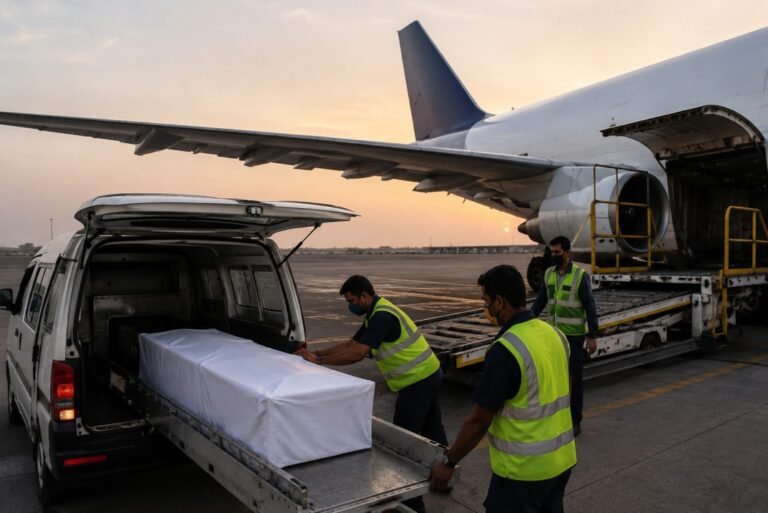
Dead Body Transportation Timelines for Major Indian Cities
The final destination affects the arrival and onward transportation arrangements. However, the city alone does not determine how long the entire international process will take.
Dead Body Transportation to Delhi
For Delhi, confirm the arrival airport, airline cargo schedule, required clearance and receiving arrangements. Delhi may be the final destination or a transit point, depending on the route.
Dead Body Transportation to Mumbai
For Mumbai, check the available flight route and cargo acceptance. Also, arrange the receiving representative and any onward transportation before the flight arrives.
Dead Body Transportation to Jaipur
Families arranging dead body transportation to Jaipur should confirm the most suitable arrival airport and road transfer. The final plan depends on the flight route, clearance and destination requirements.
See our guide to Dead Body Transportation Service in Jaipur.
Dead Body Transportation to Chennai, Bengaluru or Hyderabad
For these cities, confirm the available airline route, airport clearance and local receiving arrangements. If the selected flight arrives at another city, allow time for onward transportation.
For more information about air transportation, read Dead Body Transportation by Flight in India.
What Happens When the Dead Body Reaches India?
Arrival does not always mean immediate release. The receiving representative must complete the applicable clearance requirements before moving the deceased from the airport.
After clearance, the family or its authorised representative can arrange transportation to the final destination.
Read our related guide: What Happens When a Dead Body Reaches the Destination Airport?.
How AmbuLens Can Help
International human repatriation requires coordination between several parties. Families may need assistance understanding documentation, flight arrangements and transportation after arrival.
Contact AmbuLens to discuss your case and confirm the services currently available for your route, including:
International human repatriation coordination.
Dead body transportation arrangements.
Airport-to-destination road transportation.
Transportation planning for Indian cities.
The team can explain the available assistance and provide a case-specific quotation. Service availability and estimated timelines must be confirmed before proceeding.
Related Resources
Frequently Asked Questions
1. How long does it take to bring a dead body to India?
The timeline depends on the country and case. The Ministry of External Affairs gives a general estimate of 2–4 weeks for Gulf countries. Cases involving investigations may take significantly longer.
2. Can a dead body reach India within a few days?
It may be possible in some circumstances, but families should not assume that every case can be completed within a few days. Local procedures, documents, clearance and airline availability affect the timeline.
3. Why does repatriation take longer after an accidental death?
Authorities may need to complete a police investigation, post-mortem examination or other legal formalities before releasing the deceased for transportation.
4. Which documents are needed to bring a dead body to India?
Common documents include the death certificate, passport, next-of-kin consent, applicable police clearance, Embassy NOC, embalming certificate and airline cargo paperwork. Requirements vary by country and case.
5. Does the Indian Embassy help with repatriation?
Yes. The relevant Indian Embassy or Consulate can explain the procedure and help coordinate with local authorities. In eligible cases, it may also consider requests for financial assistance. Contact the relevant mission for current requirements.
6. Does the timeline include transportation to the hometown?
Not always. International repatriation and onward road transportation may involve separate arrangements. Confirm whether the quotation and estimated timeline include delivery to the final destination.
7. How long does dead body transportation to Jaipur take?
There is no universal timeline for Jaipur. The total duration depends on the country of origin, clearances, flight availability, arrival airport and onward transportation arrangements.