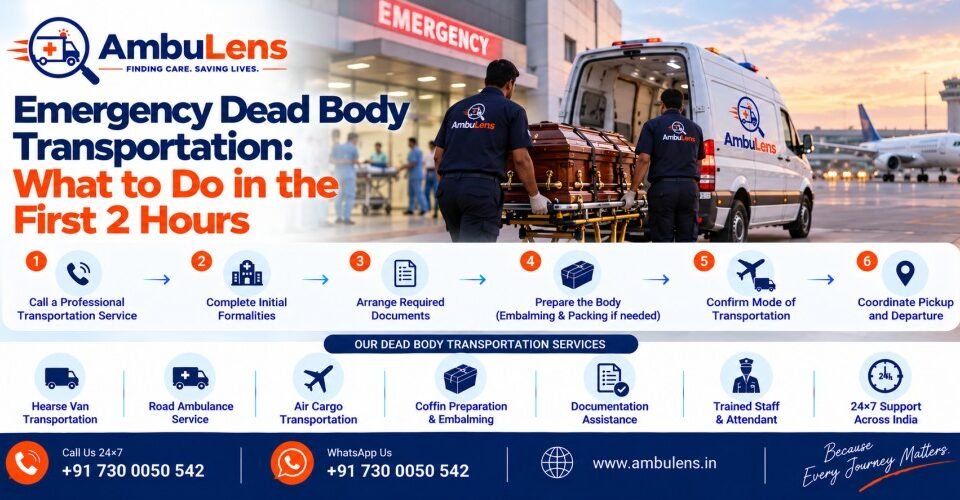

A death can create confusion for every family. The first two hours often feel difficult.
Families must make several decisions during this time. They may also need to arrange documents and transportation.
Quick planning can prevent many delays. It can also make the next steps easier.
This guide explains what to do after a death. It focuses on emergency dead body transportation in India.
What Should You Do First After a Death?
First, confirm the death with the right medical authority.
If the death happens in a hospital, speak with the hospital team. They will explain the next steps.
If the death happens at home, contact a doctor or local authority.
Do not move the body before the required clearance.
Next, collect basic information about the deceased.
You should note:
- Full name
- Date of death
- Time of death
- Place of death
- Hospital or mortuary name
- Cause of death, if known
- Final destination
- Family contact details
This information will help the transportation team.
First 30 Minutes: Complete the Initial Formalities
The first 30 minutes should focus on medical and legal steps.
Ask the hospital about the body release process.
Also, ask which documents you need.
The required documents can vary by case.
They can depend on:
- Place of death
- Cause of death
- Post-mortem requirements
- Police procedures
- Transport method
- Final destination
Therefore, confirm the requirements before making arrangements.
First 30–60 Minutes: Collect Important Documents
Start collecting documents as soon as possible.
Keep all documents in one folder. Also, make digital copies when possible.
Important documents may include:
- Death certificate
- Medical certificate
- Government ID
- Hospital records
- Post-mortem report
- Police documents
- Embalming certificate
- Passport for international transport
The exact list can change with the case.
For more details, read Documents Required for Dead Body Transportation in India.
Check Whether a Post-Mortem Is Required
Some deaths need a post-mortem.
This can happen after an accident or an unnatural death.
It can also happen in a medico-legal case.
Ask the hospital or police about the requirement.
If a post-mortem is required, wait for the official clearance.
Do not arrange final transportation before the body release.
You can read Dead Body Transportation After Post-Mortem: Complete Guide for more information.
Check If Police Clearance Is Required
Some cases need police clearance.
This depends on the circumstances of the death.
Police procedures may apply after:
- Accidents
- Unnatural deaths
- Suspected injuries
- Medico-legal cases
Ask the hospital about the next step.
Also, follow the instructions from local authorities.
You can read Police NOC for Dead Body Transportation for more details.
First 60–90 Minutes: Choose the Transport Method
Now decide how the deceased will travel.
Most families choose between road and air transportation.
The right option depends on several factors.
These include:
- Travel distance
- Urgency
- Documentation
- Airline availability
- Transportation cost
- Destination
- Family requirements
Therefore, compare the options before booking.
Road Dead Body Transportation
Road transportation works well for many routes.
It can be useful for nearby cities and interstate journeys.
A specialised vehicle can collect the deceased from the hospital or mortuary.
The vehicle can then travel directly to the destination.
AmbuLens provides Dead Body Transportation Services across India.
The service can support:
- Body pickup
- Road transportation
- Documentation
- Embalming coordination
- Coffin arrangements
- Destination delivery
For interstate movement, read How to Arrange Dead Body Transportation Between Two Indian States.

Air Dead Body Transportation
Air transportation can help with long-distance travel.
However, air cargo needs more coordination.
Families may need:
- Required documents
- Embalming
- Coffin or approved container
- Airline cargo booking
- Airport clearance
- Destination arrangements
Airline rules can vary.
Therefore, check the current requirements before booking.
For more information, read How to Transfer a Dead Body by Air in India.
First 90–120 Minutes: Arrange Body Preparation
Once you choose the transport method, arrange preparation.
The requirements can differ between road and air transport.
Embalming
Some transportation cases require embalming.
This can be important for air transportation.
It can also apply to international transportation.
Always confirm the requirement before arranging embalming.
Coffin or Approved Container
Air transportation may require a suitable coffin.
Airlines can also have packaging rules.
Therefore, check the requirements before airport delivery.
Mortuary Freezer
A mortuary freezer may help when transport takes time.
It can also help when documents are still pending.
A professional service provider can guide the family.
What Information Should You Give the Ambulance Provider?
Give complete information when you call.
This helps the provider plan the service faster.
Share these details:
- Pickup location
- Destination city
- Date of death
- Current body location
- Cause of death, if known
- Available documents
- Post-mortem status
- Preferred transport method
- Family contact number
For example, you may need dead body transportation from Jaipur to Delhi.
You may also need dead body transportation from Mumbai to Kolkata.
Clear information helps reduce communication delays.
Emergency Dead Body Transportation in Jaipur
Families in Jaipur may need transportation to another city.
Common routes include Delhi, Mumbai, Lucknow, and Patna.
A dead body transportation service in Jaipur can help with these arrangements.
AmbuLens can assist with:
- Road dead body ambulance
- Air cargo coordination
- Documentation
- Embalming
- Coffin arrangements
- Airport coordination
- Destination delivery
You can read:
- Dead Body Transportation Jaipur to Delhi
- Dead Body Transportation Jaipur to Lucknow
- Dead Body Transportation Service in Jaipur
Emergency Dead Body Transportation in Mumbai
Mumbai is another major transportation point.
Families may need road or air transportation from Mumbai.
The route can affect the best option.
Therefore, share the destination with the service provider.
Also, share the available documents.
AmbuLens can help with:
- Dead body ambulance service
- Air cargo coordination
- Embalming support
- Coffin arrangements
- Airport procedures
- Destination transportation
Read Dead Body Transportation Service in Mumbai for more information.
What Should You Avoid During an Emergency?
Quick action is important.
However, rushing can create new problems.
Do Not Move the Body Without Clearance
First, wait for official clearance.
Then, arrange transportation.
Do Not Book Air Cargo Without Checking Requirements
Airlines have specific requirements.
Therefore, check the documents first.
Do Not Ignore Police Procedures
Some cases need police clearance.
Ask the hospital or authorities about the process.
Do Not Wait Too Long
Transportation can involve several steps.
These steps may include documentation, preparation, and booking.
Start early whenever possible.
Do Not Choose Transport Only by Price
The lowest price may not suit every case.
Consider distance, urgency, and destination.
Also, consider the required documentation.
Emergency Checklist for the First 2 Hours
Use this checklist during an emergency.
First 30 Minutes
- Confirm the death officially.
- Contact the hospital or authority.
- Ask about body release.
- Confirm the final destination.
30–60 Minutes
- Collect the death certificate.
- Collect medical documents.
- Collect ID proof.
- Check post-mortem requirements.
- Check police requirements.
60–90 Minutes
- Contact a dead body transportation service.
- Share pickup details.
- Share destination details.
- Compare road and air options.
- Check the required documents.
90–120 Minutes
- Arrange embalming if required.
- Arrange the coffin if required.
- Confirm the transportation booking.
- Confirm destination arrangements.
- Keep original documents ready.
Why Professional Transportation Support Helps
Dead body transportation involves many steps.
Families may need to contact several people.
They may also need to manage documents and bookings.
A professional service can coordinate these steps.
This can save time during a difficult situation.
AmbuLens supports families with:
- Documentation assistance
- Road dead body transportation
- Air cargo coordination
- Embalming arrangements
- Coffin arrangements
- Airport coordination
- Destination delivery
- Human repatriation support
Frequently Asked Questions
1. What should I do first after a death?
First, confirm the death with the appropriate medical professional or authority. Then, ask about body release and required documentation.
2. Can I arrange dead body transportation immediately?
Transportation can begin after the required medical and legal formalities are completed. The body should not be moved before official clearance.
3. Which documents are needed for dead body transportation?
Common documents include the death certificate, identification, medical records, and other documents based on the case. Police or post-mortem documents may also apply.
4. Is embalming required for dead body transportation?
It depends on the transportation method, airline, destination, and circumstances. Air and international transportation may have additional requirements.
5. Should I choose road or air transportation?
The choice depends on distance, urgency, documents, availability, and family requirements. Road transportation can offer direct delivery, while air cargo can help with long-distance movement.
6. Can AmbuLens arrange emergency dead body transportation?
Yes. AmbuLens provides 24/7 dead body transportation support across India. Services include road transportation, air cargo coordination, documentation assistance, embalming, and destination delivery.