
When a loved one passes away in a foreign country, bringing them back home involves more than transportation arrangements. One of the most important legal requirements is obtaining Embassy Clearance for Human Repatriation. Without embassy approval, airlines and government authorities generally cannot authorize the international transportation of human remains.
Understanding the embassy clearance process helps families prepare the required documentation while avoiding unnecessary delays during an already emotional time.
At AmbuLens, we provide 24/7 International Human Repatriation Services, including embassy coordination, documentation support, airline cargo booking, customs clearance, and dignified transportation to India.
What is Embassy Clearance for Human Repatriation?
Embassy clearance is the official approval issued by the embassy or consulate of the destination country, confirming that all legal requirements have been fulfilled for transporting the deceased internationally.
The embassy verifies:
- Identity of the deceased
- Cause of death
- Legal documentation
- Transportation compliance
- Consular requirements
Consequently, this approval allows the repatriation process to move forward.
Why is Embassy Clearance Necessary?
International transportation of human remains must comply with both the country where the death occurred and the destination country’s regulations.
Embassy clearance helps ensure:
- Legal compliance
- Accurate documentation
- Identity verification
- International transportation approval
- Smooth customs processing
Therefore, obtaining embassy clearance is an essential part of the repatriation process.
When is Embassy Clearance Required?
Embassy clearance is generally required when:
- The deceased is transported internationally.
- The death occurred outside the home country.
- Human remains are transported by air cargo.
- Consular approval is mandatory under local regulations.
Accordingly, families should begin the embassy process as early as possible.
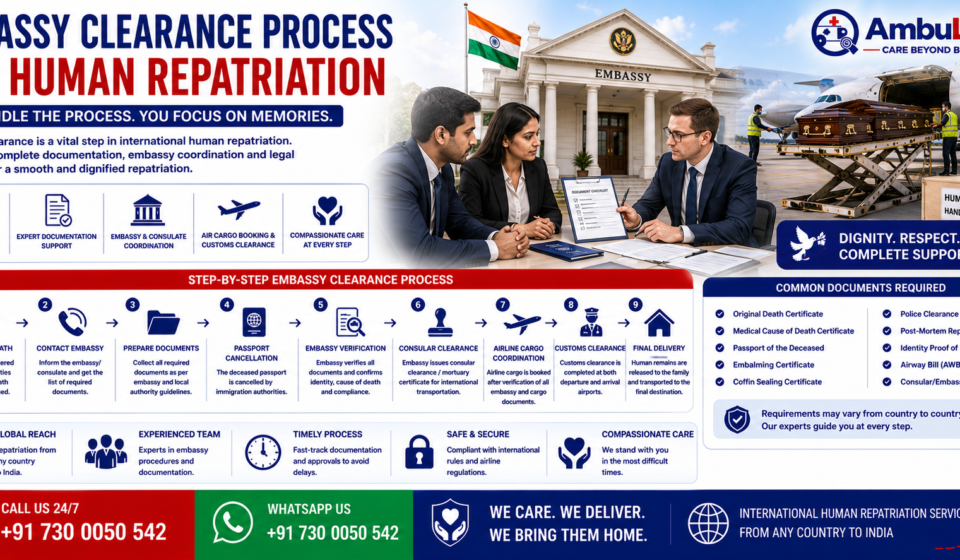
Step-by-Step Embassy Clearance Process
Step 1: Report the Death
The death must first be officially registered with the local authorities and hospital where it occurred.
Authorities issue:
- Death Certificate
- Medical Cause of Death Certificate
These documents form the foundation of the repatriation process.
Step 2: Contact the Embassy or Consulate
The next step involves informing the embassy or consulate of the deceased person’s nationality.
Embassy officials provide guidance regarding:
- Required documents
- Country-specific regulations
- Consular procedures
- Transportation requirements
Therefore, early communication helps prevent delays.
Step 3: Prepare Required Documents
The embassy typically verifies several documents.
Commonly required documents include:
- Original Death Certificate
- Medical Cause of Death Certificate
- Passport of the deceased
- Embalming Certificate
- Coffin Sealing Certificate
- Police Clearance (if applicable)
- Post-Mortem Report (if required)
- Identity proof of the family member
- Air Cargo Booking Details
Preparing these documents correctly speeds up approval.
Step 4: Passport Cancellation
The deceased person’s passport is generally cancelled before transportation.
Immigration authorities complete this process after verifying the death.
Consequently, the cancelled passport becomes part of the official documentation.
Step 5: Embassy Verification
Embassy officials review all submitted documents.
They verify:
- Identity
- Nationality
- Cause of death
- Transportation eligibility
- Compliance with destination country regulations
If everything is complete, the embassy proceeds with approval.
Step 6: Consular Clearance
Once verification is complete, the embassy issues the required consular clearance or mortuary certificate, depending on the country’s regulations.
This document authorizes international transportation.
Step 7: Airline Cargo Coordination
After embassy approval, airline cargo booking can be finalized.
The cargo team verifies:
- Embassy documents
- Coffin certification
- Embalming documentation
- Customs paperwork
Consequently, transportation arrangements proceed smoothly.
Step 8: Customs Clearance
Before departure, customs officials inspect the documentation.
Upon arrival, customs authorities in the destination country verify the same documents before releasing the remains.
Therefore, proper documentation ensures faster clearance at both airports.
Documents Commonly Required by Embassies
Although requirements vary slightly between countries, embassies generally request:
- Original Death Certificate
- Passport of the deceased
- Embalming Certificate
- Coffin Sealing Certificate
- Police Clearance (if applicable)
- Post-Mortem Report (if required)
- Identity proof of next of kin
- Airway Bill (AWB)
- Consular application forms
Professional repatriation providers assist families with every document.
Countries with Embassy Clearance Requirements
Embassy approval is commonly required for repatriation involving countries such as:
- United States
- Canada
- Australia
- United Kingdom
- United Arab Emirates
- Saudi Arabia
- Qatar
- Kuwait
- Singapore
- Malaysia
Each country may have specific documentation requirements.
How AmbuLens Helps
AmbuLens manages the complete embassy clearance process.
Our services include:
- Embassy coordination
- Documentation preparation
- Passport cancellation guidance
- Embalming arrangements
- Coffin certification
- Airline cargo booking
- Customs clearance
- End-to-end international transportation
As a result, families experience a smoother and more efficient repatriation process.
Why Choose AmbuLens?
Families trust AmbuLens because we provide:
- 24/7 international support
- Experienced documentation specialists
- Embassy coordination
- Worldwide repatriation assistance
- Air cargo booking
- Customs support
- Transparent communication
- Nationwide delivery across India
Therefore, every repatriation is handled professionally and respectfully.
Related Services
You may also find these services helpful:
- International Human Repatriation Services
- Documents Required for International Human Repatriation
- Dead Body Transportation from India to USA
- Human Repatriation from UAE to India
- Air Cargo Human Remains Transportation
Conclusion
Embassy clearance is one of the most important steps in the international human repatriation process. Proper documentation, timely coordination, and compliance with international regulations ensure that transportation proceeds without unnecessary delays. Working with an experienced service provider like AmbuLens simplifies embassy communication, documentation, airline cargo booking, and customs clearance, allowing families to focus on honoring their loved one.
Frequently Asked Questions (FAQs)
Why is embassy clearance required for human repatriation?
Embassy clearance confirms that all legal requirements have been fulfilled before international transportation of human remains.
Which documents does the embassy usually require?
Embassies commonly request the Death Certificate, Passport, Embalming Certificate, Coffin Sealing Certificate, and identity documents of the next of kin.
Does every country have the same embassy clearance process?
No. Documentation requirements vary depending on the country where the death occurred and the destination country.
Can AmbuLens coordinate with embassies?
Yes. AmbuLens provides complete embassy coordination and documentation assistance for international human repatriation.
How long does embassy clearance usually take?
The processing time depends on the country, documentation completeness, and local regulations. Accurate paperwork helps reduce delays.