
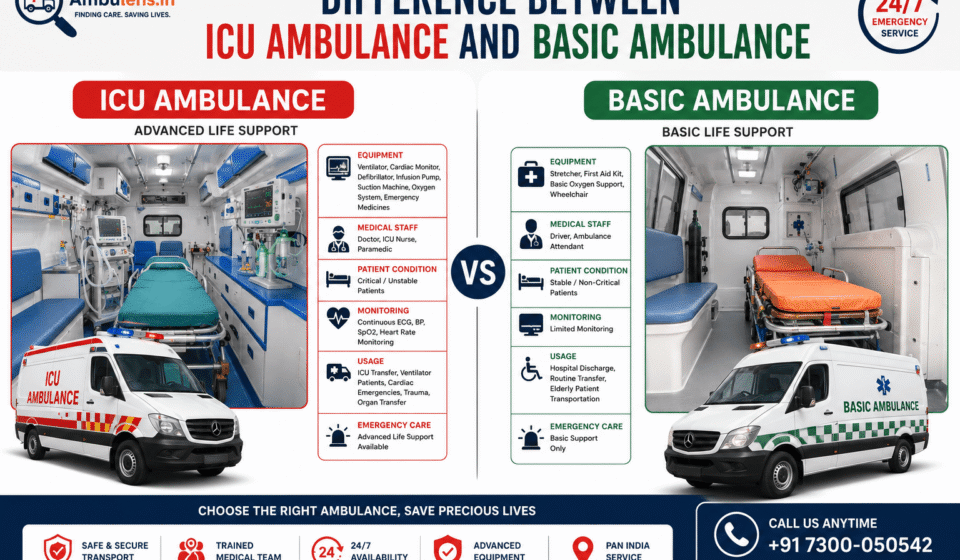

When a patient needs medical transportation, choosing the right type of ambulance is extremely important. Many people assume that all ambulances offer the same facilities. However, there is a significant difference between an ICU Ambulance and a Basic Ambulance.
The patient’s medical condition determines which ambulance should be used. While a basic ambulance is suitable for stable patients, an ICU ambulance provides advanced life-support equipment and critical care during transportation.
Ambulens.in offers both Basic Ambulance and ICU Ambulance Services across India to ensure patients receive the appropriate level of care.
What is a Basic Ambulance?
A Basic Ambulance is designed for patients who are medically stable and do not require intensive monitoring during transportation.
These ambulances provide essential transportation support for non-critical patients.
Common Uses of a Basic Ambulance
- Hospital Discharge
- Routine Patient Transfer
- Elderly Patient Transportation
- Wheelchair Patient Transfer
- Non-Emergency Medical Travel
- Home-to-Hospital Transportation
Therefore, a basic ambulance is ideal when advanced medical intervention is not required.
What is an ICU Ambulance?
An ICU Ambulance functions as a mobile intensive care unit.
It is specially equipped to transport critically ill patients who require continuous monitoring and advanced medical support during travel.
Common Uses of an ICU Ambulance
- ICU Patient Transfer
- Ventilator Patient Transportation
- Cardiac Emergency Cases
- Trauma Patients
- Stroke Patients
- Organ Transplant Transfers
- Critical Care Transportation
As a result, ICU ambulances are essential for life-threatening medical conditions.

Key Differences Between ICU Ambulance and Basic Ambulance
1. Medical Equipment
Basic Ambulance
Usually includes:
- Stretcher
- First Aid Kit
- Basic Oxygen Support
- Wheelchair Assistance
ICU Ambulance
Includes advanced equipment such as:
- Ventilator
- Cardiac Monitor
- Defibrillator
- Infusion Pump
- Suction Machine
- Oxygen System
- Emergency Medicines
Consequently, ICU ambulances can manage medical emergencies during transportation.
2. Medical Staff Availability
Basic Ambulance
Typically includes:
- Driver
- Basic Ambulance Attendant
ICU Ambulance
May include:
- Critical Care Doctor
- ICU Nurse
- Trained Paramedic
- Emergency Medical Technician
Therefore, ICU ambulances provide a higher level of medical supervision.
3. Patient Condition
Basic Ambulance
Suitable for:
- Stable Patients
- Elderly Individuals
- Routine Transfers
- Non-Emergency Cases
ICU Ambulance
Suitable for:
- Critically Ill Patients
- Ventilator Patients
- Cardiac Patients
- Emergency Cases
- Trauma Patients
Choosing the correct ambulance significantly improves patient safety.
4. Monitoring Capabilities
Basic Ambulance
Offers limited patient monitoring.
ICU Ambulance
Provides:
- Continuous ECG Monitoring
- Oxygen Saturation Monitoring
- Blood Pressure Monitoring
- Heart Rate Monitoring
Furthermore, medical teams can respond immediately if the patient’s condition changes.
5. Emergency Response Capability
Basic Ambulance
Provides transportation support only.
ICU Ambulance
Can deliver:
- Emergency Life Support
- Advanced Cardiac Care
- Ventilator Support
- Critical Care Intervention
As a result, ICU ambulances are often referred to as mobile ICUs.
When Should You Choose a Basic Ambulance?
A Basic Ambulance is generally sufficient when:
- The patient is stable.
- No advanced monitoring is required.
- The transfer is non-emergency.
- The patient can breathe independently.
In such situations, a basic ambulance offers a cost-effective transportation solution.
When Should You Choose an ICU Ambulance?
An ICU Ambulance should be selected when:
- The patient is in critical condition.
- Ventilator support is required.
- Continuous monitoring is necessary.
- The patient has recently undergone major surgery.
- A cardiac or neurological emergency exists.
Therefore, ICU ambulances provide the safest option for high-risk patients.
Benefits of ICU Ambulance Services
ICU ambulances offer several important advantages.
Key Benefits
- Advanced Life Support
- Continuous Monitoring
- Ventilator Support
- Trained Medical Team
- Emergency Medical Intervention
- Safer Long-Distance Transportation
Moreover, they help reduce transportation-related risks for critically ill patients.
Why Choose Ambulens.in?
Ambulens.in provides both Basic and ICU Ambulance Services with professional medical support.
Our Services Include
- Basic Ambulance Service
- ICU Ambulance Service
- Ventilator Ambulance
- Oxygen Ambulance
- Hospital-to-Hospital Transfer
- Long-Distance Patient Transfer
- Air Ambulance Assistance
- Train Ambulance Assistance
Additionally, our team is available 24/7 to assist families during medical emergencies.
Frequently Asked Questions
1. What is the main difference between an ICU Ambulance and a Basic Ambulance?
A Basic Ambulance provides transportation for stable patients, while an ICU Ambulance offers advanced life-support equipment and critical care monitoring.
2.Is an ICU Ambulance more expensive?
Yes. ICU ambulances cost more because they include advanced equipment, medical staff, and critical care support.
3.Can ventilator patients travel in a Basic Ambulance?
No. Ventilator patients should be transported in an ICU or Ventilator Ambulance equipped with appropriate life-support systems.
4.Which ambulance is best for hospital-to-hospital transfer?
The choice depends on the patient’s medical condition. Stable patients can use a Basic Ambulance, while critical patients should use an ICU Ambulance.
5.Does Ambulens.in provide both services?
Yes. Ambulens.in offers Basic Ambulance, ICU Ambulance, Ventilator Ambulance, and other medical transportation solutions across India.
Contact Ambulens.in
Need help choosing the right ambulance service?
Our medical transportation experts are available 24/7 to guide you and arrange the most suitable ambulance based on the patient’s condition.
📞 Phone: +91 7300-050542
💬 WhatsApp Support Available
🌐 Website: www.ambulens.in
Ambulens.in — Finding Care. Saving Lives.